How the Model T Was Assembled
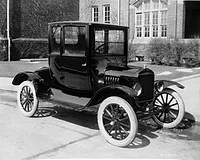
There were 45 operations involved in producing a Model T chassis on the first moving assembly line, which debuted at Ford’s Highland Park, MI, plant in early 1914. Vehicles moved 327 feet down the assembly line (from South to North) on the ground floor of the four-story factory. By mid-1914, three parallel chain-driven assembly lines were in operation. Here’s a brief look at how many assemblers were involved in the process and what the steps were:
1. Three men (one press man and two chassis frame handlers). Fix four mud guard brackets, two on each side, to the chassis frame; 600 in 8 hours.
2. Six men. On moving line, fix rear spring to chassis frame; 600 in 8 hours. Operations 1 and 2 are on a side line, work moving from north to south, and this line turns out 600 chassis frames with four mud guard brackets and rear springs in place in 8 hours, enough to supply two lines of automobile assemblers, work moving from south to north, each line turning out 300 automobile assemblies in 8 hours.
3. Three men. Two men place and fix the rear axle, connecting the rear axle spring shackles; one man working simultaneously with the other two places and fixes the front axle assembly under the chassis frame.
4. Two men. One completes the fixing of front axle, places the two combined lamp brackets and front mud guards, and catches nuts on, while the other man places and fixes the mud guard bracket truss rods.
5. Two men. Place nuts on truss rods. Place and fix control lever rock shaft.
6. One man. Fixes front spring, tightens nuts, and puts in four split pins.
7. Two men. Complete fixing of combined front fender irons and lamp brackets.
8. Two men. Place gasoline tank and fix same, also place gasoline feed pipe. The tank receives 1 gallon of gasoline before leaving the gasoline tank bridge.
9. One man. With hard grease syringe injects 4 pounds of heavy grease into the bevel gear and differential housing. Also places 1 pound heavy grease in universal joint globe housing.
10. Two men. Place motor and connect the universal joint of propeller shaft to the change-gear shaft.
11. Two men. Line up mud-guard brackets. Tighten rear-spring perch nuts and place the cotter pins in same.
12. One man. Places spark plugs. Fixes same.
13. One man. Seats and caps motor front-support and wires 2 cap screws.
14. Two men. Fix globe housing to end of transmission case, place 2 bolts and 2 cap screws.
15. One man. Puts cotter pins in the nuts placed in operation 14 and wires the cap-screw heads placed in the same operation.
16. Two men. Place and fix the 2 rear crankcase bracket bolts and 2 bolts with split pins.
17. One man. Places 4 grease cups, 2 in universal-joint casings and 2 in rear-axle gear housings.
18. Two men. Place dash assembly. Place 4 bolts.
19. One man. Places muffler and fixes exhaust pipe, also replaces rear-axle bevel-gear housing grease-plug, after first making certain that grease has been properly supplied.
20. One man. Nails name plate on dashboard.
21. One man. Adjusts pedals travel.
22. One man. Fixes steering column end to chassis frame.
23. One man. Places and fixes commutator.
24. One man. Places acetylene gas pipe and its supporting bracket inside chassis frame.
25. Two men. Place split pins in fender and lamp-bracket bolt nuts; also put split pins in 4 dashboard bottom holding-bolt nuts.
26. Two men. Place and fix motor-hood clips and hood “blocks” (wood strips) and connect the spark plug wires.
27. One man. Places radiator support and spring studs and nuts, and places split pins in nuts.
28. One man. Tightens and pins muffler-fixing bolt nuts.
29. One man. Secures gasoline feed-pipe to carburetor; also connects brake rod.
30. Two men. Places motor pans, one on each side, under chassis frame, and pan-holding bolts and nuts.
31. Four men. Tighten motor-pan-bolt nuts and place split pins in same.
32. One man. Pins steering-gear bracket nut and adjusts spark time.
33. Two men. Put on wheels, place wheel nuts.
34. One man. Connects carburetor “pull rod” (gives more or less gasoline) and adjusts the carburetor, and turns on the gasoline.
35. Three men (one head checker and two checkers, one on each side, also act as inspectors). Record chassis numbers and car numbers, fill blank records in record sheets. The third man is record inspector, and filler of his own number record book; superior to the two checkers.
36. One man. Caps steering connecting-rod globe end, places 2 cap bolts, places nuts and pins them.
37. One man. Connects magneto wire, and paints bolts and nuts on right side of chassis.
38. One man. Places radiator and its water connection and top stay-rod, and places carburetor priming rod.
39. One man. Tightens radiator water connection.
40. One man. Places nuts and split pins, radiator-support studs.
41. One man. In pit, caps front-axle radius-rod globe, and puts on two stud nuts and wires same.
42. One man. Paints bolts and nuts on left side of chassis and radiator.
43. One man. Final inspector, tags defects.
44. Two men. Fill radiator with water, handle starting weight lever on rear axle, and lift rear wheels off starting friction-wheels and attach exhaust hose.
45. One man. Drives car onto John R St. body line.
Finished chassis were driven outside and lined up under a chute, where bodies were slid down from the second floor of the factory.
Source: Ford Methods and the Ford Shops, by Horace Arnold and Fay Faurote, published in 1915 (The Engineering Magazine Co., New York).
Looking for a reprint of this article?
From high-res PDFs to custom plaques, order your copy today!