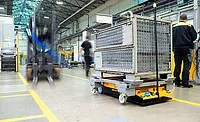
AGVs vs. Conveyors
Some experts question if conveyors still make sense in today’s lean, flexible world. They believe automated guided vehicles (AGVs) can be a better alternative for material handling, depending on the specific application.
Conveyors have been a common sight in manufacturing plants for almost 100 years. On April 1, 1913, the first moving assembly line for a large-scale manufacturing application began to operate at the Ford Motor Co. plant in Highland Park, MI. It was used to produce flywheel magnetos.
But, some experts question if conveyors still make sense in today’s lean, flexible world. They believe automated guided vehicles (AGVs) can be a better alternative for material handling, depending on the specific application.
“Conveyors are expensive and inflexible,” argues Keith Soderlund, vice president of sales at Creform Corp. (Greer, SC). “Facilities with extensive conveyor systems tend to have their production space chopped up by the conveyor. This impedes travel through the plant and limits inevitable movement of equipment and departments.
“You are often forced to work around the conveyor system,” claims Soderlund. “This limits your options and often runs counter to lean manufacturing and continuous improvement activities. In addition, AGV systems are easily reinforced by forklifts, tuggers or even the AGV itself.”
According to Soderlund, conveyors typically tie up a lot of inventory, while AGVs can handle small loads more frequently. Many conveyors also consume power constantly, rather than as-needed.
Other observers agree, such as Yves Gavin, vice president of engineering at Egemin Automation Inc. (Holland, MI). “AGVs allow moving product from point A to point B with a flexibility that can adjust easily to changes,” he points out. “Routes can be redefined when the need arises without the infrastructure changes required by conveyors, thus offering faster and more intuitive ways of adapting an existing system to new business rules.
“Also, AGVs do not introduce a single-point-of-failure because of their exchangeability,” says Gavin. “Any AGV can be used for any job within the system, so an AGV down for maintenance does not inhibit any of the functionally of the system.”
Despite those advantages, conveyors continue to play an important role in manufacturing. In fact, smaller and more modular conveyors have created new options in flexibility. Integrated intelligence and control in the assembly process has also allowed for a higher level of automation than previously existed.
Many plant floors today typically have more conveyors that are shorter and feature more sophisticated controls than their predecessors. In addition, high-efficiency motors that deliver variable speeds and constant torques help today’s generation of conveyors be much more flexible than in the past.
The widespread use of extruded aluminum structural profiles has also spurred the use of modular conveyors. They allow engineers to bolt-together components that can be reconfigured in response to changes in product mix or production volume.
“Modular, reconfigurable conveyors allow for layout changes,” says Brian Stewart, chief operating officer at Jervis B. Webb Co. (Farmington Hills, MI). Stewart’s 90-year-old company traces its roots to Ford’s early moving assembly lines. And, unlike many other suppliers, the company specializes in both AGVs and conveyors.
“Conveyors are usually better than AGVs in applications where there’s a high production rate,” Stewart points out. “We’re seeing more interest in AGVs, but we still sell plenty of conveyor systems.
“It’s often a tough decision; there’s no single answer that’s correct,” adds Stewart. “Typically, it depends on the application, including specific production requirements and the production environment. For instance, paint and welding aren’t good applications for AGVs.”
When making automation decisions, such as whether to invest in AGVs or conveyors, it’s important for manufacturing engineers to carefully consider both cost and flexibility. Be sure to answer questions such as: How much will our process change? How costly are changes? Are changes driven by customer demand or improvement?
“An AGV system is usually inherently more flexible than a conveyor,” says Jamie Flinchbaugh, a partner in the Lean Learning Center (Novi, MI). “I can carry things across great distances and (usually) reprogram as things change. But, these are expensive assets. So, if they aren’t utilized across multiple shifts and the full benefit isn’t there, it certainly would not be worth it.
“However, taking products from point A to point B with some level of changes (depending on the systems you install) is rarely cheaper than with a conveyor,” explains Flinchbaugh. “That’s doubly true if you use gravity to power the conveyance. And, it’s even better if you can figure out how to eliminate the need to convey materials altogether–that’s lean.”
Conveyors have been a common sight in manufacturing plants for almost 100 years. On April 1, 1913, the first moving assembly line for a large-scale manufacturing application began to operate at the Ford Motor Co. plant in Highland Park, MI. It was used to produce flywheel magnetos.
But, some experts question if conveyors still make sense in today’s lean, flexible world. They believe automated guided vehicles (AGVs) can be a better alternative for material handling, depending on the specific application.
“Conveyors are expensive and inflexible,” argues Keith Soderlund, vice president of sales at Creform Corp. (Greer, SC). “Facilities with extensive conveyor systems tend to have their production space chopped up by the conveyor. This impedes travel through the plant and limits inevitable movement of equipment and departments.
“You are often forced to work around the conveyor system,” claims Soderlund. “This limits your options and often runs counter to lean manufacturing and continuous improvement activities. In addition, AGV systems are easily reinforced by forklifts, tuggers or even the AGV itself.”
According to Soderlund, conveyors typically tie up a lot of inventory, while AGVs can handle small loads more frequently. Many conveyors also consume power constantly, rather than as-needed.
Other observers agree, such as Yves Gavin, vice president of engineering at Egemin Automation Inc. (Holland, MI). “AGVs allow moving product from point A to point B with a flexibility that can adjust easily to changes,” he points out. “Routes can be redefined when the need arises without the infrastructure changes required by conveyors, thus offering faster and more intuitive ways of adapting an existing system to new business rules.
“Also, AGVs do not introduce a single-point-of-failure because of their exchangeability,” says Gavin. “Any AGV can be used for any job within the system, so an AGV down for maintenance does not inhibit any of the functionally of the system.”
Despite those advantages, conveyors continue to play an important role in manufacturing. In fact, smaller and more modular conveyors have created new options in flexibility. Integrated intelligence and control in the assembly process has also allowed for a higher level of automation than previously existed.
Many plant floors today typically have more conveyors that are shorter and feature more sophisticated controls than their predecessors. In addition, high-efficiency motors that deliver variable speeds and constant torques help today’s generation of conveyors be much more flexible than in the past.
The widespread use of extruded aluminum structural profiles has also spurred the use of modular conveyors. They allow engineers to bolt-together components that can be reconfigured in response to changes in product mix or production volume.
“Modular, reconfigurable conveyors allow for layout changes,” says Brian Stewart, chief operating officer at Jervis B. Webb Co. (Farmington Hills, MI). Stewart’s 90-year-old company traces its roots to Ford’s early moving assembly lines. And, unlike many other suppliers, the company specializes in both AGVs and conveyors.
“Conveyors are usually better than AGVs in applications where there’s a high production rate,” Stewart points out. “We’re seeing more interest in AGVs, but we still sell plenty of conveyor systems.
“It’s often a tough decision; there’s no single answer that’s correct,” adds Stewart. “Typically, it depends on the application, including specific production requirements and the production environment. For instance, paint and welding aren’t good applications for AGVs.”
When making automation decisions, such as whether to invest in AGVs or conveyors, it’s important for manufacturing engineers to carefully consider both cost and flexibility. Be sure to answer questions such as: How much will our process change? How costly are changes? Are changes driven by customer demand or improvement?
“An AGV system is usually inherently more flexible than a conveyor,” says Jamie Flinchbaugh, a partner in the Lean Learning Center (Novi, MI). “I can carry things across great distances and (usually) reprogram as things change. But, these are expensive assets. So, if they aren’t utilized across multiple shifts and the full benefit isn’t there, it certainly would not be worth it.
“However, taking products from point A to point B with some level of changes (depending on the systems you install) is rarely cheaper than with a conveyor,” explains Flinchbaugh. “That’s doubly true if you use gravity to power the conveyance. And, it’s even better if you can figure out how to eliminate the need to convey materials altogether–that’s lean.”
Looking for a reprint of this article?
From high-res PDFs to custom plaques, order your copy today!