Humanoids Take on New Role at BMW’s U.S. Assembly Plant
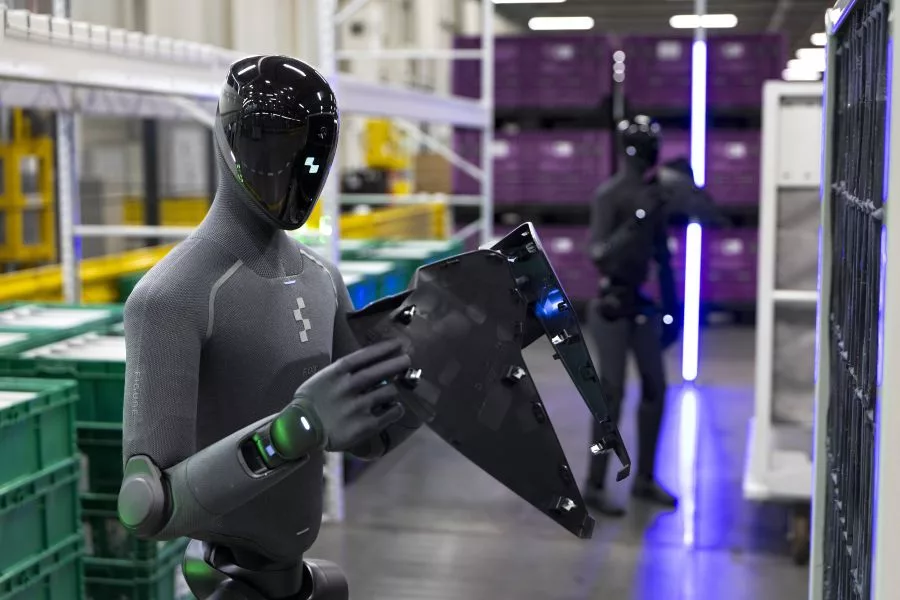
BMW is expanding its use of humanoid robots at its assembly plant in Spartanburg, SC. Photo courtesy BMW Group
SPARTANBURG, SC—BMW Group is expanding its use of humanoid robots at its assembly plant here. The company will be using Figure AI’s next-generation Figure 03 machines for complex sequencing applications in logistics.
Last year, the factory completed a successful test using a Figure 02 robot in the body shop. The machine inserted sheet metal parts for the welding process. The pilot program demonstrated that humanoid robots can safely perform precise, repeatable tasks under real-world production conditions.
“Plant Spartanburg is the birthplace of humanoid robotics in [our] operational day-to-day activities,” says Ulrich Wieland, vice president of production control and logistics at BMW Manufacturing. “Humanoid robotics is a value-adding complement to existing automation.
“Its potential lies particularly in monotonous, ergonomically demanding, or safety-critical activities,” explains Wieland. “The aim is to protect and most effectively utilize employees while further improving workplaces.”
“Humanoids are no longer lab experiments—they can be a valuable asset in establishing a flexible, reliable manufacturing workforce,” adds Brett Adcock, CEO of Figure AI. “[Our robot] introduces several new features for expanded applications.
“These include soft components designed for enhanced safety, wireless charging designed for higher availability and audio functions for speech-to-speech communication, along with improved hands with tactile sensors and palm cameras designed to increase precision and dexterity,” Adcock points out.
In the new sequencing application, parts will initially arrive in larger containers, unsorted. Figure 03 will pick them up and sort them into a sequencing trolley.
“The trolley will then be taken to a defined collection point for onward transport,” says Wieland. “An automated tugger train or [a mobile robot] will then transport the parts to the installation location, where they will be provided to assembly employees just in sequence. This use case occurs frequently in automotive production logistics and offers potential for further development and scalability.”
Looking for quick answers on assembly and manufacturing topics? Try Ask ASM, our new smart AI search tool. Ask ASM
Looking for a reprint of this article?
From high-res PDFs to custom plaques, order your copy today!