Assembly Magazine logo
search
Ask ASSEMBLY AI
cart
facebook twitter linkedin youtube
  • Sign In
  • Create Account
  • Sign Out
  • My Account
Assembly Magazine logo
  • TRENDS
    • Ask ASSEMBLY AI
    • Trends
    • News
    • New Products
  • INDUSTRIES
    • Aerospace
    • Appliance
    • DFMA Assembly
    • Medical Devices
    • Green Manufacturing
    • Lean Manufacturing
    • Machinery Assembly
    • Electronics Assembly
    • Automotive
  • TECHNOLOGIES
    • Adhesives & Dispensing
    • Assembly Presses
    • Automated Assembly Systems
    • Manufacturing Management
    • Manufacturing Software
    • Motion Control
    • Screwdriving & Riveting
    • Robotics
    • Test & Inspection
    • Plastics & Metal Welding
    • Wire Processing
    • Workstations
  • AUTONOMOUS & ELECTRIC MOBILITY
    • AEM Magazine Archives
    • Autonomy
    • Electrification
    • Mobility Services
    • Assembly & Testing
    • AV/EM News
  • MEDIA
    • Ask ASSEMBLY AI
    • Podcasts
    • Assembly News Now
    • Assembly TV
    • Webinars
    • eBooks
  • EVENTS
    • Calendar
    • The ASSEMBLY Show
  • MORE
    • Exclusives >
      • Plant of the Year
      • Capital Spending
    • Buyers Guide >
      • Supplier Insights
    • Classifieds
    • Featured Products
    • Newsletters
    • Store
    • White Papers
    • Columns
    • Sponsor Insights
  • INFOCENTER
    • Assembly & Test Solutions
  • EMAGAZINE
    • eMagazine
    • Archive Issues
    • Advertise
    • Contact Us
    • Sign Up
Columns

AIA: Solder Dispenser Connects the Dots
March 1, 2004
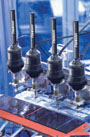
Evergreen Solar manufactures photovoltaic modules for residential and commercial use.

Four air-free dispensers from Fishman Corp. apply dots of solder paste on solar panels.


Evergreen Solar (Marlboro, MA) manufactures photovoltaic modules for residential and commercial use. Two series of modules are offered. One has 72 cells, and the other has 36 cells. Applications for the modules can range from a 50-watt system installed on the roof of a dwelling in the Dominican Republic to an 85-kilowatt solar pyramid on top of the World Trade Center in Tokyo. Undoubtedly, the most notable customer is the White House, where solar panels are used as a source of energy.

Production of solar cells is based on a process for growing crystalline silicon strips 250 to 300 microns in thickness, a technology known as "string ribbon." "The strips are continuously grown 3 inches wide," explains Randy Rotermund, director of supply chain management for Evergreen. "We rough cut them into 6-foot lengths with a scribing pen and then laser cut them into 6-inch-long, P-type wafers."

The wafers are subjected to a number of processes to convert them into photovoltaic cells, including diffusing phosphorus into the top surface of each wafer to create the junction, etching the phosphorous glass film that forms on the wafers during diffusion and applying a silicon nitride antireflective coating to the front of the wafer by chemical vapor deposition. "These are processes that we understand very well," says Rotermund. "Our overriding concern, each step of the way, is to ensure precision and quality during manufacture, and ultimately, consistent electrical performance from cell to cell within a panel. To do this, we have custom-designed and built most of the automated equipment stations on our production line."

In initially setting up the line, there was one particular challenge. After the chemical vapor deposition coating is applied, a silver pattern is fused on the top side of the wafer and an aluminum-silver pattern on the bottom side. The bottom-side pattern masks the surface of the wafer, except for six square contact points. After testing the wafers to measure output efficiency, solder-coated wire strips are installed across the circuitry on the top side. The solder is reflowed with a heat gun. The strips extend beyond the wafers to provide a means of linking cells together.

Each wire strip requires an exact amount of solder paste to be deposited in three locations. The dots line up with the exposed square contact points on the bottom side of the next wafer in the assembly line. In this way, either nine or 18 cells are linked together, depending on the size of the module. The amount of solder paste deposited for each dot must be 50 mils, and this must be consistent from dot to dot.

Unfortunately, pneumatic dispensing systems were unsuitable. After investigating various possibilities, Evergreen selected four AirFree LDS-9000 dispensing pumps from Fishman Corp. (Hopkinton, MA). They are mounted side by side in a housing to optimize assembly line throughput.

The LDS-9000 differs from a pneumatic pump. The AirFree dispenser uses a linear actuator and a mechanical leadscrew which lowers or retracts a piston at the end of the screw. The linear actuator rotates a nut between electrically charged poles. While the nut turns, its axial position does not change. The leadscrew, threaded through the nut and secured from turning itself, moves up and down on command from a microprocessor unit.

Looking for quick answers on assembly and manufacturing topics? Try Ask ASM, our new smart AI search tool. Ask ASM →

As a result of the precisely controlled rotation of the leadscrew, the piston pushes exact and repeatable amounts of solder paste through the syringe and dispensing tip. Once the system is calibrated, the control unit automatically calculates the distance the piston must travel for the volume of solder paste required. The dispensing operation is the same each time, regardless of the viscosity. After a dot of solder paste is dispensed, a programmable pullback of the piston prevents fluid ooze.

"In our opinion, the Fishman dispenser overcomes the drawbacks of a pneumatic system. We have also minimized our material and operating costs. Because of the design of the LDS-9000, the syringes we get are three-quarters filled with solder paste. . .That's part of the story. Including less waste, almost no rejects and less downtime in switching out syringes, we figure our costs are 70 percent less than what we would be paying with pneumatic dispensers," says Rotermund.

For more information on the AirFree dispenser, call 800-433-2115 or visit www.fishmancorp.com.

Share This Story

Looking for a reprint of this article?
From high-res PDFs to custom plaques, order your copy today!

Recommended Content

JOIN TODAY
To unlock your recommendations.

Already have an account? Sign In

  • Made in the U.S.A.

    Consumer Products Manufacturing: Made in the USA

    Supply chain lessons learned during the coronavirus...
    Automated Assembly Systems
    By: Austin Weber
  • Best Practices for Press-Fit Assembly

    Best Practices for Press-Fit Assembly

    In manufacturing, ironclad formulas for success are hard...
    Assembly Presses
    By: Jim Camillo
  • aem0523leader-tesla1.jpg

    Tesla Rethinks the Assembly Line

    Engineers at Tesla Inc. have developed a new process that...
    Electrification
    By: Austin Weber
Manage My Account
  • eMagazine Subscription
  • Assembly Newsletters
  • Online Registration
  • Subscription Customer Service
  • Manage My Preferences

More Videos

Sponsored Content

Sponsored Content is a special paid section where industry companies provide high quality, objective, non-commercial content around topics of interest to the ASSEMBLY audience. All Sponsored Content is supplied by the advertising company and any opinions expressed in this article are those of the author and not necessarily reflect the views of ASSEMBLY or its parent company, BNP Media. Interested in participating in our Sponsored Content section? Contact your local rep!

close
  • ultrasonic welding
    Sponsored bySonobond Ultrasonics

    Engineering Efficiency in High-Performance Assembly: How Ultrasonic Welding Enhances Throughput, Reliability and Quality

  • UV curing system
    Sponsored byDymax

    Why UV Intensity Alone Doesn’t Define Curing Performance

  • wooden pallets
    Sponsored byLEAN Manufacturing Products

    Eliminating Waste on the Shop Floor: Applying Lean Principles to Improve Manufacturing Efficiency

Popular Stories

ASSEMBLY News Now, episode-30: Volvo Redesigns EV Manufacturing

Volvo Redesigns EV Manufacturing

Boeing CEO Kelly Ortberg announces 1 billion investment

Boeing Plans $1 Billion Wichita Investment, Workforce Training Center

automated consumer goods assembly system

Best Practices for Cycle Time Optimization

Watch the latest episode of ANN now!

Events

July 24, 2025

From Shop Floor to CFO: How Manufacturers Are Closing the Loop Between Operations and Finance

On Demand Learn how manufacturers are bridging the gap between the shop floor and ERP systems to gain real-time visibility, streamline operations, and kick-start digital transformation—without waiting years.

Sponsored by:

PicoStratusGreen
July 30, 2025

Buffer Analysis and Design Fundamentals for Manufacturing Excellence

On Demand In this presentation, Dr. Herman Tang shares practical insights from his industry experience and research on buffer management in manufacturing operations.

View All Submit An Event

Poll

Difficult Assembly Processes

Which assembly process gives you the most difficulty?
View Results Poll Archive

Products

Manufacturing Cost Policy Deployment (MCPD) Profitability Scenarios: Systematic and Systemic Improvement of Manufacturing Costs

Manufacturing Cost Policy Deployment (MCPD) Profitability Scenarios: Systematic and Systemic Improvement of Manufacturing Costs

See More Products
Register for webinar - Modernizing Automotive Assembly: Why Upgrading Legacy MES is a Business Imperative

Related Articles

  • gm robot

    GM Connects Robots Through the Cloud

    See More
  • Assembly in Action: Dispenser Puts Panel Manufacturer on the Cutting Edge

    See More
  • Dispenser Hits the Right Note for Audio Assembler

    See More

Related Products

See More Products
  • foreman.jpg

    The Foreman on the Assembly Line

  • history.jpg

    Faster, Better, Cheaper in the History of Manufacturing: From the Stone Age to Lean Manufacturing and Beyond

  • digitalization.jpg

    The Digitalization of the 21st Century Supply Chain

See More Products

Related Directories

  • The Test Connection Inc. (TTCI)

    The Test Connection Inc. (TTCI) supplies quality test engineering solutions with complete documentation allow our team to support needs from the earliest design stages to test development to testing of circuit card assemblies (CCAs). Our services range from: In-Circuit Test (ICT) development and board testing services for Keysight (formerly Agilent) 3070 and Teradyne (Formerly GenRad) TestStation/228X test systems, Flying Probe development and board testing services on our Seica Pilot V8 & Digitaltest MTS500 flying probe test systems, Boundary-Scan Test Solutions with the Keysight x1149 Analyser and XJTAG system and custom Functional Test solutions.
×

Never miss the latest news and trends driving the manufacturing industry

Stay in the know on the latest assembly trends.

JOIN TODAY!
  • RESOURCES
    • Advertise
    • Contact Us
    • Directories
    • Manufacturing Division
    • Store
    • Want More?
  • SIGN UP TODAY
    • Create Account
    • eMagazine
    • Newsletters
    • Customer Service
    • Manage Preferences
  • SERVICES
    • Marketing Services
    • Reprints
    • Market Research
    • List Rental
    • Survey/Respondent Access
  • STAY CONNECTED
    • LinkedIn
    • Facebook
    • Instagram
    • YouTube
    • X (Twitter)
  • PRIVACY
    • PRIVACY POLICY
    • TERMS & CONDITIONS
    • DO NOT SELL MY PERSONAL INFORMATION
    • PRIVACY REQUEST
    • ACCESSIBILITY

Copyright ©2026. All Rights Reserved BNP Media, Inc. and BNP Media II, LLC.

Design, CMS, Hosting & Web Development :: ePublishing