Assembly Handbook: Introduction to RFID Technology
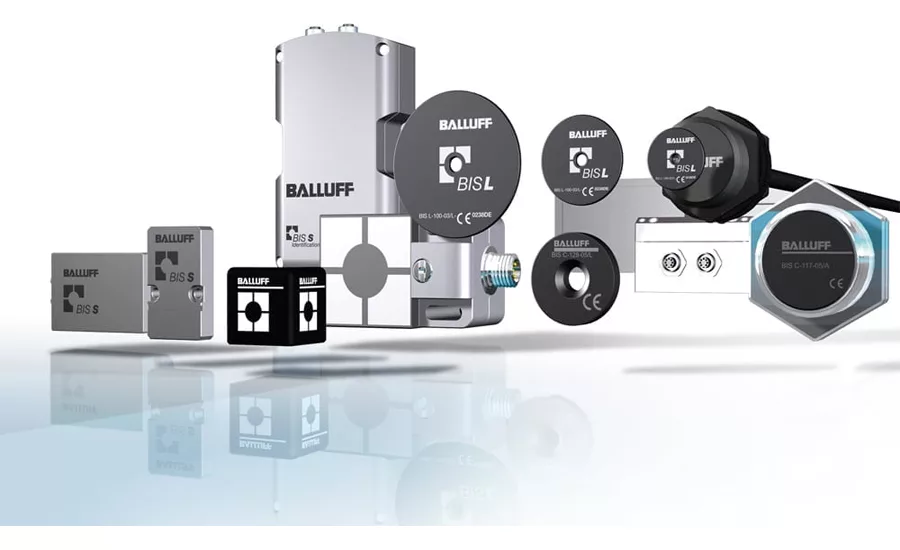
Almost every product assembled today gets tagged with a one- or two-dimensional identification code. The code might be applied to the product with a label or an etching process, or it might be placed on the product's packaging. In fact, one or more codes will likely appear on both the product and its packaging.
For good reason. Manufacturers have come to depend on bar codes, Data Matrix codes and other identification technologies to track their products throughout the assembly process and beyond.
But, codes cannot be used in every assembly application. Codes can be damaged by some manufacturing processes. The scanner must have a direct line of sight to the codes, and it cannot read more than one code simultaneously. Moreover, codes can only "store" a small amount of information. For example, a 2-inch bar code represents only 10 characters.
The most significant limitation of codes is that they are a one-time use technology. Once the code is printed, information cannot be added to it, and the code cannot be reused.
Radio frequency identification (RFID) technology was developed to overcome these limitations. RFID is a means of storing and retrieving data through radio signals. Instead of a scanner that optically reads a code, a device sends and receives radio signals from a small, reusable tag attached to the assembly itself or to the pallet or tote holding the assembly.
The ability to add and subtract information from identification tags can be important to assemblers of cars, computers, appliances and other high-value, high-mix products. An RFID tag traveling with a computer chassis can tell an assembler which disk drives to install--just like a bar code. But, unlike other identification technologies, the assembler can also input information back to the tag. For example, he can report that he has installed the drives and successfully tested them.
System Components
To implement an RFID system, a manufacturer will need an antenna, a reader, a controller interface and a number of tags.
Looking for quick answers on assembly and manufacturing topics? Try Ask ASM, our new smart AI search tool. Ask ASM
Also known as a transponder or data carrier, each RF tag consists of a solid-state memory chip, a substrate or circuit board, and an antenna, all of which is encapsulated in epoxy and plastic. The memory chip, usually EEPROM, can be programmed to hold ASCII, hex or decimal characters. The chip can have "read only," "write-once, read-many," or "read-write" memory.
The size, shape and cost of the tag varies with how much memory it has, how far it can send and receive data, and how it will be used. Tags can be shaped like a watch battery, a flat disk, a thin cylinder, a cracker, a credit card or a cigarette pack. A tag the size and shape of a suit button can store 128 bytes of information. A tag that is 65 millimeters long, 40 millimeters wide millimeters tall can store 8 kilobytes.
Unlike printed codes, RFID tags can be reused and they can withstand harsh environments. Depending on the tag and its environment, each memory address can be overwritten hundreds of thousands of times. Some tags are impervious to acids, detergents and other chemicals, and some tags can operate in temperatures of -40 to 180 C.
Most tags are bought "off the shelf," but they can be custom-made if the quantity is large enough to justify the added expense. Tags cost $1 to $200 each, depending on their complexity.
Tags are passive or active. Passive tags draw their electrical power from the radio waves generated by the reader and antenna. Active tags are powered by a battery. Passive tags last longer and are less expensive than active tags. However, active tags have more memory and a longer radio range than passive tags.
If the tag is mounted on metal, a plastic carrier will be necessary to separate the tag slightly from the part. This will prevent the radio waves from reflecting off the metal. As a rule of thumb, the space between a round tag and the metal should be one-half the tag's diameter.
Also known as the interrogator or read-write head, the antenna is a coil of copper wire that emits a radio signal at a certain frequency. It constantly broadcasts the signal and waits for a tag's reply. The antenna can be a flat, rectangular box or a small cylinder reminiscent of a proximity sensor. It can be mounted above or alongside a conveyor, or it can be a handheld wand.
Either way, the antenna's maximum transmission distance is directly proportional to its size and signal frequency. A large antenna broadcasting a high-frequency signal will have a longer range than a small antenna broadcasting a low-frequency signal.
Introduced in the 1980s, the first RFID systems were low-frequency devices that broadcast at 125 to 150 kilohertz. The maximum range of these systems is approximately 2 feet for passive tags and 10 feet for active tags.
Medium-frequency systems emerged in the 1990s. These systems broadcast at a standard frequency of 13.56 megahertz. The advantage of this frequency is that tags need fewer coil windings and thus are less expensive. The broadcast range is also slightly larger.
Some recent RFID systems broadcast at 915 megahertz, or the microwave spectrum. These systems have an even longer range than 13.56-megahertz systems. However, because liquids can interfere with microwave signals, this system is not suitable for all applications.
High-frequency systems that broadcast at gigahertz frequencies are available, but are rarely needed for manufacturing. With a broadcast range of several hundred feet, these systems are used in automatic toll collection systems.
For assembly line applications, the distance between the antenna and the tag is usually less than 18 inches and rarely exceeds 6 feet. Tags do not have to be directly in sight of the antenna, but they must be within the antenna's broadcast range. To avoid interference, large metal objects should not be placed between the antenna and the tag.
The reader powers the antenna. It receives tag data from the antenna, then filters, boosts and transmits the data to the controller interface. The interface translates the signals from the reader into a computer language and transfers that information to a PC or a programmable logic controller. A reader can control one or two antennas, and one interface can control several readers. Some RFID suppliers offer the reader and the interface as a single unit.
Resources
ASSEMBLY would like to thank the following companies and organizations for their contributions to this article: Accu-Sort Systems Inc., AIM Inc., Balluff Inc., Intermec Technologies Corp., Motorola Inc., Omron Electronics LLC and RFID Inc.
Sidebar: RFID Checklist
Before contacting an RFID supplier, assemblers should answer the following questions:
- What will be identified?
- What type of environment will the RFID system be in? Will there be electrical noise, temperature extremes, high humidity or harsh chemicals?
- How many read stations will be needed?
- How many tags will be needed?
- How fast will the tags be moving?
- Will the RFID system be reporting to a PC or a PLC?
- What read range is needed?
- How much information will be transferred to and from the tags?
- How often will the tags be read and written to?
- Will more than one tag need to be read at the same time?
Sidebar: Glossary of Terms
Active tag: An RF tag powered by a battery.
Antenna: Also known as the interrogator or read-write head, it sends and receives information from RF tags.
EEPROM: Electrically erasable programmable read-only memory. A memory chip that holds its content without power. It functions like nonvolatile RAM.
Interface: The device that translates signals from the reader into a computer language and transfers that information to a PC or a PLC.
Passive tag: An RF tag that draws its electrical power from radio waves.
Reader: The device that powers the antenna. It receives tag data from the antenna, then filters, boosts and transmits the data to the controller interface.
RF portal: The effective broacast area of the antenna.
RF tag: Also known as a transponder or data carrier, each RF tag consists of a memory chip, a substrate and an antenna.
Looking for a reprint of this article?
From high-res PDFs to custom plaques, order your copy today!


