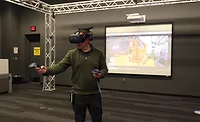
Human Modeling Software Helps Engineers Improve Ergonomics and Increase Efficiency
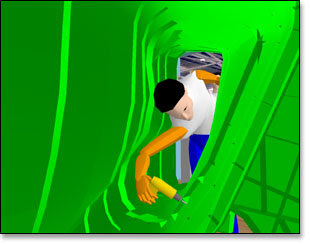
"It is much cheaper to design in ergonomic features than it is to go back and modify existing designs," says Chris McIntyre, president of Ergonomics at Work Inc. (Kitchener, ON). "Software allows for what-if scenarios regarding risk of injury, productivity, workstation dimensions and other important factors."
Automakers are leading the charge to simulated assembly. General Motors Corp. (Detroit) has developed a program called Virtual Factory that manufacturing engineers use to address ergonomic issues before they occur on the assembly line. By creating virtual assembly plants with computer simulation, engineers test how tooling and fixtures interact with assemblers. "The technology is key to reducing vehicle development times, reducing costs, improving product quality and enhancing workplace safety," says Guy Briggs, vice president and general manager of GM vehicle manufacturing.
DaimlerChrysler Corp. (Auburn Hills, MI) has also harnessed the power of simulation to improve assembly efficiency. Its new $1.2 billion Toledo North assembly plant that builds the Jeep Liberty was designed using simulation software. By simulating the entire assembly process before any tools and equipment were physically installed, the company was able to build the facility for only $54 per square foot, compared to the industry average of $70 to $80 per square foot.
"By simulating manufacturing we can make tooling and equipment updates in a virtual environment rather than with the actual tooling, which is a significant savings in cost and manpower throughout the supply chain," says Frank Ewasyshyn, senior vice president of advanced manufacturing engineering at DaimlerChrysler. "Simulation allows the tooling process within the manufacturing facility to be much more precise, resulting in assembly operations being brought up to speed faster and with fewer issues."
However, the inherent benefits of simulation are often overshadowed by other important factors, such as time and expense. "As things get easier to model, use of models will increase," predicts John Boyle, a design and ergonomics consultant at Munro & Associates Inc. (Troy, MI). "But, right now most models are so time-intensive people skip over them to use checklists and other 'quickie' methods. Some highly touted modeling systems take a week to detail a few minutes of a job."
"Some of these tools are complex and leave the interpretation up to the user," adds Kevin Costello, executive vice president of Ergonomic Technologies Corp. (Syosset, NY). "To accurately simulate an operation can be an excruciatingly tedious process. Often, the time is not there." Costello's company recently unveiled an online risk assessment and analysis tool called Ergotivity that uses artificial intelligence to interpret data and make recommendations.
Most observers predict digital modeling applications will increase as cost and usability issues are worked out. "I think simulation tools can and should be used with capital-intensive projects," concludes Boyle. "When major tooling with significant human interaction is being designed, simulation definitely has a place."
Looking for quick answers on assembly and manufacturing topics? Try Ask ASM, our new smart AI search tool. Ask ASM
Looking for a reprint of this article?
From high-res PDFs to custom plaques, order your copy today!