Assembly Magazine logo
search
Ask ASSEMBLY AI
cart
facebook twitter linkedin youtube
  • Sign In
  • Create Account
  • Sign Out
  • My Account
Assembly Magazine logo
  • TRENDS
    • Ask ASSEMBLY AI
    • Trends
    • News
    • New Products
  • INDUSTRIES
    • Aerospace
    • Appliance
    • DFMA Assembly
    • Medical Devices
    • Green Manufacturing
    • Lean Manufacturing
    • Machinery Assembly
    • Electronics Assembly
    • Automotive
  • TECHNOLOGIES
    • Adhesives & Dispensing
    • Assembly Presses
    • Automated Assembly Systems
    • Manufacturing Management
    • Manufacturing Software
    • Motion Control
    • Screwdriving & Riveting
    • Robotics
    • Test & Inspection
    • Plastics & Metal Welding
    • Wire Processing
    • Workstations
  • AUTONOMOUS & ELECTRIC MOBILITY
    • AEM Magazine Archives
    • Autonomy
    • Electrification
    • Mobility Services
    • Assembly & Testing
    • AV/EM News
  • MEDIA
    • Ask ASSEMBLY AI
    • Podcasts
    • Assembly News Now
    • Assembly TV
    • Webinars
    • eBooks
  • EVENTS
    • Calendar
    • The ASSEMBLY Show
  • MORE
    • Exclusives >
      • Plant of the Year
      • Capital Spending
    • Buyers Guide >
      • Supplier Insights
    • Classifieds
    • Featured Products
    • Newsletters
    • Store
    • White Papers
    • Columns
    • Sponsor Insights
  • INFOCENTER
    • Assembly & Test Solutions
  • EMAGAZINE
    • eMagazine
    • Archive Issues
    • Advertise
    • Contact Us
    • Sign Up
ColumnsAppliance AssemblyAutomated Assembly SystemsRobotics Assembly

Automation Profiles: Robots Help Philips Shave Assembly Costs

By John Sprovieri
June 1, 2012
When Philips Electronics needed an assembly system to produce its current line of electric shavers and support future redesigns, the company turned to Adept Technology Inc. for robots and flexible feeders. Systems integrator Bremer Werk fur Montagesysteme GmbH (BWM) of Lilienthal, Germany, designed and built the line.

“True flexible feeding means being able to solve tomorrow’s challenges today,” says Ruediger Winter, director of European sales at Adept. “Changing products no longer requires any hardware changes, but just a few minutes to teach the system to accept the new parts. This makes our customers feel safer about the long-term competitiveness of their assembly lines.”
automation profiles column
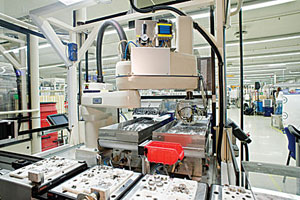
A vision-guided SCARA robot retrieves parts from a flexible feeder at the Philips shaver assembly plant in Drachten, Netherlands. Photo courtesy Adept Technology Inc.

The shavers are assembled at Philips’ factory in Drachten, Netherlands, which is also home to the company’s research and development center. The shavers had to be produced at the highest level of quality, which is why the Drachten plant wanted to assemble them automatically rather than manually.

“The real challenge in finding the right solution for Philips was to accommodate the enormous model variety of the shavers,” says Matthias Schaller, head of robotics at BWM. Philips currently markets 60 different shaver lines, each with their own model variants. All totaled, Philips produces some 600 shaver models. As a result, the production mix at the plant changes almost daily.

Beyond that obstacle, Philips also wanted a system that would still be viable well into the future. “We wanted to implement a future-oriented assembly concept,” says Sietze Bremer, senior industrial sourcing specialist at Philips. “With regard to the total investment, we wanted to feel certain that the equipment would still be able to economically produce shavers in ten years without knowing what future shavers would look like.”

Building machinery capable of assembling products that don’t yet exist presented a significant challenge. BWM’s engineers chose Adept after realizing that they would need six-axis robots, SCARA robots, vision systems, parts feeders and controls. Adept’s technology met all requirements and had already shown its efficiency in similar projects for BWM.

The first item to address was how to maximize flexibility. The shaver consists of three main components that can be assembled independent of one another on different lines. Thus, the assembly system itself was also modular.

The three-head shavers are assembled on nine lines, each composed of five to eight cells. Each cell operates autonomously and can be connected or disconnected in plug-and-play fashion. Small, mutually independent lines with autonomous cells maximize the system’s flexibility and availability.

Looking for quick answers on assembly and manufacturing topics? Try Ask ASM, our new smart AI search tool. Ask ASM →

All totaled, the line contains more than 120 robots and 40 flex feeders. “The majority of Viper six-axis and Cobra SCARA robots are equipped with AdeptSight vision guidance and inspection technology,” says Bremer. “The systems arrive already having been tried and tested in existing lines. The robots impress with their precision, speed and availability.”

Adept’s AnyFeeder flexible feeders are a critical component of the system. The feeder works like this: A bulk hopper dumps a small amount of parts onto a tray. The tray gives the parts a quick shake to randomly distribute them across its surface. A vision system above the tray locates and inspects the parts and directs a robot to retrieve any that are correctly oriented for pick up. When all the parts have been picked up, the process repeats. Changeover is simply a matter of pouring in new parts and changing the vision program. The surface of the tray is easily changed to optimize the performance of the vision system or accommodate a sensitive part.

“Flexible feeding systems are key components for intelligent assembly automation, especially relating to the sustainability of the Philips equipment,” says Schaller. “Regardless of how the individual parts of the shaver will look in the future, the AnyFeeder will feed them as bulk goods. After ‘seeing’ the parts, the robots will pick them up and assemble them. In ten years, this simple and basic principle will not change.”

Vision guidance has been added to approximately 50 robots on the new assembly lines. Most of the robots on the existing lines were already equipped with vision guidance, and all new machines are required to have a vision system. “A robot with integrated vision guidance can be perfectly adopted for varying tasks,” says Bremer.

For more information robots and flexible feeders, call 800-222-1117, visit www.adept.com or e-mail info@adept.com.

For more information on automated assembly systems, visit www.bwm-gmbh.de or e-mail bwm@bwm-gmbh.de.                      

  Editor’s note: Whether you’re a systems integrator or the in-house automation team of an OEM, if you’ve designed a system that you’re particularly proud of, tell us about it. Send an e-mail to John Sprovieri, chief editor of ASSEMBLY, at sprovierij@bnpmedia.com, or call 847-405-4068.

KEYWORDS: flexible assembly flexible feeder machine vision systems parts feeding SCARA robot

Share This Story

Looking for a reprint of this article?
From high-res PDFs to custom plaques, order your copy today!

John has been with ASSEMBLY magazine since February 1997. John was formerly with a national medical news magazine, and has written for Pathology Today and the Green Bay Press-Gazette. John holds a B.A. in journalism from Northwestern University, Medill School of Journalism.

Recommended Content

JOIN TODAY
To unlock your recommendations.

Already have an account? Sign In

  • Made in the U.S.A.

    Consumer Products Manufacturing: Made in the USA

    Supply chain lessons learned during the coronavirus...
    Automated Assembly Systems
    By: Austin Weber
  • Best Practices for Press-Fit Assembly

    Best Practices for Press-Fit Assembly

    In manufacturing, ironclad formulas for success are hard...
    Assembly Presses
    By: Jim Camillo
  • aem0523leader-tesla1.jpg

    Tesla Rethinks the Assembly Line

    Engineers at Tesla Inc. have developed a new process that...
    Electrification
    By: Austin Weber
Manage My Account
  • eMagazine Subscription
  • Assembly Newsletters
  • Online Registration
  • Subscription Customer Service
  • Manage My Preferences

More Videos

Sponsored Content

Sponsored Content is a special paid section where industry companies provide high quality, objective, non-commercial content around topics of interest to the ASSEMBLY audience. All Sponsored Content is supplied by the advertising company and any opinions expressed in this article are those of the author and not necessarily reflect the views of ASSEMBLY or its parent company, BNP Media. Interested in participating in our Sponsored Content section? Contact your local rep!

close
  • ultrasonic welding
    Sponsored bySonobond Ultrasonics

    Engineering Efficiency in High-Performance Assembly: How Ultrasonic Welding Enhances Throughput, Reliability and Quality

  • UV curing system
    Sponsored byDymax

    Why UV Intensity Alone Doesn’t Define Curing Performance

  • wooden pallets
    Sponsored byLEAN Manufacturing Products

    Eliminating Waste on the Shop Floor: Applying Lean Principles to Improve Manufacturing Efficiency

Popular Stories

ASSEMBLY News Now, episode-30: Volvo Redesigns EV Manufacturing

Volvo Redesigns EV Manufacturing

Boeing CEO Kelly Ortberg announces 1 billion investment

Boeing Plans $1 Billion Wichita Investment, Workforce Training Center

GE Appliances Worker on Line

GE Appliances Expands Factory AI With 800 Gemini Enterprise Agents

Watch the latest episode of ANN now!

Events

July 24, 2025

From Shop Floor to CFO: How Manufacturers Are Closing the Loop Between Operations and Finance

On Demand Learn how manufacturers are bridging the gap between the shop floor and ERP systems to gain real-time visibility, streamline operations, and kick-start digital transformation—without waiting years.

Sponsored by:

PicoStratusGreen
July 30, 2025

Buffer Analysis and Design Fundamentals for Manufacturing Excellence

On Demand In this presentation, Dr. Herman Tang shares practical insights from his industry experience and research on buffer management in manufacturing operations.

View All Submit An Event

Poll

Difficult Assembly Processes

Which assembly process gives you the most difficulty?
View Results Poll Archive

Products

Manufacturing Cost Policy Deployment (MCPD) Profitability Scenarios: Systematic and Systemic Improvement of Manufacturing Costs

Manufacturing Cost Policy Deployment (MCPD) Profitability Scenarios: Systematic and Systemic Improvement of Manufacturing Costs

See More Products
Register for webinar - Modernizing Automotive Assembly: Why Upgrading Legacy MES is a Business Imperative

Related Articles

  • Automation Profiles: Preconfigured Systems Help Assembler Get to Market Faster

    See More
  • Automation Profiles: Cabinet Assembly Moves Into 21st Century

    See More
  • Automation Profiles: Integrator Sheds Light on Assembly Challenge

    See More

Related Products

See More Products
  • reducing.jpg

    Reducing Process Costs with Lean, Six Sigma, and Value Engineering Techniques

  • 9781138498730.jpg

    Manufacturing Cost Policy Deployment (MCPD) Profitability Scenarios: Systematic and Systemic Improvement of Manufacturing Costs

See More Products

Related Directories

  • Assembly & Automation Technology Inc.

    Assembly & Automation Technology delivers intelligent automation systems integrating machine learning, computer vision and smart robotics for industrial, medical and biotechnical applications. Our AI-enhanced assembly machines, robotic systems and vision-guided quality control optimize productivity while reducing human error. We engineer custom automated solutions that learn, adapt and continuously improve manufacturing processes.
  • Industrial Profile Systems

    As a provider of custom-engineered mechanical aluminum extrusion solutions, Industrial Profile Systems specializes in industrial solutions for linear motion, safety hard guarding, material handling, assembly workstations, and other industrial applications. IPS engineers are always ready to discuss a fully optimized and customized solution designed to help you "frame the future" of your environment.
  • Automated Assembly Corp.

    Automated Assembly Corporation stands at the forefront of the manufacturing industry, specializing in roll-to-roll assembly capabilities that range from low to high-volume production. Our advanced automation systems are engineered to handle diverse production requirements with precision and efficiency, making us the ideal partner for businesses needing scalable assembly solutions.
×

Never miss the latest news and trends driving the manufacturing industry

Stay in the know on the latest assembly trends.

JOIN TODAY!
  • RESOURCES
    • Advertise
    • Contact Us
    • Directories
    • Manufacturing Division
    • Store
    • Want More?
  • SIGN UP TODAY
    • Create Account
    • eMagazine
    • Newsletters
    • Customer Service
    • Manage Preferences
  • SERVICES
    • Marketing Services
    • Reprints
    • Market Research
    • List Rental
    • Survey/Respondent Access
  • STAY CONNECTED
    • LinkedIn
    • Facebook
    • Instagram
    • YouTube
    • X (Twitter)
  • PRIVACY
    • PRIVACY POLICY
    • TERMS & CONDITIONS
    • DO NOT SELL MY PERSONAL INFORMATION
    • PRIVACY REQUEST
    • ACCESSIBILITY

Copyright ©2026. All Rights Reserved BNP Media, Inc. and BNP Media II, LLC.

Design, CMS, Hosting & Web Development :: ePublishing