Assembly Magazine logo
search
Ask ASSEMBLY AI
cart
facebook twitter linkedin youtube
  • Sign In
  • Create Account
  • Sign Out
  • My Account
Assembly Magazine logo
  • TRENDS
    • Ask ASSEMBLY AI
    • Trends
    • News
    • New Products
  • INDUSTRIES
    • Aerospace
    • Appliance
    • DFMA Assembly
    • Medical Devices
    • Green Manufacturing
    • Lean Manufacturing
    • Machinery Assembly
    • Electronics Assembly
    • Automotive
  • TECHNOLOGIES
    • Adhesives & Dispensing
    • Assembly Presses
    • Automated Assembly Systems
    • Manufacturing Management
    • Manufacturing Software
    • Motion Control
    • Screwdriving & Riveting
    • Robotics
    • Test & Inspection
    • Plastics & Metal Welding
    • Wire Processing
    • Workstations
  • AUTONOMOUS & ELECTRIC MOBILITY
    • AEM Magazine Archives
    • Autonomy
    • Electrification
    • Mobility Services
    • Assembly & Testing
    • AV/EM News
  • MEDIA
    • Ask ASSEMBLY AI
    • Podcasts
    • Assembly News Now
    • Assembly TV
    • Webinars
    • eBooks
  • EVENTS
    • Calendar
    • The ASSEMBLY Show
  • MORE
    • Exclusives >
      • Plant of the Year
      • Capital Spending
    • Buyers Guide >
      • Supplier Insights
    • Classifieds
    • Featured Products
    • Newsletters
    • Store
    • White Papers
    • Columns
    • Sponsor Insights
  • INFOCENTER
    • Assembly & Test Solutions
  • EMAGAZINE
    • eMagazine
    • Archive Issues
    • Advertise
    • Contact Us
    • Sign Up
IndustriesColumnsAutomotive Assembly

Turbos Give Small Car Engines a Big Boost
By Austin Weber
turbocharger

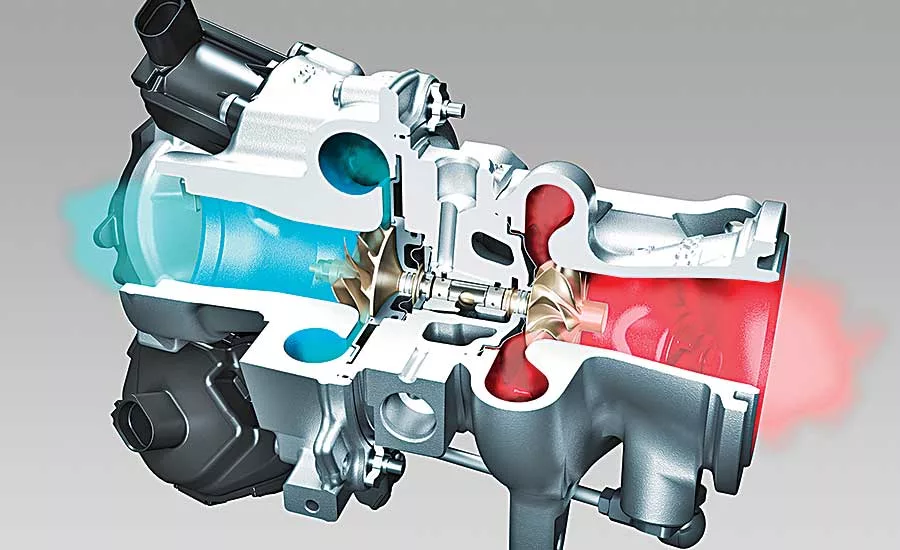
Turbochargers are a costeffective way to improve fuel efficiency. Illustration courtesy Continental AG

May 4, 2017

This month, 33 cars will start the 101st Indianapolis 500 motor race. While each will sport a different color scheme, they’ll all share something in common. Every vehicle will be equipped with a turbocharger to boost engine performance.

Turbochargers have been used on race cars for decades. They’re also commonly used on heavy-duty trucks to improve operating efficiency and on sports cars to add extra power.

But, turbochargers are starting to appear under the hood of more mundane passenger cars. That’s because the devices are a cost-effective way to improve fuel efficiency. Turbos can help a four-cylinder engine produce as much power as their bigger V-6 counterparts.

It’s part of an ongoing trend toward engine downsizing. Automotive engineers are eager to harness the advantages of turbo technology to improve fuel efficiency and reduce emissions.

Turbochargers are centrifugal compressors powered by exhaust gas. They increase efficiency by forcing extra air into internal combustion engines.

Passenger vehicles equipped with turbocharged engines made up only 8 percent of the market in 2010, but that number has been rising steadily. In fact, by 2020, LMC Automotive predicts that more than one-third of all light vehicles will contain turbochargers.

IBISWorld says ongoing fuel-efficiency regulations are driving that demand. The market research firm claims that turbos will experience 3 percent annual growth between now and 2022.

Looking for quick answers on assembly and manufacturing topics? Try Ask ASM, our new smart AI search tool. Ask ASM →

That’s good news for Tier 1 suppliers such as BorgWarner, Continental and Honeywell, which produce the majority of turbochargers. Another supplier that hopes to cash in on growing demand for turbochargers in the North American market is Mitsubishi Heavy Industries Ltd. The company recently opened a new assembly plant in Franklin, IN.

“As emission regulations continue to tighten, mature automotive markets like the United States…are turning to turbochargers to help provide cleaner transportation,” says Olivier Rabiller, president and CEO of Honeywell Transportation Systems. “This is creating what we refer to as the golden age of turbo.

“With the ability to improve emissions and fuel economy by 20 percent to 40 percent in gas and diesel engines, turbocharging technology is a smart choice for helping automakers meet tougher global emissions standards without sacrificing performance,” claims Rabiller.

“In North America, more engine downsizing is expected,” adds Rabiller. “The current average engine size is a 3.0-liter six-cylinder. As the region continues to shift from larger naturally aspirated engines to smaller turbocharged ones, [our engineers are] working to provide more twin-scroll turbo technology support, which extracts more energy from four-cylinder exhaust profiles.”

Engineers are experimenting with advanced materials that can withstand higher exhaust gas temperatures and reduce weight, such as such as titanium aluminide and high-strength plastics like nylon. They’re also changing the inflow angle and speed of turbine wheel inlets.

Future turbocharger systems will also have to overcome new emissions constraints that may prevent engines from using scavenging, a strategy that adjusts engine valve timing to improve low-end torque.

According to Hiroshi Ataka, manager of Japan component forecasts and analysis at IHS Markit, the goal is to develop new types of turbochargers that can improve aerodynamic efficiency, reduce heat loss and reduce friction.

“[Lately, there’s been increasing demand for] smaller turbines and compressors to minimize the so called turbo lag (delay of the response),” says Ataka. “That’s because the exhaust gas power from small displacement, downsized engines is less than bigger displacement engines.

“Smaller turbines and compressors also need to be more durable to withstand higher revolution speeds than before,” Ataka points out. “The latest trends are aluminum compressors, electric superchargers and variable geometry turbochargers.”

Earlier this year, BorgWarner unveiled a line of variable turbine geometry turbochargers for a broad range of gasoline-powered vehicles. They feature an electric actuator that controls the pressure upstream of the turbine, rapidly and precisely adjusting the guide vanes for nearly instant acceleration and optimum power output. Patented S-shaped guide vanes regulate the turbine output, improving thermodynamics and engine response.       

Share This Story

Looking for a reprint of this article?
From high-res PDFs to custom plaques, order your copy today!

Austinweber headshot
Austin has been senior editor for ASSEMBLY Magazine since September 1999. He has more than 21 years of b-to-b publishing experience and has written about a wide variety of manufacturing and engineering topics. Austin is a graduate of the University of Michigan.

Recommended Content

JOIN TODAY
To unlock your recommendations.

Already have an account? Sign In

  • Made in the U.S.A.

    Consumer Products Manufacturing: Made in the USA

    Supply chain lessons learned during the coronavirus...
    Automated Assembly Systems
    By: Austin Weber
  • Best Practices for Press-Fit Assembly

    Best Practices for Press-Fit Assembly

    In manufacturing, ironclad formulas for success are hard...
    Assembly Presses
    By: Jim Camillo
  • aem0523leader-tesla1.jpg

    Tesla Rethinks the Assembly Line

    Engineers at Tesla Inc. have developed a new process that...
    Industries
    By: Austin Weber
Manage My Account
  • eMagazine Subscription
  • Assembly Newsletters
  • Online Registration
  • Subscription Customer Service
  • Manage My Preferences

More Videos

Sponsored Content

Sponsored Content is a special paid section where industry companies provide high quality, objective, non-commercial content around topics of interest to the ASSEMBLY audience. All Sponsored Content is supplied by the advertising company and any opinions expressed in this article are those of the author and not necessarily reflect the views of ASSEMBLY or its parent company, BNP Media. Interested in participating in our Sponsored Content section? Contact your local rep!

close
  • ultrasonic welding
    Sponsored bySonobond Ultrasonics

    Engineering Efficiency in High-Performance Assembly: How Ultrasonic Welding Enhances Throughput, Reliability and Quality

  • UV curing system
    Sponsored byDymax

    Why UV Intensity Alone Doesn’t Define Curing Performance

  • wooden pallets
    Sponsored byLEAN Manufacturing Products

    Eliminating Waste on the Shop Floor: Applying Lean Principles to Improve Manufacturing Efficiency

Popular Stories

ASSEMBLY News Now, episode-30: Volvo Redesigns EV Manufacturing

Volvo Redesigns EV Manufacturing

Boeing CEO Kelly Ortberg announces 1 billion investment

Boeing Plans $1 Billion Wichita Investment, Workforce Training Center

GE Appliances Worker on Line

GE Appliances Expands Factory AI With 800 Gemini Enterprise Agents

Watch the latest episode of ANN now!

Events

July 24, 2025

From Shop Floor to CFO: How Manufacturers Are Closing the Loop Between Operations and Finance

On Demand Learn how manufacturers are bridging the gap between the shop floor and ERP systems to gain real-time visibility, streamline operations, and kick-start digital transformation—without waiting years.

Sponsored by:

PicoStratusGreen
July 30, 2025

Buffer Analysis and Design Fundamentals for Manufacturing Excellence

On Demand In this presentation, Dr. Herman Tang shares practical insights from his industry experience and research on buffer management in manufacturing operations.

View All Submit An Event

Poll

Difficult Assembly Processes

Which assembly process gives you the most difficulty?
View Results Poll Archive

Products

Manufacturing Cost Policy Deployment (MCPD) Profitability Scenarios: Systematic and Systemic Improvement of Manufacturing Costs

Manufacturing Cost Policy Deployment (MCPD) Profitability Scenarios: Systematic and Systemic Improvement of Manufacturing Costs

See More Products
Register for webinar - Modernizing Automotive Assembly: Why Upgrading Legacy MES is a Business Imperative

Related Articles

  • Daimler.jpg

    Biden Administration Gives Big Boost to Domestic Battery Production

    See More
  • Small Robots Play a Big Role in Automation

    Small Robots Play a Big Role in Automation

    See More
  • 1.5 Million Reasons Why Detroit Should Build a Good Small Car

    See More

Related Products

See More Products
  • assembly april 2020

    ASSEMBLY April 2020 Issue

  • handbook of digital.jpg

    Handbook of Digital Innovation, Transformation, and Sustainable Development in a Post-Pandemic Era

See More Products
×

Never miss the latest news and trends driving the manufacturing industry

Stay in the know on the latest assembly trends.

JOIN TODAY!
  • RESOURCES
    • Advertise
    • Contact Us
    • Directories
    • Manufacturing Division
    • Store
    • Want More?
  • SIGN UP TODAY
    • Create Account
    • eMagazine
    • Newsletters
    • Customer Service
    • Manage Preferences
  • SERVICES
    • Marketing Services
    • Reprints
    • Market Research
    • List Rental
    • Survey/Respondent Access
  • STAY CONNECTED
    • LinkedIn
    • Facebook
    • Instagram
    • YouTube
    • X (Twitter)
  • PRIVACY
    • PRIVACY POLICY
    • TERMS & CONDITIONS
    • DO NOT SELL MY PERSONAL INFORMATION
    • PRIVACY REQUEST
    • ACCESSIBILITY

Copyright ©2026. All Rights Reserved BNP Media, Inc. and BNP Media II, LLC.

Design, CMS, Hosting & Web Development :: ePublishing