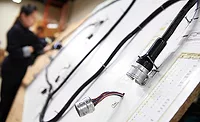
Wire Processing: Automating Harness Assembly
Inserting wires into connectors and bundling them into harnesses has always been done manually-until now.
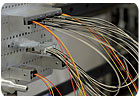
 Fully automatic equipment for cutting, stripping and crimping wire has been available for decades. However, the process of inserting terminated wires into connector housings has resisted efforts at automation.
Indeed, over the past decade, ASSEMBLY has reported on numerous innovations to simplify the process of populating connectors with wires. In 1998, we reviewed an “augmented reality” system that used a universal wiring board, an audiovisual headset and a portable computer to guide workers during harness assembly. In 2002, Adept Technology Inc. introduced a system that used a vision-guided laser to show assemblers where to insert wires. And, Cirris Systems Corp. introduced its computer-guided Easy Wire assembly and test system a decade ago.
As novel as these technologies are, they still rely on people to do the work. Now, Komax Corp. has introduced a series of flexible machines that can produce a complete wire harness from start to finish automatically, including insertion of terminated wires into connectors.
The base of the system is the modular Zeta 633, which automatically cuts, strips and crimps wire from 10 to 26 AWG. The standard machine can be equipped with any combination of five stations, such as five crimping presses, or four presses and a seal assembly station. An extended length version accommodates eight stations. With an optional extension, five more stations can be added to either system. Sensors on the presses monitor crimp force for quality control.
A linear track runs the length of the machine. Shuttles with special grippers-one shuttle for each end of the wire-travel up and down the track, transferring the wire from one station to the next. The machine maintains control of the wire at all times. The standard machine handles cut wire in lengths ranging from 240 to 3,000 millimeters. With optional equipment, it can handle wires as short as 85 millimeters or as long as 10,000 millimeters.
An optional wire feeding system can supply the machine with 36 different wires without changeover. Other options include an ink-jet marker, bar code scanner, wire-end compactor, sleeve loader, fluxing and tinning module, and twisting module. Custom and third-party equipment, such as ultrasonic welders, can also be added.
Instruments for measuring crimp height and pull force are integrated with the machine. At the start of a run, the operator measures crimp height and pull force on a first-run assembly. These measurements are automatically compared with set values, and production cannot commence until the results match specifications.
At the end of the line, the machine hands off the terminated wires to an automated bundling machine or to one of three fully automatic block-loading machines: the Zeta 651, 655 or 656.
The Zeta 651 can insert wires into single- or double-row connectors. The connectors are fed automatically to a fixtured insertion point from a vibratory bowl or linear feeder. The feeders can be replenished while the machine is running.
When a terminated wire reaches the end of the track, the contacts are mechanically centered and rotated, if necessary, to the correct orientation for insertion. An actuator retrieves one end of the wire from the shuttle and inserts it into the corresponding hole in the connector. Each insertion takes approximately 1.8 seconds.
“Because connectors are getting smaller and smaller, it has become difficult to manually insert wires without a high scrap rate,” says Patrick Boyer, HM product manager for Komax.
The actuator’s gripper can handle almost any wire and does not need to be changed with each application. However, the fixtures holding the connectors are usually different for each application.
Force sensors provide feedback on the insertion process. For example, an unexpected spike in the insertion force might indicate that the terminal has collided with the connector or encountered a blockage inside the hole. When the sensor determines that the wire is fully seated, the controller signals the robot to pull back slightly to ensure that the terminal is locked into place.
“If you inserted the wire manually, you’d pull back on it to make sure the latch caught. We do the same with the machine,” explains Boyer. “Of course, we don’t want to bend the latch, so we measure the force and stop when it reaches a certain point. All this is programmable.”
The Zeta 655 and 656 are more sophisticated versions of the 651, able to handle thinner wire and a greater variety of connectors. Instead of an actuator, a vision-guided five-axis Cartesian robot inserts the wire. And, instead of inserting only one end of a wire into a connector, these machines can insert each end of the wire into different connectors. These machines can also accomplish finer pitch insertions-the 656 handles a pitch of 0.06 inch-and insertions at angles other than 90 degrees.
As with any automation, engineers can facilitate the process by designing the connector for efficient assembly. The block-loading machine will have an easier time inserting a wire into a hole with a chamfered edge than a sharp edge. “If the connector is very hard to do by hand, it’s going to be hard to do with a block-loading machine,” Boyer points out.
The machines are already being used to assemble wire harnesses for such products as automotive dashboards and clothes washers. Recently, the Zeta 656 was used to assemble an application that required seven connectors (four different kinds) and 47 wires (six different types). All totaled, the machine made 94 insertions per harness. The machine produces a complete harness in just 2 minutes, 50 seconds.
Indeed, over the past decade, ASSEMBLY has reported on numerous innovations to simplify the process of populating connectors with wires. In 1998, we reviewed an “augmented reality” system that used a universal wiring board, an audiovisual headset and a portable computer to guide workers during harness assembly. In 2002, Adept Technology Inc. introduced a system that used a vision-guided laser to show assemblers where to insert wires. And, Cirris Systems Corp. introduced its computer-guided Easy Wire assembly and test system a decade ago.
As novel as these technologies are, they still rely on people to do the work. Now, Komax Corp. has introduced a series of flexible machines that can produce a complete wire harness from start to finish automatically, including insertion of terminated wires into connectors.
The base of the system is the modular Zeta 633, which automatically cuts, strips and crimps wire from 10 to 26 AWG. The standard machine can be equipped with any combination of five stations, such as five crimping presses, or four presses and a seal assembly station. An extended length version accommodates eight stations. With an optional extension, five more stations can be added to either system. Sensors on the presses monitor crimp force for quality control.
A linear track runs the length of the machine. Shuttles with special grippers-one shuttle for each end of the wire-travel up and down the track, transferring the wire from one station to the next. The machine maintains control of the wire at all times. The standard machine handles cut wire in lengths ranging from 240 to 3,000 millimeters. With optional equipment, it can handle wires as short as 85 millimeters or as long as 10,000 millimeters.
An optional wire feeding system can supply the machine with 36 different wires without changeover. Other options include an ink-jet marker, bar code scanner, wire-end compactor, sleeve loader, fluxing and tinning module, and twisting module. Custom and third-party equipment, such as ultrasonic welders, can also be added.
Instruments for measuring crimp height and pull force are integrated with the machine. At the start of a run, the operator measures crimp height and pull force on a first-run assembly. These measurements are automatically compared with set values, and production cannot commence until the results match specifications.
At the end of the line, the machine hands off the terminated wires to an automated bundling machine or to one of three fully automatic block-loading machines: the Zeta 651, 655 or 656.
The Zeta 651 can insert wires into single- or double-row connectors. The connectors are fed automatically to a fixtured insertion point from a vibratory bowl or linear feeder. The feeders can be replenished while the machine is running.
When a terminated wire reaches the end of the track, the contacts are mechanically centered and rotated, if necessary, to the correct orientation for insertion. An actuator retrieves one end of the wire from the shuttle and inserts it into the corresponding hole in the connector. Each insertion takes approximately 1.8 seconds.
“Because connectors are getting smaller and smaller, it has become difficult to manually insert wires without a high scrap rate,” says Patrick Boyer, HM product manager for Komax.
The actuator’s gripper can handle almost any wire and does not need to be changed with each application. However, the fixtures holding the connectors are usually different for each application.
Force sensors provide feedback on the insertion process. For example, an unexpected spike in the insertion force might indicate that the terminal has collided with the connector or encountered a blockage inside the hole. When the sensor determines that the wire is fully seated, the controller signals the robot to pull back slightly to ensure that the terminal is locked into place.
“If you inserted the wire manually, you’d pull back on it to make sure the latch caught. We do the same with the machine,” explains Boyer. “Of course, we don’t want to bend the latch, so we measure the force and stop when it reaches a certain point. All this is programmable.”
The Zeta 655 and 656 are more sophisticated versions of the 651, able to handle thinner wire and a greater variety of connectors. Instead of an actuator, a vision-guided five-axis Cartesian robot inserts the wire. And, instead of inserting only one end of a wire into a connector, these machines can insert each end of the wire into different connectors. These machines can also accomplish finer pitch insertions-the 656 handles a pitch of 0.06 inch-and insertions at angles other than 90 degrees.
As with any automation, engineers can facilitate the process by designing the connector for efficient assembly. The block-loading machine will have an easier time inserting a wire into a hole with a chamfered edge than a sharp edge. “If the connector is very hard to do by hand, it’s going to be hard to do with a block-loading machine,” Boyer points out.
The machines are already being used to assemble wire harnesses for such products as automotive dashboards and clothes washers. Recently, the Zeta 656 was used to assemble an application that required seven connectors (four different kinds) and 47 wires (six different types). All totaled, the machine made 94 insertions per harness. The machine produces a complete harness in just 2 minutes, 50 seconds.
Looking for a reprint of this article?
From high-res PDFs to custom plaques, order your copy today!