Wire Termination Uses and Methods
For centuries, copper wire has been used as an electrical conduit. But wire requires termination. Simple screw clamps were originally used to terminate wire. Although screw clamps are still used today, there are now numerous means to terminate wires.
Soldering
Soldering has been around since about 3,000 BC. However, the first use in an electronics application was in the early 20th century. Soldering offers flexibility, durability and corrosion-resistance. Connections can be made and removed easily, which simplifies prototyping and fieldwork.
Most soldering equipment is relatively inexpensive. A good soldering station only costs a few hundred dollars. However, the labor requirements can be higher than with other termination methods. The operator needs some level of skill to ensure quality and efficiency.
From a safety perspective, hot irons and molten metal are not the most desirable items to have on a production floor. They can be dangerous, so safety training must be provided. Furthermore, fume extractors are usually required to remove and filter the fumes from the burned flux.
Flux can be corrosive. It can damage the surface or connection over time, so cleaning is required. Depending on the application, a no-clean flux might be used. This type of flux does not require cleaning and can eliminate the cleaning step.
Hand soldering is mostly used in low-volume production. But in some high-volume applications, hand soldering is unavoidable, such as wire-to-board applications or connecting wires to any specialty device where a splice is impossible. Also, many high-end coaxial and semirigid cable applications require soldering the cable to the connector.
Flame soldering units can be used to automate the process. In a flame soldering application, the object is placed over a tiny flame, heated for a specified time and a precise amount of solder is applied. The flame comes from a tiny nozzle with an inner diameter that ranges from 0.15 to 0.5 millimeter, depending on the application. Some systems only require distilled water to create a hydrogen-oxygen gas, eliminating the need for bottled gas. Heating times, dwell times and the amount of solder placed on the connection are all programmable, which makes these systems accurate and repeatable. They can hold temperatures to within ±1 degree, so maintaining consistent quality is simple.
Looking for quick answers on assembly and manufacturing topics? Try Ask ASM, our new smart AI search tool. Ask ASM
According to Gary Miller of Spirig USA (Springfield, MA), flame soldering is most commonly done with benchtop equipment. Custom fixtures can be created for easy operation. Flame soldering systems can also be integrated into automatic cut, strip and terminate machines.
Some applications require the terminal to be soldered after it is crimped onto the end of the wire, Miller says. This might be to fight corrosion or to add mechanical strength for reliability in critical applications. Fast processing times make these systems suitable for automated equipment.
Soldering is not as fast and efficient as many other methods of terminating. However, it has had its place in electronics for many years, and it will continue to play a significant role well into the future.
Insulation Displacement Connections
Insulation displacement connectors (IDC) are probably the fastest way to terminate wires. IDCs were first used in the telecom industry on small, stranded wire. The process can quickly and efficiently terminate the hundreds of wires in large patch panels.
There is no need to strip the wires when using IDC. IDC tools are inexpensive and virtually error-proof. There are no chemicals to deal with and no insulation slugs to clean up.
IDC applications are usually reserved for small, stranded wire up to 22 AWG. Some companies make IDC connectors for larger wires, but the majority of connectors are made for 22 to 30 AWG wires.
Crimping
Crimping is the most commonly used method of wire termination, and is most efficient for high-volume wire termination. The terminations are fast, clean and mechanically strong.
For low volume or fieldwork, loose terminals are applied with a plethora of handheld and benchtop crimping devices. These devices come with interchangeable die sets to eliminate adjustments to the tool to ensure a good crimp. A tool that uses an interchangeable die system offers the most flexibility. Most good crimping tools are ergonomically designed with a good ratcheting system, making it easier for operator use. Also all good tools have an assured-closed feature, which will not allow the tool to open until it has gone through a full cycle. This ensures that the tooling will always close to the correct dimensions.
As volumes increase, so will the degree of automation. Terminals that are available in continuous strip form can be fed and crimped in industry-standard crimping applicators. These applicators can be placed in either benchtop crimping presses or in fully automated machines.
Because crimping applicators are standardized, they fit it in presses made by different manufacturers. New designs use one-piece construction, where the body and base are milled from one piece of metal. This produces a lighter weight applicator and ensures that the tooling is never out of alignment. These new designs require fewer adjustments to the applicator, and if adjustments are required, they are easier to perform.
These standard applicators can be used in either benchtop crimping presses or stripper-crimper presses that strip and terminate the wire in one step. Most of these stripper-crimpers use mechanical adjustments, but fully programmable machines are available for fast changeover and good repeatability.
Ultrasonic Welding
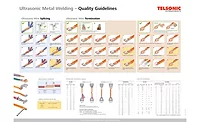
Ultrasonic welding has been used to weld plastics materials since the 1960s. According to Tony DiFinizio, engineering manager at Stapla Ultrasonics (Wilmington, MA), the first metal applications were developed in the early 1980s.
Ultrasonic welding is used in various bonding applications, such as joining such dissimilar metals as copper, aluminum, nickel and brass.
DiFinizio explains that ultrasonic welding works by scrubbing two surfaces together under pressure at an ultrasonic frequency, such as 20,000 cycles per second. The two base metals intermingle to form a metallurgical bond.
Ultrasonic welding is widely used in wire harness manufacturing, where welding multiple wires is required. The resulting molecular bonds are strong and can provide lower resistance than soldering or crimping. Ultrasonic welding can also bond wire to terminals. The advantage is the lower resistance. The disadvantage is that this process takes longer than crimping—approximately 2 seconds. Furthermore, the cost of an ultrasonic press is higher. Many crimping applications do not require such low resistance, so the additional time and cost cannot be justified.
Ultrasonic welding cannot be used with tin plating, which is soft and will undermine the friction welding process. However, alternative plating materials, such as silver, nickel and gold, can be used. Many terminal manufacturers can provide standard terminals without plating.
Ultrasonic welding is extremely flexible. An application that is becoming more common in the automotive industry is the ground lug. Instead of connecting many ground wires to separate locations on the chassis, auto manufacturers are now running up to 20 wires to one common point. These wires are then ultrasonically welded to a large ground lug.
On the other end of the spectrum, ultrasonic welding is being used to terminate flat flexible cable (FFC). FFC is becoming popular—especially in the automotive industry. Ultrasonics can be used to weld FFC to another FFC, frets, connectors and even discrete wires. This process is suitable for critical applications, such as air bags or antilock braking systems, where a strong bond, low resistance and full quality control are needed.
Standardization of Quality
Quality is a relative term. A supplier of disposable flashlights is going to have different quality standards than manufacturers of heart pacemakers. Many industries have some type of standard. The standard that is becoming very popular in the wire industry is the IPC/WHMA-A-620 Specification on Requirements and Acceptance for Cable and Wire Harness Assemblies. This document breaks down the various acceptability standards for the different levels of quality in wire processing. Termination methods are critical in the wire industry for obvious reasons, and the standard covers them extensively.
Looking for a reprint of this article?
From high-res PDFs to custom plaques, order your copy today!