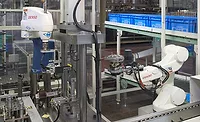
How to Equip Robots With Readers
There are many reasons to mount a bar code reader to a robot. However, for the application to succeed, engineers must do more than simply allocate space for the device on the arm.
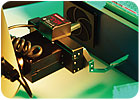
In automated assembly systems, bar codes and other symbols provide a dependable, inexpensive means of validating assembly steps, preventing errors, tracking work in process, and building model variants. Mounting readers to robots makes the process of scanning bar codes that much faster, and it gives engineers extra flexibility when reconfiguring assembly systems.
However, these benefits are difficult to realize if the reader’s functionality is compromised. For a successful application, engineers must do more than simply allocate space for the reader on the robot arm.
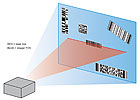
The scan envelope is the total, three-dimensional space in which a reader can decode a bar code at a specified distance. The size of the envelope is determined by the depth of the reader, the scan angle and the distance between the reader and the bar code.
Design Considerations
There are four key areas to address when embedding a bar code reader into robotic assembly equipment: scan envelope, shock and vibration, moving mass, and electrical functionality.The scan envelope is the total, three-dimensional space in which a reader can decode a bar code at a specified distance. The scan envelope varies widely between readers, so it must be precisely calculated in advance, especially in space-constrained applications such as robotic arms. The size of the envelope is determined by the depth of the reader, the scan angle and the distance between the reader and the bar code. The depth is easily found by measuring the reader’s case. The scan angle is important because it directly determines the width of the reader’s field of view. The scan distance is the distance between the front of the reader and the symbol. This distances varies from reader to reader, due to differing optics between brands.
The abrupt, uneven movements of robotic arms can affect the performance and longevity of a bar code reader. To determine a reader’s compatibility with robotic equipment, shock and vibration tests should be conducted. Specifically, three separate tests should be performed under operational conditions: shock, sinusoidal vibration and random vibration. The shock test measures the effect of sudden movement, such as the rapid acceleration and stopping of a robotic arm. The sinusoidal vibration test evaluates the performance of the reader at predetermined frequency levels. The random vibration test uses uneven vibration to simulate “real world” conditions that the reader is more likely to experience. To ensure optimal function and a long life for the bar code reader, it should be tested at a minimum of twice the equipment’s calculated shock and vibration loads at the location the reader will be mounted.
In high-speed automated applications, robots typically cannot move large masses, so the size and construction of the bar code reader is important. Accurate speed and movement of the robotic arm can be compromised by a heavy, bulky bar code reader. All-in-one readers that combine the light source, decoder and camera in one unit are a good choice for robotic applications, because of their small case size and nominal mass. Adding these compact devices will have a minimal effect on the force required to move the arm. They also maximize mounting options.
The reader’s case should be constructed of a lightweight material, such as a magnesium alloy, that is strong and resilient enough to protect the device within the demanding environment of automated assembly.
Electrical functions also should be considered when integrating a bar code reader with robotics. Most readers require 5 to 28 volts of electricity. Readers with minimal power requirements will reduce the drain on the host controller. The routing of connectivity cables should be carefully designed. Special high-flex cables may be needed to cope with the repetitive movement of the robotic arm.
Triggers tell the scanner when to look for the bar code. There are two kinds of trigger: discrete (external) and serial (software). Which type of trigger to use depends on whether you prefer wiring or programming. Discrete triggers are separate sensors, or object detectors, that are wired directly into the reader. They require much less programming than serial triggers. Serial triggers are dispatched from an external device, such as a PLC or host PC, which tells the reader to look for a bar code. Serial triggers are often used in embedded applications to provide more control.
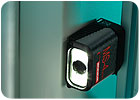
Robots typically cannot move large masses, so the size and construction of the bar code reader is important. All-in-one readers that combine the light source, decoder and camera in one unit are a good choice.
Additional Considerations
For successful integration, engineers should consider the software interface between the reader and the robot. Today’s bar code readers function like independent computers, reducing the amount of programming required on the host controller to process the data. Once the bar code is decoded, the reader can output the data in the exact format required for a specific process. Interface software should be designed to initialize the reader, check for status, and create a robust real-time communication protocol between reader and host.Engineers should also evaluate the environment where the bar code reader will be operating. Temperature, ambient lighting, electrical noise, and dust or water exposure must all be considered to avoid low read rates. Engineers should make sure the reader’s housing meets the necessary industrial rating. If not, they’ll need to build an enclosure to protect the reader from the environment. In addition to affecting the reader’s performance, the environment can also affect the quality of the bar code itself. Engineers are well-advised to spend time to find a label material and adhesive that will withstand the various processes to which the bar code label will be subjected.
Effective integration of bar code readers is critical to the success of any manufacturing process. As a unique integration challenge, robots require special consideration and planning. By anticipating the technical requirements of the reader in advance and incorporating process specifications into the design, engineers will dramatically increase the performance and accuracy of their data capture, while significantly lowering the total cost of ownership of the equipment.
Looking for a reprint of this article?
From high-res PDFs to custom plaques, order your copy today!