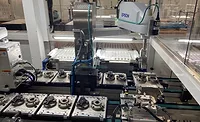
Assembly Automation: Robotic Screwdrivers Assemble Auto Parts
A German research team has developed robotic assembly cells for connecting electronic devices to flexible flat cables in automotive modules.
Today’s cars have more electronic gizmos than Radio Shack. These electronic devices may be popular, but the extra wiring can add a lot of weight and cost to a vehicle.
Using flexible flat cable (FFC) instead of standard wiring harnesses is one way around that problem. However, before FFC can become a mainstay in vehicles, automotive assemblers will need a fast, efficient method for installing it.
Such a method could be just around the corner. Scientists at the Institute for Manufacturing Automation and Production Systems at the Friedrich-Alexander University of Erlangen-Nuremberg in Germany have developed a prototype system for automated handling and assembling FFCs. Their system uses Cartesian robots to route multicore FFCs onto a 3D module, such as a door panel, and secure them with hot-melt adhesive or laser welding.
A key part of their research was finding a means of connecting the cables to electronic devices, such as loudspeakers, and their host components, such as door panels. Because FFCs are only accessible from one side after they are positioned, the researchers had to develop a new connection technology for the application. The technology had to be “automation-friendly” and include the additional step of penetrating the wire insulation.
The “direct-contact spring clip” is what they came up with. In this design, the FFC is positioned in a “contact mound.” As electronic devices are applied to the FFC in a vertical motion, blades on the direct-contact spring clip cut through the insulation on the cable, slide over the copper conductor, and simultaneously slip under the insulation, resulting in a large contact area.
Next, a linear actuator applies a clamping force to the connection. This force counteracts the pressure from the spring clips, until the electronic device can be secured to its functional component with screws. Once the screws are installed, the clamp force is removed and an electrical connection between the cable and device is realized.
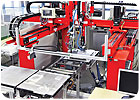
For example, one cell assembles a loudspeaker to a door panel. The cell employs two RL16 Cartesian robots from Reis Robotics. Two robots are positioned so they share a common working area. To extend the working range of the robots, the workpiece is mounted to an automated hexapod that allows additional positioning movements. A dual-belt transfer system feeds materials in and out of the cell.
One robot is equipped with an automatic screwdriver from DEPRAG Inc. The other has a custom-made gripper for handling the loudspeakers.
When a door module arrives at the cell, it is fixed onto a pallet attached to the hexapod. Next, the robot with the gripper picks up a loudspeaker and places it into position on the door panel. At this point, contact between the FFC and loudspeaker has been established. The robot must maintain its position long enough for the loudspeaker to be fixed with the joining elements and fastened securely.
This is the task of the screwdriving robot. The robot moves to each joint and installs a screw to the correct torque. Then, the robots return to their starting positions, and the door module exits the cell.
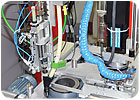
The main component of the screwdriving system is DEPRAG’s Minimat-E 320E27-0042 programmable screwdriver with a torque range of 0.7 to 4.2 newton-meters. “Due to its small size and low weight, this device proved to be the best-suited screwdriving spindle for the robot,” says Markus Michl, who led the Institute’s development team on the project.
Four 12-millimeter M4 screws are required for this application. These are fed by a standard DEPRAG screwfeeder, which consists of a vibratory drive, a spiral-track bowl and a screw separator. After exiting the bowl, the screws are blown through a tube to the nosepiece of the screwdriver.
The robot positions the driver over each screw location. With the help of a linear slide, the screwdriver moves downwards. The bit descends through the nosepiece onto the head of the screw. At the start signal from the main controller, the screw is tightened.
The screws are tightened in a two-step process. The screw is first threaded in at a slow speed and then tightened to a preset torque (minimum 1.2 newton-meters, maximum 1.8 newton-meters). Once torque has been reached, the screwdriver stops automatically. The screw is seated securely every time at the same torque, with a maximum standard deviation of 3 percent. Each screw is installed in 1.3 seconds. This process is monitored by DEPRAG’s AST10 screwdriver controller, which is integrated with the central control system of the assembly cell.
“Our AST10 sequence controller is not only used in fully automated assembly systems, but also in handheld stations,” says Bernd März, head of DEPRAG’s Mechatronic Development Center.
The unit drives the tool’s brushless electric motor, operates the tool remotely, controls and monitors the screwdriving process, and collects and stores data on the assembly process. With an http interface and integrated web server, the controller enables engineers to access process data from anywhere in the world.
Today’s cars have more electronic gizmos than Radio Shack. These electronic devices may be popular, but the extra wiring can add a lot of weight and cost to a vehicle.
Using flexible flat cable (FFC) instead of standard wiring harnesses is one way around that problem. However, before FFC can become a mainstay in vehicles, automotive assemblers will need a fast, efficient method for installing it.
Such a method could be just around the corner. Scientists at the Institute for Manufacturing Automation and Production Systems at the Friedrich-Alexander University of Erlangen-Nuremberg in Germany have developed a prototype system for automated handling and assembling FFCs. Their system uses Cartesian robots to route multicore FFCs onto a 3D module, such as a door panel, and secure them with hot-melt adhesive or laser welding.
A key part of their research was finding a means of connecting the cables to electronic devices, such as loudspeakers, and their host components, such as door panels. Because FFCs are only accessible from one side after they are positioned, the researchers had to develop a new connection technology for the application. The technology had to be “automation-friendly” and include the additional step of penetrating the wire insulation.
The “direct-contact spring clip” is what they came up with. In this design, the FFC is positioned in a “contact mound.” As electronic devices are applied to the FFC in a vertical motion, blades on the direct-contact spring clip cut through the insulation on the cable, slide over the copper conductor, and simultaneously slip under the insulation, resulting in a large contact area.
Next, a linear actuator applies a clamping force to the connection. This force counteracts the pressure from the spring clips, until the electronic device can be secured to its functional component with screws. Once the screws are installed, the clamp force is removed and an electrical connection between the cable and device is realized.
The main component of the screwdriving system is the Minimat-E programmable screwdriver with a torque range of 0.7 to 4.2 newton-meters.
Automating Assembly
The researchers have tested the feasibility of the direct-contact spring clip with a variety of assembly cells. They have built cells for automated routing and connecting of FFCs, as well as fully automated assembly of vehicle modules containing FFCs.For example, one cell assembles a loudspeaker to a door panel. The cell employs two RL16 Cartesian robots from Reis Robotics. Two robots are positioned so they share a common working area. To extend the working range of the robots, the workpiece is mounted to an automated hexapod that allows additional positioning movements. A dual-belt transfer system feeds materials in and out of the cell.
One robot is equipped with an automatic screwdriver from DEPRAG Inc. The other has a custom-made gripper for handling the loudspeakers.
When a door module arrives at the cell, it is fixed onto a pallet attached to the hexapod. Next, the robot with the gripper picks up a loudspeaker and places it into position on the door panel. At this point, contact between the FFC and loudspeaker has been established. The robot must maintain its position long enough for the loudspeaker to be fixed with the joining elements and fastened securely.
This is the task of the screwdriving robot. The robot moves to each joint and installs a screw to the correct torque. Then, the robots return to their starting positions, and the door module exits the cell.
The main component of the screwdriving system is DEPRAG’s Minimat-E 320E27-0042 programmable screwdriver with a torque range of 0.7 to 4.2 newton-meters. “Due to its small size and low weight, this device proved to be the best-suited screwdriving spindle for the robot,” says Markus Michl, who led the Institute’s development team on the project.
Four 12-millimeter M4 screws are required for this application. These are fed by a standard DEPRAG screwfeeder, which consists of a vibratory drive, a spiral-track bowl and a screw separator. After exiting the bowl, the screws are blown through a tube to the nosepiece of the screwdriver.
The robot positions the driver over each screw location. With the help of a linear slide, the screwdriver moves downwards. The bit descends through the nosepiece onto the head of the screw. At the start signal from the main controller, the screw is tightened.
The screws are tightened in a two-step process. The screw is first threaded in at a slow speed and then tightened to a preset torque (minimum 1.2 newton-meters, maximum 1.8 newton-meters). Once torque has been reached, the screwdriver stops automatically. The screw is seated securely every time at the same torque, with a maximum standard deviation of 3 percent. Each screw is installed in 1.3 seconds. This process is monitored by DEPRAG’s AST10 screwdriver controller, which is integrated with the central control system of the assembly cell.
“Our AST10 sequence controller is not only used in fully automated assembly systems, but also in handheld stations,” says Bernd März, head of DEPRAG’s Mechatronic Development Center.
The unit drives the tool’s brushless electric motor, operates the tool remotely, controls and monitors the screwdriving process, and collects and stores data on the assembly process. With an http interface and integrated web server, the controller enables engineers to access process data from anywhere in the world.
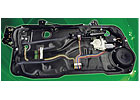
Using flexible flat cable instead of a traditional wiring harness could save space, reduce weight and lower the cost of producing automotive modules such as this door assembly.
Simplified Programming
Michl chose the AST10 for this project “because of its ease of integration into our control system.” The central controller for the assembly system is a PC, which is connected via several interfaces to the individual machine controllers. Connection between the computer and both robot controllers is via Ethernet, over which data packages with guidance instructions in XML format can be set externally. The PC is also connected to the hexapod via Ethernet. Sensors and pneumatic control valves are connected to the PC via “I/O Warriors,” microcontrollers that carry out typical PLC tasks, such as setting and processing of digital inputs and outputs. The sensors and valves coordinate the work of the screwfeeder and other feeding components.
The screwdriving controller is linked to the IO-Warrior via a PLC port. The screwdriving program is selected via this communication interface (binary signals). The IO-Warrior also processes the start signal for screwdriving, as well as any messages from the screwdriving controller (system OK or not OK, screw assembly OK or not OK).
Data strings that contain, for example, information about error codes or the final tightening torque of the screws, are communicated via a serial connection. The content of these data strings can be configured in advance via the web-based configuration interface of the screwdriver controller. A detailed data record of the screwdriving process can be called up via an http request for analysis and documentation. Torque, angle and number of screw installations are available instantly for analysis in case of error or for process documentation.
To make programming as simple as possible, elementary functions such as robot or hexapod motions, screwfeeding and screwdriving are done in Python, an object-oriented script language. There is no need to create a sequence program, which is time-consuming and error-prone. The engineer simply specifies the working instructions to the device in a preset data format. The data scheme always contains five elements: contract name, precondition, machine name, command and parameter.
Before these new technologies see widespread use in the automotive industry, further tests must be carried out. The researchers want to perform long-term tests to analyze the reliability of FFCs, the direct-contact spring clip and other options for cabling and connecting parts.
For more information on automated screwdriving, call DEPRAG at 800-4-DEPRAG or visit www.depragusa.com.
For more information on robotics, call Reis Robotics at 847-741-9500 or visit http://reisroboticsusa.com.
ASSEMBLY ONLINE
For more information on robotic screwdriving, visit www.assemblymag.com to read these articles:
The screwdriving controller is linked to the IO-Warrior via a PLC port. The screwdriving program is selected via this communication interface (binary signals). The IO-Warrior also processes the start signal for screwdriving, as well as any messages from the screwdriving controller (system OK or not OK, screw assembly OK or not OK).
Data strings that contain, for example, information about error codes or the final tightening torque of the screws, are communicated via a serial connection. The content of these data strings can be configured in advance via the web-based configuration interface of the screwdriver controller. A detailed data record of the screwdriving process can be called up via an http request for analysis and documentation. Torque, angle and number of screw installations are available instantly for analysis in case of error or for process documentation.
To make programming as simple as possible, elementary functions such as robot or hexapod motions, screwfeeding and screwdriving are done in Python, an object-oriented script language. There is no need to create a sequence program, which is time-consuming and error-prone. The engineer simply specifies the working instructions to the device in a preset data format. The data scheme always contains five elements: contract name, precondition, machine name, command and parameter.
Before these new technologies see widespread use in the automotive industry, further tests must be carried out. The researchers want to perform long-term tests to analyze the reliability of FFCs, the direct-contact spring clip and other options for cabling and connecting parts.
For more information on automated screwdriving, call DEPRAG at 800-4-DEPRAG or visit www.depragusa.com.
For more information on robotics, call Reis Robotics at 847-741-9500 or visit http://reisroboticsusa.com.
ASSEMBLY ONLINE
For more information on robotic screwdriving, visit www.assemblymag.com to read these articles:
Looking for a reprint of this article?
From high-res PDFs to custom plaques, order your copy today!