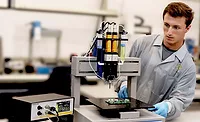
Dispensing Potting Materials
There’s more to the potting process than simply pouring a liquid resin onto an assembly.
Ten years ago, Bridgestone/Firestone Inc. was faced with a major product recall after discovering the treads on several tire models were separating. The case involved more than 14.4 million tires, most of which had been installed on Ford Explorers.
Ford blamed Bridgestone/Firestone for the problem. The tire maker blamed Ford for recommending a tire pressure that was too low. In the end, the debacle spurred growth of a new technology: tire pressure monitoring systems.
These systems consist of electronic pressure sensors within each tire that wirelessly transmit data to the instrument panel. The battery-powered sensor can be mounted to the end of the valve stem or banded to the wheel rim. These sensors must endure extreme vibration, shock, force, heat, cold and chemicals. And, they have to last at least 10 years.
In such severe conditions, ordinary soldered connections wouldn’t stand a chance. That’s why pressure sensors are completely encased with a potting compound. The resin locks the electronic components in place, and protects the assembly from the elements. During manufacturing, a Cartesian robot dispenses the two-component material into the sensor housing, filling it from the bottom up to ensure that no air is trapped inside.
Pressure sensors are just one example of the many types of assemblies that are potted. Elsewhere in the automotive industry, potting compounds protect such components as alternators, batteries, optical sen-sors, motor management sensors, and control modules for antilock brakes.
Outside of the automotive industry, potting is used to protect capacitors, transducers, transformers and switches. The windings of waterproof servomotors are potted to prevent shorts, while reflective road markers are potted to keep them from being crushed by traffic. A manufacturer of hot tubs pots the con-troller to protect it from water, heat and chemicals.
Dispensing a potting material may seem like it should be easier than, say, dispensing dots of solder paste on a circuit board or applying a bead of gasketing material around a flange. However, there’s more to the process than simply pouring the resin over the parts. How large a volume must be filled, and how accessible is it? Will the material be dispensed with semiautomatic or fully automatic equipment? How will the material be supplied? Does the material or the assembly have to be heated? Will a vacuum be needed to prevent air bubbles in the assembly?
“Sometimes, the area [into which we’re dispensing] is very tight. In other cases, it’s an open housing,” says Claude Bergeron, product line manager for dispense valves at Nordson EFD. “We’ve worked on applica-tions to fill very small volumes, and we’ve done applications with very large housings.
“During the product design stage, dispensing may not seem important, but it’s critical to understand both the fluid and the process. We’re often asked to resolve issues where it’s difficult to access the parts. We’re filling an internal cavity through a blind hole, and there’s no way for air to escape. A different design might have alleviated that issue.”
Regardless of chemistry, potting materials typically have a honey-like viscosity.
“Potting materials have a little body to them, but they flow nice and easy,” says David C. Mandeville, director of marketing at Sealant Equipment and Engineering Inc. “You want the material to flow into all the nooks and crannies of the assembly and push the air out.”
Potting materials can include fillers, such as flame retardants and colorants. When cured, the materials can be very hard, which is useful to prevent product tampering, or they can be somewhat flexible to absorb vibrations and shock.
The full gamut of technologies can be used to dispense potting materials, from handheld time-pressure systems to side-by-side cartridge systems to fully automatic meter-mix equipment mounted on a robot. Which to choose depends on the production volume, the complexity of the assembly, and the type and amount of material to be dispensed.
For example, Nordson EFD recently supplied equipment to pot a small GPS transmitter with an expensive, military-grade epoxy. The transmitter is embedded in the uniforms of soldiers so officers can locate their troops in the field. The manufacturer uses a semiautomatic meter-mix system to fill 30-cc syringes with parts A and B, which are bought in bulk. Then, handheld time-pressure systems are used to fill each sensor with 1 cc of epoxy.
“The time-pressure unit takes away the guesswork from the filling process. There’s just one shot,” says Bergeron. “When the air pressure does the hard work for you, you can just concentrate on the location of the dispensing tip.”
The transmitter manufacturer opted for time-pressure units because the production volume was relatively low, the amount dispensed was small, and the epoxy had a short pot life. If the production volume were higher and the pot life of the epoxy were longer, the manufacturer might have gone with a fully automatic dispenser and an indexing system.
“If you’ve got a significant volume of parts, you want to feed the material from a large reservoir, so you’re not constantly stopping production to mix a batch of epoxy,” says Bergeron.
For automated dispensing, Cartesian robots are favored by assemblers for their flexibility. For example, Dispense Works Inc. offers Cartesian robots with work envelopes ranging from 4 inches by 6 inches to 4 feet by 8 feet. The robots accept pneumatic syringes (55 cc and less), side-by-side cartridges (50, 200, 400 and 600 milliliters), and dispense heads from meter-mix equipment.
“Our control systems provide six axes of motion control, so the robot can have an additional head for spot curing, screwdriving or pick-and-place operations,” says Emil Cendric, president of Dispense Works.
Beyond labor savings, the advantage of a robot is that it can be programmed to move the dispense tip around the housing to ensure an air-free fill. Ideally, the housing should be filled from the bottom up, rather than from the top down. In some cases, the tip may need to move back and forth to evenly distribute the material and avoid entrapping air.
“If you’re potting a sensor with vertical leads, you can program the head to circle around each lead,” says Cendric. “You can teach it the pattern for one part, then teach it the configuration of the pallet, and then it will just go from part to part until it completes every part on the pallet.”
In still other cases, the potting material is injected into the housing under pressure. The material is pushed into every recess in the housing, forcing out air as it goes. The key here is to find the right spot to inject the material and provide an opening for the air to escape. Indeed, during the product design stage, engineers will sometimes mold several housings from clear plastic so they can see how well the potting material flows around the parts.
“Sometimes, you have to move the injection point; sometimes you have to redesign the case,” says Mandeville. “We had a customer who had to redesign the case three times before he got it right.”
“Air is the enemy in a potting application,” says Mandeville. “When the device heats up, the trapped air will expand, which could crack the housing.”
Preventing air bubbles starts with the material supply. “Bubbles in, bubbles out,” says Kelvin Fernandez, product line manager for dispensers and automation products at Nordson EFD. “If you’re pumping the material through a valve, you need to ensure that the fluid in the tank does not have bubbles.”
Although some suppliers degas potting compounds prior to shipping them, many assemblers opt to pull a vacuum on the reservoir of the dispensing system just to be sure, particularly if the material is poured into the tank from another container. The process doesn’t have to be particularly rigorous. Applying a 0.5-hp vacuum pump to the reservoir for 30 minutes or so will often do the trick.
For critical applications, assemblers may place freshly potted parts in a vacuum chamber prior to curing. They might even dispense the material in a vacuum chamber.
Sealant Equipment was recently involved in just such an application. An automotive supplier needed to dispense 10 cc of a potting compound into a door handle, which housed the electronics for the vehicle’s keyless entry system. Because of the long, narrow shape of the handle, engineers could not fill the handles all at once, nor could they be sure that the handle would be free of air bubbles.
As a result, the engineers decided to fill the handles in a vacuum chamber. The chamber contained a rotary indexing dial that accommodated 12 handles. A dual-head meter-mix system dispensed 2 cc of potting material into two handles simultaneously. The table would then index, and the dispenser would fill two more handles with fluid. Each shot took approximately 2 seconds. After five complete rotations, all 12 handles were full.
“A little bit of a material degasses quicker than the full 10 cc,” explains Mandeville. “So 10 handles are degassing while two are being filled.”
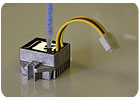
This voltage regulator for a motorcycle is potted with an epoxy. Photo courtesy Sealant Equipment and Engineering Inc.
Ten years ago, Bridgestone/Firestone Inc. was faced with a major product recall after discovering the treads on several tire models were separating. The case involved more than 14.4 million tires, most of which had been installed on Ford Explorers.
Ford blamed Bridgestone/Firestone for the problem. The tire maker blamed Ford for recommending a tire pressure that was too low. In the end, the debacle spurred growth of a new technology: tire pressure monitoring systems.
These systems consist of electronic pressure sensors within each tire that wirelessly transmit data to the instrument panel. The battery-powered sensor can be mounted to the end of the valve stem or banded to the wheel rim. These sensors must endure extreme vibration, shock, force, heat, cold and chemicals. And, they have to last at least 10 years.
In such severe conditions, ordinary soldered connections wouldn’t stand a chance. That’s why pressure sensors are completely encased with a potting compound. The resin locks the electronic components in place, and protects the assembly from the elements. During manufacturing, a Cartesian robot dispenses the two-component material into the sensor housing, filling it from the bottom up to ensure that no air is trapped inside.
Pressure sensors are just one example of the many types of assemblies that are potted. Elsewhere in the automotive industry, potting compounds protect such components as alternators, batteries, optical sen-sors, motor management sensors, and control modules for antilock brakes.
Outside of the automotive industry, potting is used to protect capacitors, transducers, transformers and switches. The windings of waterproof servomotors are potted to prevent shorts, while reflective road markers are potted to keep them from being crushed by traffic. A manufacturer of hot tubs pots the con-troller to protect it from water, heat and chemicals.
Dispensing a potting material may seem like it should be easier than, say, dispensing dots of solder paste on a circuit board or applying a bead of gasketing material around a flange. However, there’s more to the process than simply pouring the resin over the parts. How large a volume must be filled, and how accessible is it? Will the material be dispensed with semiautomatic or fully automatic equipment? How will the material be supplied? Does the material or the assembly have to be heated? Will a vacuum be needed to prevent air bubbles in the assembly?
“Sometimes, the area [into which we’re dispensing] is very tight. In other cases, it’s an open housing,” says Claude Bergeron, product line manager for dispense valves at Nordson EFD. “We’ve worked on applica-tions to fill very small volumes, and we’ve done applications with very large housings.
“During the product design stage, dispensing may not seem important, but it’s critical to understand both the fluid and the process. We’re often asked to resolve issues where it’s difficult to access the parts. We’re filling an internal cavity through a blind hole, and there’s no way for air to escape. A different design might have alleviated that issue.”
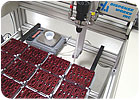
For automated dispensing of potting compounds, Cartesian robots are favored for their flexibility. Photo courtesy Dispense Works Inc.
Perfect Potting
A number of chemistries are used for potting, but the three most common are epoxies, urethanes and silicones. Most are two-part materials with mix ratios ranging from 1-to-1 to 10-to-1. Some materials are more forgiving than others in terms of mixing at the right ratio. Most should be mixed to within 1 percent to 2 percent of the specified ratio.Regardless of chemistry, potting materials typically have a honey-like viscosity.
“Potting materials have a little body to them, but they flow nice and easy,” says David C. Mandeville, director of marketing at Sealant Equipment and Engineering Inc. “You want the material to flow into all the nooks and crannies of the assembly and push the air out.”
Potting materials can include fillers, such as flame retardants and colorants. When cured, the materials can be very hard, which is useful to prevent product tampering, or they can be somewhat flexible to absorb vibrations and shock.
The full gamut of technologies can be used to dispense potting materials, from handheld time-pressure systems to side-by-side cartridge systems to fully automatic meter-mix equipment mounted on a robot. Which to choose depends on the production volume, the complexity of the assembly, and the type and amount of material to be dispensed.
For example, Nordson EFD recently supplied equipment to pot a small GPS transmitter with an expensive, military-grade epoxy. The transmitter is embedded in the uniforms of soldiers so officers can locate their troops in the field. The manufacturer uses a semiautomatic meter-mix system to fill 30-cc syringes with parts A and B, which are bought in bulk. Then, handheld time-pressure systems are used to fill each sensor with 1 cc of epoxy.
“The time-pressure unit takes away the guesswork from the filling process. There’s just one shot,” says Bergeron. “When the air pressure does the hard work for you, you can just concentrate on the location of the dispensing tip.”
The transmitter manufacturer opted for time-pressure units because the production volume was relatively low, the amount dispensed was small, and the epoxy had a short pot life. If the production volume were higher and the pot life of the epoxy were longer, the manufacturer might have gone with a fully automatic dispenser and an indexing system.
“If you’ve got a significant volume of parts, you want to feed the material from a large reservoir, so you’re not constantly stopping production to mix a batch of epoxy,” says Bergeron.
For automated dispensing, Cartesian robots are favored by assemblers for their flexibility. For example, Dispense Works Inc. offers Cartesian robots with work envelopes ranging from 4 inches by 6 inches to 4 feet by 8 feet. The robots accept pneumatic syringes (55 cc and less), side-by-side cartridges (50, 200, 400 and 600 milliliters), and dispense heads from meter-mix equipment.
“Our control systems provide six axes of motion control, so the robot can have an additional head for spot curing, screwdriving or pick-and-place operations,” says Emil Cendric, president of Dispense Works.
Beyond labor savings, the advantage of a robot is that it can be programmed to move the dispense tip around the housing to ensure an air-free fill. Ideally, the housing should be filled from the bottom up, rather than from the top down. In some cases, the tip may need to move back and forth to evenly distribute the material and avoid entrapping air.
“If you’re potting a sensor with vertical leads, you can program the head to circle around each lead,” says Cendric. “You can teach it the pattern for one part, then teach it the configuration of the pallet, and then it will just go from part to part until it completes every part on the pallet.”
In still other cases, the potting material is injected into the housing under pressure. The material is pushed into every recess in the housing, forcing out air as it goes. The key here is to find the right spot to inject the material and provide an opening for the air to escape. Indeed, during the product design stage, engineers will sometimes mold several housings from clear plastic so they can see how well the potting material flows around the parts.
“Sometimes, you have to move the injection point; sometimes you have to redesign the case,” says Mandeville. “We had a customer who had to redesign the case three times before he got it right.”
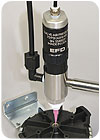
A Nordson EFD 725DA-SS dispense valve fills the well for a calibration screw with adhesive to make it tamper-resistant. Photo courtesy Nordson EFD
Suck It Up
Molding test parts out of clear plastic and programming complex dispense paths may seem like a lot of work for such a simple application, but it’s well worth the effort if assemblers can prevent air bubbles from forming in the material.“Air is the enemy in a potting application,” says Mandeville. “When the device heats up, the trapped air will expand, which could crack the housing.”
Preventing air bubbles starts with the material supply. “Bubbles in, bubbles out,” says Kelvin Fernandez, product line manager for dispensers and automation products at Nordson EFD. “If you’re pumping the material through a valve, you need to ensure that the fluid in the tank does not have bubbles.”
Although some suppliers degas potting compounds prior to shipping them, many assemblers opt to pull a vacuum on the reservoir of the dispensing system just to be sure, particularly if the material is poured into the tank from another container. The process doesn’t have to be particularly rigorous. Applying a 0.5-hp vacuum pump to the reservoir for 30 minutes or so will often do the trick.
For critical applications, assemblers may place freshly potted parts in a vacuum chamber prior to curing. They might even dispense the material in a vacuum chamber.
Sealant Equipment was recently involved in just such an application. An automotive supplier needed to dispense 10 cc of a potting compound into a door handle, which housed the electronics for the vehicle’s keyless entry system. Because of the long, narrow shape of the handle, engineers could not fill the handles all at once, nor could they be sure that the handle would be free of air bubbles.
As a result, the engineers decided to fill the handles in a vacuum chamber. The chamber contained a rotary indexing dial that accommodated 12 handles. A dual-head meter-mix system dispensed 2 cc of potting material into two handles simultaneously. The table would then index, and the dispenser would fill two more handles with fluid. Each shot took approximately 2 seconds. After five complete rotations, all 12 handles were full.
“A little bit of a material degasses quicker than the full 10 cc,” explains Mandeville. “So 10 handles are degassing while two are being filled.”
ASSEMBLY ONLINE
For more information on dispensing potting materials, visit www.assemblymag.com to read these articles:
Looking for a reprint of this article?
From high-res PDFs to custom plaques, order your copy today!