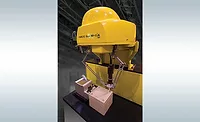
Robotic Screwdriving
Flexible systems help drive down production costs.
No one ever accused William Sellers of "having a screw loose." Sellers was a 19th century mechanical engineering genius who developed the concept of standardized screw threads. His simple idea ushered in the era of interchangeable parts and mass production 150 years ago.
Earlier this year, a special ceremony was held to commemorate a landmark speech Sellers delivered at the Franklin Institute in Philadelphia. During his historic talk, Sellers urged manufacturers to adopt his screw standard, which quickly received widespread support and changed the face of American manufacturing.
The ubiquitous screw hasn't changed much since the mid-1850s. But, the tools and techniques for driving screws have advanced. Today, new tools, such as six-axis robots, are putting a fresh spin on an old concept.
Rising labor costs are forcing manufacturers to abandon manual screwdriving and semiautomatic fastening equipment in favor of fully automated systems. While many engineers once viewed robots as a "luxury" item, they are now seen as a strategic weapon in the fight to keep assembly lines running in the United States.
More and more screwdriving applications are being sent overseas today, because labor is inexpensive and less hard tooling is required. However, by harnessing robots, American manufacturers can achieve higher cycles per screwdriver spindle and faster cycle time per screw, while improving quality.
In the past, not all fastening applications were well suited to articulated robots. But, more and more manufacturing engineers are considering robotics as "an intended method of production vs. a ‘let's see if the robot can do it' approach," notes Mike Beaupre, technology manager at Kuka Robotics Corp. "As robot technology continues to advance, while costs drop, we will see more sophistication and flexibility in these devices."
Looking for quick answers on assembly and manufacturing topics? Try Ask ASM, our new smart AI search tool. Ask ASM
Robotic screwdriving differs from more traditional applications, such as fixed or handheld screwdriving. "Traditional screwdriving is based on fixed locations, tooled components and virtually no flexibility," explains Phil Baratti, manager of applications engineering at Epson Robots. "If you're doing ganged screwdriving, with a multispindle system, you need to be more aware of product repeatability for manufacturing and placement.
"If you have an assembler doing the screwdriving, your biggest concern will be the physical challenges of ergonomics," warns Baratti. Indeed, the total cost of one ergonomic injury can easily approach the cost of a robot.
"In the old days, screwdriving was synonymous with projects running for five years or more; large volumes; and less changes to assemblies," says Jim Dixon, vice president of Dixon Automatic Tool Inc. "Flexibility was not a key word and hard-tooled automation was the order of the day.
"On a traditional screwdriving cell, two or more screws would be driven using dedicated screwdrivers for each position," Dixon points out. "These multiple screwdrivers-sometimes with mountings at weird angles and projections-would be very costly and could only be justified with high volumes. If a changeover was required, it would be very time-consuming."
Robots provide tremendous flexibility. Indeed, robotic screwdriving makes it easy to do quick changeovers and run small, varying size batches of related assemblies. Robots can drive screws from all directions, sometimes with varying torque requirements. They also have the ability to drive different sizes of screws using various feeders for each type of fastener.
However, with robots, the accuracy of the parts location and stack-up become a critical variable. Typically, the robot is going to go to the exact same location every cycle. If the parts are fixtured correctly and the tolerance of the stack-up is uniform with respect to design, then the result is going to be a very reliable production system.
When an operator handles the parts in a manual or fixed screwdriving application, fixture accuracy is often not as critical. In fact, fixture accuracy can be detrimental to manual throughput. With robotic applications, however, the assembly must be brought to the robot for true automatic throughput. That requires constant part security during transfer phases and rigid support at the drive locations during the fastening phases.
Is Six Better?
Robotic screwdriving is not an entirely new concept. Indeed, it's been around for more than 15 years. Cartesian and SCARA robots are often used for screwdriving applications. Those robots are less expensive and are usually faster than their articulated cousins, which most manufacturing engineers associate with material handling, painting and welding applications.
But, with the right type of end effectors and feeders, six-axis robots can also be used as fast, flexible screwdriving tools. Because they provide articulated motion that closely resembles a human, six-axis robots are ideal alternatives for many screwdriving applications.
Unlike Cartesian robots, which have a rectilinear work envelope, or SCARAs, which have a cylindrical work envelope, six-axis robots have a spherical work envelope. An articulated robot can reach above, below, around and behind itself. Its wrist can rotate a fastening tool or turn it on an angle.
Six-axis robots offer agility and long reach, and they can handle complex part geometries. However, articulated robots are not as fast as Cartesians and SCARAs, and they're more expensive. Manufacturing engineers must decide if a screwdriving application justifies the trade-offs.
"Fasteners in the ranges of #00 through 1.5-inch AF bolts are regularly fastened using robotics, and the size and style of the robot usually varies throughout the range," says Jim Graham, president of Weber Screwdriving Systems Inc. "We normally see small, lightweight pass through or gantry-style robots for smaller screws and torques. As we move up in size, we see X-Y Cartesian and SCARA systems used for midsize fasteners. Larger, multiaxis robots are typically used for mid- and high-end fastener sizes.
"In many applications, Cartesian systems simply will not reach, or you cannot bring the parts being assembled directly beneath the smaller robot," notes Graham. "Larger robots offer greater working footprints and have greater flexibility to take on multiple tasks, such as material handling, adhesive dispensing or inspection simply by changing end effectors."
"Cartesian robots are best suited for automated screwdriving applications," argues Baratti. "They can handle heavier loads and, with the majority of applications, they do not need a rotation axis on the robot. The rotation joint is the weakest point on the robot, and is most susceptible to moments generated by the end of arm tool."
Screwdrivers attached to six-axis robots are more common in Europe. But, as the cost differential between an operator and a robot narrows, American manufacturers are beginning to consider this option.
"Robotic screwdriving is shifting away from traditional four-axis robots to more-flexible six-axis robots, made possible by the increased rigidity of today's six-axis robot arms," claims Brian Jones, sales manager at Denso Robotics. "A six-axis robot enables screwdriving to be accomplished on multiple planes without changing the orientation of the part."
However, some observers question whether that agility is really necessary. "We have found that in most applications, a three- or four-axis robot is more than capable of accessing the fastener locations and performing the task," says Ken Maio, business development manager at AIMCO.
"The increased horizontal rigidity of a six-axis robot is quite beneficial compared to a four-axis robot," argues Jones. Of course, determining whether or not a six-axis robot is overkill depends on the application.
Six-axis robots are required when the driving angle varies. The bit must always be perpendicular to the driving plane. When that plane angle changes, a two- or four-axis robot is insufficient. Most engineers would likely have their operators use a handheld automatic screwfeeder to fasten on different angles. Putting one fastener into a low-volume, easy-access part would seem to fit that description. However, one of the beautiful aspects of owning a six-axis robot is its future-use adaptability.
And, contrary to popular belief, special tooling is not always required. "Many handheld screwdrivers can be mounted to robots," notes Maio. "The key is to be able to manage the starting of the driver when the robot needs it and to realize the shutoff once torque has been achieved. Electric tools offer the most possibilities to do this, but many air screwdrivers can be modified as well."
Numerous Applications
While six-axis robotic screwdriving is not widespread, it's slowly becoming more popular. "We've seen a steady increase in automated screwdriving, especially with manufacturers challenged with requirements of flexibility, throughput and the ability to track and monitor the performance of every screw being torqued," says Epson's Baratti.
Robots are ideal for high-torque applications in hard-to-get-to places or in environments unsafe for people. They are used to assemble a wide variety of auto parts, such as engine blocks, cylinder heads, cooling units and transmissions. Robotic screwdriving is also used to assemble electronic components, such as disk drives, and consumer goods, such as appliances, tape measures and frequency converters for cable television.
According to Dixon, "There are virtually no limits to the type of parts that can be assembled using automatic screwdrivers mounted to robots."
"Any application is ideal for robotics, as long as the screw locations are accessible and they are reasonably consistent in their position," adds Kuka Robotics' Beaupre. "Highly repetitive operations involving multiple screws or nuts are good candidates for robotics.
"Robotic screwdriving is advantageous in many assembly tasks where there is a requirement for relatively high torque, high production rates, multiple fasteners, multiple styles of components being assembled and different axis of insertion for those fasteners," claims Beaupre. In general, he says any fastening job where operator limitations would directly effect process capability and production throughput are ideal candidates for robots.
Robotic screwdriving allows manufacturers to address more challenging applications than a typical operator may be comfortable with. "Varying angles of approach required at the fastening location is one example," says AIMCO's Maio. "Another would be parts that require several steps in the screwdriving process.
"One application we undertook was an electronic component with an insulating paper laid over the printed circuit board," explains Maio. "The robot offered the ability to drive several screws to a loose torque locating the paper, driving the remaining screws to final torque, then returning to the loosely tightened screws to apply final torque to them."
Boris Baeumler, an applications engineer at Deprag Inc., recalls working on a recent robotic screwdriving project. "We supplied two dual-spindle screwdriving units to integrate onto two six-axis robots from Fanuc. Each robot feeds four large machining centers. At the appropriate time, the robot presents our screwdriver into the machining center for some mid-machining assembly work on a bearing cap," he says.
Regardless of the type of industry or type of application, manufacturers are usually driven to robots by the same factors: Quality, throughput, and the ability to track and maintain the data involved in automated screwdriving.
"This would include, seat torque, torque depth, cross threading and stripping of the threads," explains Baratti. "We have incorporated many robots in the packaging of electronic components ranging from hard-drive assemblies to sealed satellite components.
"The tight tolerance involved in these types of assemblies require a repeatable presentation of the driver to the screw hole, and commonly the ability to present the screws in varying heights relative to the component being assembled. This is where robotics really pay off, as compared to traditional, fixed-station screwdriving."
However, the type and size of screw used often determines whether or not robots make sense. Screws with internal drive recesses typically work the best. But, slotted screws should be avoided.
"Good engagement, with the least amount of down force is critical," notes Baeumler. He says Phillips or Torx head screws are mandatory with robotic systems.
Pros and Cons
Robotic screwdriving offers numerous advantages, such as accuracy, repeatability and flexibility. Robots have become much more affordable and easier to program. And, they can use vision systems to accurately zero in on the target hole.
Screws typically are blown through a flexible tube. If a fastener does not lend itself to blow feeding, a robot can easily take the screwdriver to the feeder and use a vacuum to pick it from a separating nest. If necessary, screws can be preloaded in a magazine or a track to get them to the moving driver.
"The main advantage of robotic screwdriving is flexibility," says Roger Patton, tooling and automation project manager at PennEngineering Fastening Technologies. "Flexibility in the form of moving the driver to anywhere on the workpiece instead of manipulating the workpiece to align with the axis of the driver. Also, flexibility in the form of the capability of producing different configurations of a workpiece within the same cell.
"In nonrobotic applications, the workpiece is usually brought to the drivers either by hand or by some form of automation," adds Patton. "The drivers then only move in one axis-usually vertically-to install the screws. In robotic screwdriving applications, the driver is usually brought to the workpiece via the robot and the screws are installed in any axis."
Repeatability is another advantage of using robots for screwdriving applications. "There is no subjectivity or vague approach to the manufacturing process," says Weber's Graham. "Being flexible and having the ability to change the assembly task based upon the model coming into the cell in real time offers huge benefits. [You can] maintain a production cell that can deal with anything [you] throw at it.
"With the use of multiple bowl feeder racks and quick-change end effectors, a robot can deal with multiple styles and sizes of fasteners simply by changing tools in the predefined sequence. The appropriate feeder unit will deliver a fastener to the drive unit and the preprogrammed torque-angle parameters are instantly available to each specific fastener."
However, engineers must also weigh all the benefits of robots against some potential disadvantages. For instance, cost is often cited as a big drawback. Unless a robot is totally utilized, it may be more cost-prohibitive than traditional hard tooling.
"The general disadvantages [of using robots for screwdriving] are usually cost and speed," Patton points out. "In a dedicated workcell, where the workpiece is oriented to the driver, several drivers can be positioned to install fasteners simultaneously. In most robotic applications, one driver puts in all the screws sequentially, which takes more time. Since each robotic screwdriver requires both the driver and a robot, it is usually cost-prohibitive to use more than one robot in an application."
According to Epson's Baratti, the initial setup of a screwdriving system is typically more costly, and exacting. "The system designers need to take into account the presentation of the product to the robot and the perpendicularity of the work surface to the tool," he explains. "This holds true more so in using SCARA or Cartesian robots, however.
"Articulated robots have their disadvantages as well," adds Baratti. "The screwdriving mechanisms for robots are heavy and sizeable in relation to other types of tooling for robotic applications. So, mounting a screwdriving unit onto a six-axis arm requires a heavy payload robot, which can be a more costly solution."
Some observers don't subscribe to the initial cost theory. "Initial cost is a misconception," argues Maio. "Most robotic systems allow a manufacturer to save labor to a point where the system pays for itself in an extraordinary period of time." However, safety requirements are more involved and costlier than with a simple hard-tooled cell or station.
Technical complexity, such as programming and maintenance, is another important factor for engineers to consider. For example, some robotic systems are complex and require specialized knowledge. Other robots are relatively easy for existing plant personnel to maintain with minimal training from the supplier.
Robotic Screwdriving Checklist
Before considering robotic screwdriving, manufacturing engineers should answer the following questions:
- What size and type of screws need to be driven?
- Is there more than one size for the system to handle?
- What cycle rate is required for the application? "This will help determine the amount of equipment needed and the type of presentation," says Phil Baratti, manager of applications engineering at Epson Robots.
- How do the screws need to be presented to the driver? "If the screw size is consistent, blowfeeding is the quickest solution," claims Baratti. "However, this adds additional load to the end-of-arm tooling." The other option for presentation is fixed-position picking from a vibratory feeder bowl.
- How much does the screwdriving mechanism weigh?
- Will the driver have its own vertical actuator or does the robot need to drive the tool into the hole?
- Does the application have varying surface heights that need to be addressed ?
- Do the jaws need to be rotated to clear obstructions on the workpiece?
- Do the planes of the workpiece vary? "This would lead to the need for an articulated arm," says Baratti.
- What type of feedback is required for the application?
- How sensitive does the driver need to be in torque and position?
Looking for a reprint of this article?
From high-res PDFs to custom plaques, order your copy today!