Adhesives and Tubing
Although plastic medical tubing can be joined to itself, it’s often attached to a device, bag or connection. As medical device manufacturers look for alternatives to traditional solvent welding, demand for adhesives is increasing.
Adhesives offer several benefits vs. traditional welding techniques. It joins dissimilar materials, including many hard-to-bond substrates; it can be flexible or rigid; it fills large gaps; and it achieves hermetic seals.
A wide variety of dispensing equipment makes adhesive application simple and easy to automate. From simple pressure-time systems to fully automated, positive displacement set-ups, adhesive processing times can be as low as seconds.
Adhesives are also compatible with an extensive range of materials, including ommon tubing materials such as flexible PVC, polyurethane and silicone. In addition, adhesives are becoming more popular because they efficiently bond combinations of materials-a process not easily accomplished with welding techniques.
“Significant differences in chemical make-up and physical characteristics between components make adhesives the ideal assembly method,” claims Christine Salerni Marotta, medical focus segment manager at Henkel Corp. “Adhesives enable designers to lessen the tight tolerances, since they will fill a range of gaps. Although varied by adhesive chemistry, gaps above and beyond 0.5 inch are achievable with typical medical device adhesives.”
Three primary categories of adhesives are typically used for plastic medical tubing assembly applications: light-cure adhesives, cyanoacrylates and silicone.
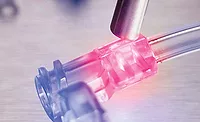
Light-cure adhesives are typically the first choice if one of the materials being assembled is light transmissible or if light can reach the bondline). “This technology is selected because of its rapid cure time-typically less than 10 seconds-and the extremely high strengths achievable,” Marotta points out. “Highly flexible grades of light-cure adhesives ensure that no additional stress or damage is introduced to the tube joint. These adhesives can dramatically change throughput time, as no drying nor extended curing time is required.”
Cyanoacrylates are often chosen for tubing applications where light cure is not possible or not desired due to process costs. “Care should be exercised in cyanoacrylate selection, since most cyanoacrylates are rigid by nature and can induce knife-edging into an otherwise flexible joint,” warns Marotta. “Hence, flexible and toughened grades of these adhesives are [preferred] for medical tube assemblies. Although cyanoacrylates develop handling strength very quickly, they continue to develop strength and full properties over several hours. Fixturing for the full duration is not required, [but] some ‘set’ time may be desired with cyanoacrylate-joined tubing assemblies.”
Silicone adhesives are typically selected when silicone tubing or components are present. “Silicone adhesives offer high adhesion to silicone tubing, and newer light-curing silicones also offer high adhesion to the more common mating materials, such as polycarbonate and acrylic,” notes Marotta.
As new tube materials enter the medical device marketplace, Marotta says compatible assembly methods will need to be identified. “With the olefin blends under development, traditional welding techniques may not be an option,” she explains. Designers will need to focus on joint designs that are conducive to the methods available-in many cases, adhesives.”
Adhesives offer several benefits vs. traditional welding techniques. It joins dissimilar materials, including many hard-to-bond substrates; it can be flexible or rigid; it fills large gaps; and it achieves hermetic seals.
A wide variety of dispensing equipment makes adhesive application simple and easy to automate. From simple pressure-time systems to fully automated, positive displacement set-ups, adhesive processing times can be as low as seconds.
Adhesives are also compatible with an extensive range of materials, including ommon tubing materials such as flexible PVC, polyurethane and silicone. In addition, adhesives are becoming more popular because they efficiently bond combinations of materials-a process not easily accomplished with welding techniques.
“Significant differences in chemical make-up and physical characteristics between components make adhesives the ideal assembly method,” claims Christine Salerni Marotta, medical focus segment manager at Henkel Corp. “Adhesives enable designers to lessen the tight tolerances, since they will fill a range of gaps. Although varied by adhesive chemistry, gaps above and beyond 0.5 inch are achievable with typical medical device adhesives.”
Three primary categories of adhesives are typically used for plastic medical tubing assembly applications: light-cure adhesives, cyanoacrylates and silicone.
Light-cure adhesives are typically the first choice if one of the materials being assembled is light transmissible or if light can reach the bondline). “This technology is selected because of its rapid cure time-typically less than 10 seconds-and the extremely high strengths achievable,” Marotta points out. “Highly flexible grades of light-cure adhesives ensure that no additional stress or damage is introduced to the tube joint. These adhesives can dramatically change throughput time, as no drying nor extended curing time is required.”
Cyanoacrylates are often chosen for tubing applications where light cure is not possible or not desired due to process costs. “Care should be exercised in cyanoacrylate selection, since most cyanoacrylates are rigid by nature and can induce knife-edging into an otherwise flexible joint,” warns Marotta. “Hence, flexible and toughened grades of these adhesives are [preferred] for medical tube assemblies. Although cyanoacrylates develop handling strength very quickly, they continue to develop strength and full properties over several hours. Fixturing for the full duration is not required, [but] some ‘set’ time may be desired with cyanoacrylate-joined tubing assemblies.”
Silicone adhesives are typically selected when silicone tubing or components are present. “Silicone adhesives offer high adhesion to silicone tubing, and newer light-curing silicones also offer high adhesion to the more common mating materials, such as polycarbonate and acrylic,” notes Marotta.
As new tube materials enter the medical device marketplace, Marotta says compatible assembly methods will need to be identified. “With the olefin blends under development, traditional welding techniques may not be an option,” she explains. Designers will need to focus on joint designs that are conducive to the methods available-in many cases, adhesives.”
Looking for a reprint of this article?
From high-res PDFs to custom plaques, order your copy today!