Station to Station: Robots Lend Flexibility to Automated Assembly Line
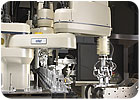
Guided by machine vision, this SCARA robot retrieves a syringe needle from pocketed tape. Photo courtesy Integrated BioSciences Inc.
This is exactly the strategy pursued by Integrated BioSciences Inc. (IBS, Lewisberry, PA), a contract manufacturer of class I and II medical devices and a builder of custom automation systems. Two years ago, the company set out to design a standardized, flexible assembly platform that could accommodate a variety of medical products with minimal effort.
“We wanted a platform that we could configure in different shapes and sizes to handle different process flows and operations, such as dispensing, press-fit assembly, ultrasonic welding-any operation that might be needed to assemble rubber, plastic and metal parts,” explains Keith Bocchicchio, director of technology for IBS. The chassis had to be clean-room compatible, and it had to interface with standard feeding systems, including vibratory bowls, centrifugal feeders and belt feeders. The goal was a system that could output 30 million to 40 million assemblies per year while tended by just one or two operators.
The end result is a high-speed indexing chassis that can transfer pallets from one station to another in 200 milliseconds. Robots, inspection stations and process modules, such as ultrasonic welders, can be added, removed or repositioned as needed.
“This isn’t the fastest machine we’ve worked on, but that wasn’t our goal,” says Bocchicchio. “The idea was to lower time to market and minimize labor input.”
The workhorse of the system is the Cobra i600 vision-guided SCARA robot from Adept Technology Inc. (Livermore, CA). The robot is self-contained, so it’s easily integrated into workcells where space is at a premium. The amplifiers and motion controller are built into the robot-no external electronics are needed. Installing the robot takes four steps: supply power; attach the emergency stop; plug in digital I/O cables to interface with peripherals; and add tooling and vacuum lines. Programming is done through a PC, which can be removed once the system is running. The robot has a maximum reach of 600 millimeters and a maximum payload of 5.5 kilograms. Repeatability in the X-Y plane is ±0.017 millimeter.
“The good thing about the Adept Cobra is that it doesn’t have a big footprint and it’s easy to integrate,” says Bocchicchio. “We may eventually run into situations that require more complex motion than what a SCARA can offer, but mostly we can work around that or engineer it out.”
In the IBS system, SCARAs are used primarily for pick-and-place operations: taking a part from an escapement and placing it on a pallet; transferring a subassembly from one section of a pallet to another; or unloading finished assemblies into sterile packaging. Pneumatic, vacuum-powered and servo-driven end-effectors handle parts, and IBS engineers design products and pallets to facilitate top-down, or additive, assembly.
Vision guidance keeps fixturing costs low by enabling engineers to use simple, inexpensive methods to present parts for pickup by the robots. For example, the first task for the IBS system is production of a family of safety syringes in 1-, 5- and 10-milliliter sizes. Needles for the syringes are fed in pocketed tape. Vision guidance gives the robot the exact location and orientation of the needle within the pocket.
For more information on contract assembly of medical devices, contact IBS at 800-324-7674 or visit www.ibiosci.com. For more information on robots and vision, contact Adept at 800-292-3378 or visit www.adept.com.
Looking for a reprint of this article?
From high-res PDFs to custom plaques, order your copy today!