50 Years of ASSEMBLY: Brazing and Soldering Are Still Old School
ASSEMBLY magazine is celebrating its 50th anniversary this year. To mark the occasion, we are publishing a series of articles examining the past, present and future of various assembly technologies.

 Brazing and soldering are two of the world’s oldest joining processes. During the past 50 years, ASSEMBLY magazine has devoted extensive coverage to each topic. In fact, when the publication debuted in October 1958, it contained a feature entitled “High Temperature Brazing.” The article examined how new types of filler metals were being developed for evolving applications, such as jet engines and rockets.
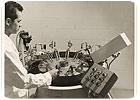
At the time, brazing and soldering were manual operations with handheld torches, typically acetylene, used to heat the parts being joined. Indexing dial machines were just coming on the scene, carrying fixtured parts to natural gas or propane-fired torches.
Early articles in ASSEMBLY touted the benefits of automation. For instance, the January 1959 issue contained a feature entitled “Auto Heater Tank Brazing.” It explained how an automatic gas-fired silver brazing machine cut costs and improved joint quality for automotive heaters manufactured by the Blackstone Corp. (Jamestown, NY).
According to the company’s production superintendent, the automatic operation of the nine-station, self-indexing machine “assures uniformly brazed joints by stabilizing all significant variables. One man produces as much with this machine as five men did by the old hand torch method.” The machine also took up less space than the manual brazing operation.
In addition to automation, the advent of copper brazing as a low-cost method of joining carbon steel helped spur numerous applications in the 1950s. At the same time, silver brazing emerged as the preferred method of joining dissimilar metals.
“Over the last 50 years, brazing has grown and spread into many various applications,” says Bob Peaslee, vice president emeritus of Wall Colmonoy Corp. (Madison Heights, MI). “The advancement in continuous furnace design has led to the brazing of stainless steels in a protective atmosphere, so the brazement comes out of the furnace bright and clean without the use of flux. This has increased production. The introduction of vacuum furnaces also improved quality and reduced cost.”
Peaslee has been involved in brazing since the 1940s, when he was a welding engineer at Curtiss-Wright Jet Engine Co. (Woodridge, NJ), where he developed nickel brazing filler metal. “I worked with the rocket engine manufacturers to introduce them to furnace brazing, and they took off from there,” he recalls.
Indeed, the Space Age fueled rapid advancement in brazing and soldering technology. In the early 1960s, President John F. Kennedy boldly promised that the United States would land a man on the moon by the end of the decade.
Fulfilling that proclamation required manufacturers and suppliers to develop “more stringent quality requirements on all types of joining processes,” says Paul Vianco, principle member of the technical staff at the Materials and Process Sciences Center at Sandia National Laboratories (Albuquerque, NM). For instance, thin honeycomb panels were used to provide strong, lightweight fuselage structures.
An article in the July 1960 issue of ASSEMBLY explained how brazing was used to produce the supersonic XB-70 Valkyrie high-altitude bomber. The groundbreaking aircraft, which featured hinged delta wings, was designed to fly 2,000 mph at altitudes ranging from 15 to 20 miles.
“Two years ago, [the aircraft] could not have been built,” noted the magazine’s West Coast editor, who described the challenges faced by engineers at North American Aviation Inc. (Downey, CA). Strength requirements and manufacturing tolerances “exceeded anything that had ever been attempted before [to assemble an aircraft that is] as strong as a bridge and as precise as a fine watch.”
Transforming that challenge into a production reality involved “one of the most comprehensive and concerted manufacturing efforts ever attempted by American industry.” The ASSEMBLY article claimed that four methods of brazing were developed or refined for use in the ambitious project. Special inspection techniques also had to be created.
A major challenge was caused by the large amount of stainless steel, honeycomb sandwich panels used throughout the aircraft. The specifications and size of the panels exceeded any that had been used before in the aerospace industry. Sheet stock used to create the brazed honeycomb panels measured 0.006 inch thick and was “harder to handle than paper.”
Because of the thousands of feet of ducting needed for the aircraft’s six jet engines, engineers also were forced to develop new brazing techniques for joining tubes. For instance, a remote induction-heating coil was used, which saved “considerable weight over the older method of using flanged bolt couplings in the tube joining” process.
According to Peaslee, vacuum brazing furnaces did not arrive until the late 1960s. By then, NASA had accomplished its moon mission, and automation was widely used for numerous brazing and soldering applications.
For example, an article in the March 1969 issue of ASSEMBLY described how fuel system subassemblies were soldered automatically at AC Spark Plug Co. (Flint, MI). The company, a division of General Motors Corp. (GM, Detroit), turned out up to 25 different designs and variations daily for a wide variety of vehicles, such as the Buick Riviera sedan, which featured air conditioning and power windows.
The plant had been using fully automatic soldering machines since the early 1960s. However, the ASSEMBLY article focused on a new machine that was designed and built in-house. It differed from the older machines in that it had the capability for two complete soldering operations.
The GM engineering department built a turntable that could hold 36 fixtures vs. 24 on the older machines. As a result, the various soldering phases-dispensing, preheating, soldering, cooling, cleaning and drying-were performed on two parts at once. That dual processing capability provided greater production flexibility.
Consumer demand for air conditioning in the 1960s and 1970s created new applications for brazing technology. “The high volume brazing of aluminum, which began in the late 1970s, led to many assemblies found in today’s automotive air conditioning systems,” notes Gene Stout, regional sales manager at Fusion Inc. (Willoughby, OH), who has been in the industry for more than 30 years
“Today, aluminum-brazed components can also be found on cellular phone towers, cookware heating elements, bicycle components and musical percussion heads,” Stout points out. “Orthodontic brace pads are typically brazed in atmosphere furnaces with nickel-silver filler metals.”
“Some people regard brazing as a mature manufacturing process with a diminishing influence in the future,” notes Ken Allen, technical sales manager at Bellman-Melcor Inc. (Tinley Park, IL). “Nothing is further from the truth. There are thousands of distinct applications for brazing.”
Many new applications have developed over the last few years, such as the brazing of ceramics and nonmetallics. “The future of brazing is in applying the universal scientific principles that govern brazing to countless new material joining possibilities,” he points out.
For instance, Allen says brazing alloys have been developed for use in joining titanium. In addition, new technology is available for use with atmosphere induction and rotary flame heating systems. Assemblies produced by these systems require little or no post-braze cleaning, which alleviates environmental issues with brazing technology.
“Brazing’s long history of producing leak-proof assemblies that last a lifetime, resist high service temperatures, and withstand difficult environments give it a solid future as a metal joining technique,” predicts Fusion’s Stout.
The popularity of solder has waxed and waned as different attachment methods were developed over the last 50 years. “Competing technologies, such as laser and ultrasonic welding, have had their 5 minutes of fame with those convinced that soldering is a second best method,” says John Vivari, applications engineering supervisor at EFD Inc. (East Providence, RI). “That said, solder is in much wider use today than 50 years ago.
“Advancements in flux chemistry and heating techniques have opened the door for solder into applications where it would never have been considered before,” adds Vivari. “In addition, advancements in solder paste dispensing have allowed for high-speed automation of soldering that is not possible with other solder forms. Time is money, and the fastest method has a distinct advantage in today’s economy.”
The rising cost of raw materials has diminished the popularity of soldering for price-sensitive applications, such as automotive radiators. But, the higher thermal transfer efficiency of soldering has boosted interest in the joining process for other industrial applications.
“New fields are opening up, such as heat sink soldering, soldering of superconductor cable, magnet wire soldering, and some indirect soldering operations supporting the electronics field,” says Bill Avery, industrial product manager at Kester Solder (Itasca, IL). “One of the outgrowths of the expansion in the electronics field is the use of a far more controllable soldering method instead of torches and hotplates.”
According to Sandia’s Vianco, a big area that is currently receiving attention is solar cells, which need reliability in harsh outdoor environments. In addition, Vianco predicts that fuel cells may rely upon soldering in the future for electrical buses and some structural applications.
“As the science of soldering becomes better understood, we are seeing soldering considered for applications that would not have been addressed without the know-how that is coming to light,” explains Vianco. “For example, soldering may be an alternative to an adhesively bonded joint when a higher strength is required, when outgassing cannot be tolerated, or when adhesion problems plague the glue joint. Soldering is becoming ‘the other option,’ not only for consumer products, but for high-reliability military, space and avionic applications.”
At the time, brazing and soldering were manual operations with handheld torches, typically acetylene, used to heat the parts being joined. Indexing dial machines were just coming on the scene, carrying fixtured parts to natural gas or propane-fired torches.
Early articles in ASSEMBLY touted the benefits of automation. For instance, the January 1959 issue contained a feature entitled “Auto Heater Tank Brazing.” It explained how an automatic gas-fired silver brazing machine cut costs and improved joint quality for automotive heaters manufactured by the Blackstone Corp. (Jamestown, NY).
According to the company’s production superintendent, the automatic operation of the nine-station, self-indexing machine “assures uniformly brazed joints by stabilizing all significant variables. One man produces as much with this machine as five men did by the old hand torch method.” The machine also took up less space than the manual brazing operation.
In addition to automation, the advent of copper brazing as a low-cost method of joining carbon steel helped spur numerous applications in the 1950s. At the same time, silver brazing emerged as the preferred method of joining dissimilar metals.
“Over the last 50 years, brazing has grown and spread into many various applications,” says Bob Peaslee, vice president emeritus of Wall Colmonoy Corp. (Madison Heights, MI). “The advancement in continuous furnace design has led to the brazing of stainless steels in a protective atmosphere, so the brazement comes out of the furnace bright and clean without the use of flux. This has increased production. The introduction of vacuum furnaces also improved quality and reduced cost.”
Peaslee has been involved in brazing since the 1940s, when he was a welding engineer at Curtiss-Wright Jet Engine Co. (Woodridge, NJ), where he developed nickel brazing filler metal. “I worked with the rocket engine manufacturers to introduce them to furnace brazing, and they took off from there,” he recalls.
Indeed, the Space Age fueled rapid advancement in brazing and soldering technology. In the early 1960s, President John F. Kennedy boldly promised that the United States would land a man on the moon by the end of the decade.
Fulfilling that proclamation required manufacturers and suppliers to develop “more stringent quality requirements on all types of joining processes,” says Paul Vianco, principle member of the technical staff at the Materials and Process Sciences Center at Sandia National Laboratories (Albuquerque, NM). For instance, thin honeycomb panels were used to provide strong, lightweight fuselage structures.
An article in the July 1960 issue of ASSEMBLY explained how brazing was used to produce the supersonic XB-70 Valkyrie high-altitude bomber. The groundbreaking aircraft, which featured hinged delta wings, was designed to fly 2,000 mph at altitudes ranging from 15 to 20 miles.
“Two years ago, [the aircraft] could not have been built,” noted the magazine’s West Coast editor, who described the challenges faced by engineers at North American Aviation Inc. (Downey, CA). Strength requirements and manufacturing tolerances “exceeded anything that had ever been attempted before [to assemble an aircraft that is] as strong as a bridge and as precise as a fine watch.”
Transforming that challenge into a production reality involved “one of the most comprehensive and concerted manufacturing efforts ever attempted by American industry.” The ASSEMBLY article claimed that four methods of brazing were developed or refined for use in the ambitious project. Special inspection techniques also had to be created.
A major challenge was caused by the large amount of stainless steel, honeycomb sandwich panels used throughout the aircraft. The specifications and size of the panels exceeded any that had been used before in the aerospace industry. Sheet stock used to create the brazed honeycomb panels measured 0.006 inch thick and was “harder to handle than paper.”
Because of the thousands of feet of ducting needed for the aircraft’s six jet engines, engineers also were forced to develop new brazing techniques for joining tubes. For instance, a remote induction-heating coil was used, which saved “considerable weight over the older method of using flanged bolt couplings in the tube joining” process.
According to Peaslee, vacuum brazing furnaces did not arrive until the late 1960s. By then, NASA had accomplished its moon mission, and automation was widely used for numerous brazing and soldering applications.
For example, an article in the March 1969 issue of ASSEMBLY described how fuel system subassemblies were soldered automatically at AC Spark Plug Co. (Flint, MI). The company, a division of General Motors Corp. (GM, Detroit), turned out up to 25 different designs and variations daily for a wide variety of vehicles, such as the Buick Riviera sedan, which featured air conditioning and power windows.
The plant had been using fully automatic soldering machines since the early 1960s. However, the ASSEMBLY article focused on a new machine that was designed and built in-house. It differed from the older machines in that it had the capability for two complete soldering operations.
The GM engineering department built a turntable that could hold 36 fixtures vs. 24 on the older machines. As a result, the various soldering phases-dispensing, preheating, soldering, cooling, cleaning and drying-were performed on two parts at once. That dual processing capability provided greater production flexibility.
Consumer demand for air conditioning in the 1960s and 1970s created new applications for brazing technology. “The high volume brazing of aluminum, which began in the late 1970s, led to many assemblies found in today’s automotive air conditioning systems,” notes Gene Stout, regional sales manager at Fusion Inc. (Willoughby, OH), who has been in the industry for more than 30 years
“Today, aluminum-brazed components can also be found on cellular phone towers, cookware heating elements, bicycle components and musical percussion heads,” Stout points out. “Orthodontic brace pads are typically brazed in atmosphere furnaces with nickel-silver filler metals.”
“Some people regard brazing as a mature manufacturing process with a diminishing influence in the future,” notes Ken Allen, technical sales manager at Bellman-Melcor Inc. (Tinley Park, IL). “Nothing is further from the truth. There are thousands of distinct applications for brazing.”
Many new applications have developed over the last few years, such as the brazing of ceramics and nonmetallics. “The future of brazing is in applying the universal scientific principles that govern brazing to countless new material joining possibilities,” he points out.
For instance, Allen says brazing alloys have been developed for use in joining titanium. In addition, new technology is available for use with atmosphere induction and rotary flame heating systems. Assemblies produced by these systems require little or no post-braze cleaning, which alleviates environmental issues with brazing technology.
“Brazing’s long history of producing leak-proof assemblies that last a lifetime, resist high service temperatures, and withstand difficult environments give it a solid future as a metal joining technique,” predicts Fusion’s Stout.
The popularity of solder has waxed and waned as different attachment methods were developed over the last 50 years. “Competing technologies, such as laser and ultrasonic welding, have had their 5 minutes of fame with those convinced that soldering is a second best method,” says John Vivari, applications engineering supervisor at EFD Inc. (East Providence, RI). “That said, solder is in much wider use today than 50 years ago.
“Advancements in flux chemistry and heating techniques have opened the door for solder into applications where it would never have been considered before,” adds Vivari. “In addition, advancements in solder paste dispensing have allowed for high-speed automation of soldering that is not possible with other solder forms. Time is money, and the fastest method has a distinct advantage in today’s economy.”
The rising cost of raw materials has diminished the popularity of soldering for price-sensitive applications, such as automotive radiators. But, the higher thermal transfer efficiency of soldering has boosted interest in the joining process for other industrial applications.
“New fields are opening up, such as heat sink soldering, soldering of superconductor cable, magnet wire soldering, and some indirect soldering operations supporting the electronics field,” says Bill Avery, industrial product manager at Kester Solder (Itasca, IL). “One of the outgrowths of the expansion in the electronics field is the use of a far more controllable soldering method instead of torches and hotplates.”
According to Sandia’s Vianco, a big area that is currently receiving attention is solar cells, which need reliability in harsh outdoor environments. In addition, Vianco predicts that fuel cells may rely upon soldering in the future for electrical buses and some structural applications.
“As the science of soldering becomes better understood, we are seeing soldering considered for applications that would not have been addressed without the know-how that is coming to light,” explains Vianco. “For example, soldering may be an alternative to an adhesively bonded joint when a higher strength is required, when outgassing cannot be tolerated, or when adhesion problems plague the glue joint. Soldering is becoming ‘the other option,’ not only for consumer products, but for high-reliability military, space and avionic applications.”
Looking for a reprint of this article?
From high-res PDFs to custom plaques, order your copy today!


