50 Years of ASSEMBLY: From Cams to Computers
ASSEMBLY magazine is celebrating its 50th anniversary this year. To mark the occasion, we are publishing a series of articles examining the past, present and future of various assembly technologies.

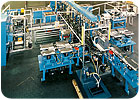 In 1960, a remarkable machine debuted on the shop floor of the Parker Pen Co. in Janesville, WI. It was a carousel-style multistation system to automatically assemble caps for pens. Built by Gilman Engineering & Manufacturing Co., a Parker subsidiary in Janesville, the cam-actuated machine assembled caps at a rate of 2,880 per hour.
Before the machine arrived, the caps were assembled manually. The 16-station machine replaced 23 assemblers working on two shifts, saving the company 65,512 man-hours per year. Moreover, the machine occupied 600 less square feet than the manual assembly line. At the time, the machine cost $80,000 and was expected to pay for itself in just 5 months.
Some 50 years later, much has changed and much has stayed the same. Both Parker and Gilman have been bought and sold several times. Parker, now owned by Newell Rubbermaid (Atlanta), assembles its pens in England. Gilman, still in Janesville, is now a subsidiary of Thyssen Krupp (Dusseldorf, Germany). Yet through it all, both companies have continued to make high-quality products.
Similarly, the technology for high-speed automatic assembly of small products has seemingly changed very little, and yet it, too, has changed quite dramatically.
Cam-actuated indexing systems-whether dials, carousels or walking beams-are still the foundation of many machines. Vibratory feeder bowls remain the primary method of singulating, orienting and delivering bulk parts. Pneumatic mechanisms are still used to transfer parts and assemblies in and out of the machine.
At the same time, however, high-speed automatic assembly systems have benefited significantly from advances in motion control, computers, software, sensors, machine vision and robotics.
Today’s automatic assembly systems “offer a level of performance and control that could only be dreamed about 50 years ago,” says Flavy Miller, an electronics technician and machine assembler with 27 years of experience at Automation Tool Co. (Cookeville, TN). “Today, we can offer companies more automation at value levels that are not even comparable to the past. This has reduced debug times and speed to market. We recently shipped equipment valued at more than $2 million in less than 16 weeks. This would have been impossible years ago.”
Two articles in ASSEMBLY-written by engineers from Honeywell International Inc. (Morristown, NJ), but published 36 years apart-point out the differences between assembly systems of the past and those of today.
In June 1961, Honeywell process engineer R.S. Mueller described his company’s new machine for automatically assembling relays for industrial air-conditioners: a cam-actuated rotary indexing dial built by Bodine Assembly & Test Systems (Bridgeport, CT).
Freshly stamped terminals were manually fed into a track. At the first station, a terminal was transferred from the track to the dial with a simple pick-and-place device. At the next station, a sensor determined if the terminal had, in fact, been transferred. At the next two stations, a silver contact was resistance-welded to the stamping, and the assembly was inspected again. Successive stations tapped the part, inserted screws and ejected the finished assembly.
Running at 40 cycles per minute, the machine produced 10,000 to 12,000 parts per shift. Thanks to automation, the cost of manufacturing the relay decreased from $38.10 per 1,000 units to just $5.10 per 1,000 units.
Flash forward to March 1997, when automation engineers Kevin Mangle, Gerald Richard and Wayne Desrude described their system, designed and built in-house, for automatically assembling household thermostats. The asynchronous system consisted of several independent assembly stations linked by a pallet-transfer conveyor. Vision-guided SCARA robots picked and placed parts fed from flexible, conveyor-based feeders. Soldering and resistance welding operations were done automatically.
Thanks to the automation system, the number of manual operations needed to assemble the thermostats decreased from 19 to six. The system could assemble 600 to 750 thermostats per hour, and paid for itself in 2 years. In its first year of operation, the system saved Honeywell $500,000 in production costs.
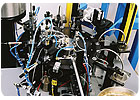
Electronic controls have made assembly machines much more flexible than they were in the past. Fifty years ago, adding or eliminating an insertion station from the system was virtually impossible. Even a simple change, such as adjusting how far a pick-and-place unit traveled, was difficult. Today, either operation is easily accomplished.
Besides better machine control, electronics have given engineers unprecedented ability to monitor and document the assembly process. Today, assembly machines are festooned with sensors to measure force, displacement, torque, and the absence or presence of parts. Vision systems measure part dimensions and orientation. And, testing of functional requirements, such as leak rates, is typically done in-line.
“Adding value to suspect parts is largely a thing of the past,” notes Gene Bressler, vice president of Automation Tool Co.
The availability of prepackaged machine components has greatly simplified the process of designing and building assembly systems. “In the past, you had to design and build your own linear actuators. You bought the linear bearing, air cylinder, stops and shock absorbers and put it all together. These days, you can buy it as a single unit,” says O’Hara. “If you wanted a servo system, you bought a ballscrew, slide, motor and coupler. Today, you just call somebody and get it all together, including the control system and the software. It’s ready to use right out of the box.”
In spite of all the technological advances, assembly machines are not more expensive than they used to be, if inflation is taken into account. A machine sold 50 years ago was actually more expensive than a comparable machine today. According to an article in the April 1964 issue of ASSEMBLY, a multistation assembly machine cost an average of $100,000. To put that in perspective, the average price of a new home in 1964 was $13,050, while the average price of a new car was $3,500.
Back then, the machine itself represented approximately 35 percent of the cost of the system. The process of designing and building the machine accounted for 40 percent of the cost, while debugging made up the final 25 percent. Today, those percentages aren’t that much different. Hardware might account for a larger portion, but debugging would be less.
The business of building assembly machines has also evolved. There are fewer systems integrators today than there were 50 years ago, and fewer customers for them to pursue. Despite the cost and quality benefits of automation, many U.S. companies have opted to assemble their products in China and other low-cost labor markets.
“It’s always been a competitive industry, and it’s always been an extremely difficult industry. Not much has changed there,” says O’Hara. “What has changed is the nature of our customers. Increasingly, we are building machines for manufacturers that supply multiple customers. The same company might be making parts for Delphi, Visteon, Honda and Toyota, so our equipment has to be much more flexible than it used to be.”
In the future, says Bressler, integrators and their customers will work more closely together, collaborating on product designs and sharing the responsibility for assembly system design.
“Customer expectations have grown,” adds Bressler. “The need for a project to be successful is more critical than ever.”
The automotive industry will continue to be the bread and butter of machine builders for the foreseeable future, but other industries will grow in importance. “The medical device industry will be important,” says O’Hara. “We’re only just starting to scratch the surface of how much business can be done on the medical side. Emerging markets, such as manufacturers of alternative energy sources, will be important, too.”
Before the machine arrived, the caps were assembled manually. The 16-station machine replaced 23 assemblers working on two shifts, saving the company 65,512 man-hours per year. Moreover, the machine occupied 600 less square feet than the manual assembly line. At the time, the machine cost $80,000 and was expected to pay for itself in just 5 months.
Some 50 years later, much has changed and much has stayed the same. Both Parker and Gilman have been bought and sold several times. Parker, now owned by Newell Rubbermaid (Atlanta), assembles its pens in England. Gilman, still in Janesville, is now a subsidiary of Thyssen Krupp (Dusseldorf, Germany). Yet through it all, both companies have continued to make high-quality products.
Similarly, the technology for high-speed automatic assembly of small products has seemingly changed very little, and yet it, too, has changed quite dramatically.
Cam-actuated indexing systems-whether dials, carousels or walking beams-are still the foundation of many machines. Vibratory feeder bowls remain the primary method of singulating, orienting and delivering bulk parts. Pneumatic mechanisms are still used to transfer parts and assemblies in and out of the machine.
At the same time, however, high-speed automatic assembly systems have benefited significantly from advances in motion control, computers, software, sensors, machine vision and robotics.
Today’s automatic assembly systems “offer a level of performance and control that could only be dreamed about 50 years ago,” says Flavy Miller, an electronics technician and machine assembler with 27 years of experience at Automation Tool Co. (Cookeville, TN). “Today, we can offer companies more automation at value levels that are not even comparable to the past. This has reduced debug times and speed to market. We recently shipped equipment valued at more than $2 million in less than 16 weeks. This would have been impossible years ago.”
Two articles in ASSEMBLY-written by engineers from Honeywell International Inc. (Morristown, NJ), but published 36 years apart-point out the differences between assembly systems of the past and those of today.
In June 1961, Honeywell process engineer R.S. Mueller described his company’s new machine for automatically assembling relays for industrial air-conditioners: a cam-actuated rotary indexing dial built by Bodine Assembly & Test Systems (Bridgeport, CT).
Freshly stamped terminals were manually fed into a track. At the first station, a terminal was transferred from the track to the dial with a simple pick-and-place device. At the next station, a sensor determined if the terminal had, in fact, been transferred. At the next two stations, a silver contact was resistance-welded to the stamping, and the assembly was inspected again. Successive stations tapped the part, inserted screws and ejected the finished assembly.
Running at 40 cycles per minute, the machine produced 10,000 to 12,000 parts per shift. Thanks to automation, the cost of manufacturing the relay decreased from $38.10 per 1,000 units to just $5.10 per 1,000 units.
Flash forward to March 1997, when automation engineers Kevin Mangle, Gerald Richard and Wayne Desrude described their system, designed and built in-house, for automatically assembling household thermostats. The asynchronous system consisted of several independent assembly stations linked by a pallet-transfer conveyor. Vision-guided SCARA robots picked and placed parts fed from flexible, conveyor-based feeders. Soldering and resistance welding operations were done automatically.
Thanks to the automation system, the number of manual operations needed to assemble the thermostats decreased from 19 to six. The system could assemble 600 to 750 thermostats per hour, and paid for itself in 2 years. In its first year of operation, the system saved Honeywell $500,000 in production costs.
Better Control
Looking back, experts agree that the biggest difference between today’s assembly machines and those from 50 years ago lies in their control systems. “Without doubt, the availability of cheap and simple-to-use electronic controls is the single biggest change in assembly systems since even 15 years ago,” says John O’Hara, director of sales and marketing at Cox Automation Systems (Bloomingdale, IL). “Generally, older machines were cam-driven. A single motor turned a shaft, and all the motions of the machine came from that. All the timing was derived from gears, belts, linkages and cams. Electronic controls, even for a slow-speed machine, did not exist or were very simple and crude.”Electronic controls have made assembly machines much more flexible than they were in the past. Fifty years ago, adding or eliminating an insertion station from the system was virtually impossible. Even a simple change, such as adjusting how far a pick-and-place unit traveled, was difficult. Today, either operation is easily accomplished.
Besides better machine control, electronics have given engineers unprecedented ability to monitor and document the assembly process. Today, assembly machines are festooned with sensors to measure force, displacement, torque, and the absence or presence of parts. Vision systems measure part dimensions and orientation. And, testing of functional requirements, such as leak rates, is typically done in-line.
“Adding value to suspect parts is largely a thing of the past,” notes Gene Bressler, vice president of Automation Tool Co.
The availability of prepackaged machine components has greatly simplified the process of designing and building assembly systems. “In the past, you had to design and build your own linear actuators. You bought the linear bearing, air cylinder, stops and shock absorbers and put it all together. These days, you can buy it as a single unit,” says O’Hara. “If you wanted a servo system, you bought a ballscrew, slide, motor and coupler. Today, you just call somebody and get it all together, including the control system and the software. It’s ready to use right out of the box.”
In spite of all the technological advances, assembly machines are not more expensive than they used to be, if inflation is taken into account. A machine sold 50 years ago was actually more expensive than a comparable machine today. According to an article in the April 1964 issue of ASSEMBLY, a multistation assembly machine cost an average of $100,000. To put that in perspective, the average price of a new home in 1964 was $13,050, while the average price of a new car was $3,500.
Back then, the machine itself represented approximately 35 percent of the cost of the system. The process of designing and building the machine accounted for 40 percent of the cost, while debugging made up the final 25 percent. Today, those percentages aren’t that much different. Hardware might account for a larger portion, but debugging would be less.
Changing Practices
Just as high-speed automation systems have changed with the times, so too have the products assembled on those systems. The electronic content of small assemblies has increased considerably. “Not so long ago, products were a lot simpler in design,” says O’Hara. “Medical products, for example, are a lot more sophisticated than they used to be. Electronics are even being built into single-use, disposable products.”The business of building assembly machines has also evolved. There are fewer systems integrators today than there were 50 years ago, and fewer customers for them to pursue. Despite the cost and quality benefits of automation, many U.S. companies have opted to assemble their products in China and other low-cost labor markets.
“It’s always been a competitive industry, and it’s always been an extremely difficult industry. Not much has changed there,” says O’Hara. “What has changed is the nature of our customers. Increasingly, we are building machines for manufacturers that supply multiple customers. The same company might be making parts for Delphi, Visteon, Honda and Toyota, so our equipment has to be much more flexible than it used to be.”
In the future, says Bressler, integrators and their customers will work more closely together, collaborating on product designs and sharing the responsibility for assembly system design.
“Customer expectations have grown,” adds Bressler. “The need for a project to be successful is more critical than ever.”
The automotive industry will continue to be the bread and butter of machine builders for the foreseeable future, but other industries will grow in importance. “The medical device industry will be important,” says O’Hara. “We’re only just starting to scratch the surface of how much business can be done on the medical side. Emerging markets, such as manufacturers of alternative energy sources, will be important, too.”
Looking for a reprint of this article?
From high-res PDFs to custom plaques, order your copy today!