Adhesives for Motor Assembly
Light-cure adhesives help motor manufacturers improve performance and lower production costs.
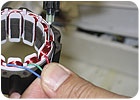
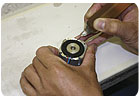
A bead of acrylic adhesive is dispensed onto the interface between the stator and housing. The assembly is then placed on a conveyor where it's exposed to light for 30 seconds. After it exits the conveyor, the assembly is fully cured and ready to be handled.
To remain competitive in this environment, motor manufacturers have to get lean. Lean manufacturing focuses on eliminating waste. To accomplish that, design and manufacturing teams must work closely together to improve their products and processes. Critical focus areas include decreasing time to manufacture, reducing batch size, achieving continuous flow, and upholding high quality standards.
Adhesives and sealants are helping motor manufacturers meet these goals. Adhesives have been used to enhance performance, reduce costs, increase quality, and improve the manufacturability of electric motors and generators for more than 40 years. Anaerobic adhesives are used to attach bearings to housings, bond commutators to shafts, and secure threaded fasteners against loosening from vibration. Cyanoacry-lates bond brush holders and lead wires. Epoxies encapsulate circuit boards, seal connectors and bond magnets. Hot-melts bond insulation to the stator, rotor and wires. Silicones seal conduit boxes and end plates.
In particular, light-cure adhesives have dramatically changed the way motor makers assemble their products. Light-cure adhesives are used to attach brackets to the stator and housing; insulate the stator, rotor and wires; unitize lamination stacks; bond lead wires to the stator or armature; and join the stator to the housing or mounting frame.
Light-cure adhesives cure on demand, eliminating the trade-off between open time and cure speed. All but the fastest light-cure adhesives will be unaffected by ambient light for hours, providing an almost unlimited amount of time for adjusting parts. Upon exposure to light of the correct intensity and spectral output, the photoinitiator in the adhesive starts the curing process, rapidly yielding a cured polymer. While cure times depend on many factors, 10 to 30 seconds of exposure typically achieves full cure to depths in excess of 0.5 inch. Light-cure adhesives are available with physical properties ranging from rigid, glass-like materials to soft, flexible elastomers.
Acrylic adhesives are the most common type of light-curing adhesive, but four other chemistries can be cured with light as well: anaerobics, cyanoacrylates, epoxies and silicones. Significant work has been done on these chemistries in the past 5 years, and they may offer improved performance compared with light-cure acrylics in many motor applications.
Light-cure adhesives are ideal for lean manufacturing. Their long open time makes them easy to handle. This minimizes storage costs, line maintenance and waste. Because they achieve full cure in seconds, there’s almost no work in process, allowing for immediate quality inspections. And, because the adhesive is applied as a liquid, one adhesive can be used on many different motor designs and sizes. This permits fast line changeovers and saves inventory costs, compared with mechanical alternatives, such as gaskets that must be custom-made for each design.
The primary limitation of light-cure adhesives is that light must reach the full bond line. This may limit their use in motors when bonding opaque substrates, such as two metal parts. However, many manufacturers have learned that by light-curing the excess adhesive around the joint (also called the “fillet”), they can rapidly fixture the part. This allows the part to be handled while the adhesive cures between the opaque substrates via a secondary mechanism.
Another consideration when selecting a light-cure adhesive is that equipment is required to cure the adhesive. Light-curing adhesives require specific radiant energy for polymerization to occur. Therefore, it is critical that engineers match the adhesive with the appropriate light source. Adhesive manufacturers can recommend the appropriate system. Low-intensity systems typically cost $800 to $1,000, while high-intensity, custom systems can cost tens of thousands of dollars.
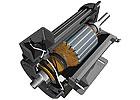
Lin Engineering uses a light-cure acrylic adhesive to seal the hole in the motor housing for the lead wires. This prevents dirt and moisture from damaging the assembly.
Stepper Motors
Stepper motors are used for a variety of high-precision applications-to run medical equipment, drive industrial robots, and control surveillance cameras, just to name a few. These compact motors provide high step accuracy, high resolution and smooth motion. Due to their broad range of application, they are often customized. Components that are commonly customized include winding patterns, shaft configurations, housings and bearings.Their small size and high degree of customization makes the design and manufacture of stepper motors challenging. To allow for customization and still offer short lead times, manufacturers of stepper motors need processes that enable them to rapidly assemble small batches of motors. One such manufacturer, Lin Engineering, uses light-cure acrylic adhesives to achieve that goal.
Wire tacking and strain relief: The connection between the lead wires and the stator must be reliable. The lead wires normally pass outside the motor through the housing. If the lead wires are not adequately secured, they can be exposed to sharp pull forces or vibration that can degrade the solder connections. In addition, irregularities in the solder joint, such as solder balls or sharp peaks, can cause shorts if the wires are free to move in the motor.
Various methods, such as adhesive tacking, grommets or specialty clamps, can be used to prevent lead wire failures. The size of a grommet or clamp may require that a larger frame housing be used for a given motor, which is undesirable. In addition, assembly of the grommet or clamp can be a tedious process that delays production. Grommets and clamps also add cost.
Lin Engineering determined that tacking the lead wires in place with a light-curing acrylic adhesive was the optimum method based on performance and manufacturability. To accomplish this, the operator manually dispenses a bead of Loctite 352 over the wire connections using a handheld syringe. The viscosity of the adhesive makes dispensing quick and easy. Because the adhesive can be dispensed in any pattern, the same process can also be used for all motor sizes and configurations.
After the adhesive is dispensed, the motor assembly is placed on a conveyor where a 30-second exposure to light fully cures the adhesive. After curing, the lead wires are fully reinforced and immediately ready for handling.
Bonding stator to housing: When Lin Engineering encapsulated the stator in plastic, engineers originally envisioned that the motor could be mounted via bolt holes in the encapsulant. However, the wide range of mounting configurations requested by customers made it impossible to standardize on a mounting configuration that met everyone’s needs. To increase the motor’s relative degree of customization, Lin Engineering began bonding the molded stators into custom housings using Loctite 3942 light-cure acrylic adhesive. The custom housings were often machined from aluminum to meet a manufacturer’s current mounting configuration.
To bond the housing to the motor, the motor is manually inserted into the housing. A bead of Loctite 3942 is then dispensed onto the interface between the stator and housing. The mated assembly is then placed on a conveyor where it’s exposed to light for 30 seconds. After it exits the conveyor, the assembly is fully cured and ready to be handled.
By applying the adhesive to the stator-housing interface, Lin Engineering is able to provide its customers any mounting configuration they require. The ability to customize the mounting bracket is a major benefit and often significantly reduces assembly time for the customer. For example, some motors are configured with a bayonet-style mounting bracket that allows for manual assembly of the motor in a blind location in a robotic device.
Applying the adhesive to the stator-housing interface also structurally reinforces the motor, allowing for a reduction in the overall thickness of the motor body.
Sealing wires in housing: Lead wires typically pass through an opening in the motor housing that creates a leak path between the motor’s service environment and the interior of the motor. This leak path must be sealed to prevent contaminants, such as dirt and moisture, from damaging the motor. Dirt can bind bearings or abrade wires. Moisture and fluids can rust the bearings or cause shorts.
Sealing these wire connections is a common challenge among motor manufacturers. Various methods can be used to seal the connections, but the two most common are heat-shrink seals and potting with adhesives. Lin Engineering evaluated both methods.
Heat-shrink seals did not seal effectively. Lin’s stepper motors typically have four to eight lead wires. Although the heat-shrink seals fit snuggly around the outside of the wires, they did not adequately seal between the wires.
As for potting, Lin found that the rheology of the adhesive was critical to successful sealing. In this motor design, the lead wires passed directly through the housing. As a result, there was no cavity that could simply be potted using a low-viscosity adhesive. Thus, the material had to be thin enough to create a seal but not so thin that it ran into the motor and contaminated the interior. The adhesive had to flow around the lead wires to create a complete seal.
Lin Engineering conducted extensive tests on other adhesives commonly used for potting, such as epoxies, polyurethanes and silicones. However, engineers found these chemistries were harder to handle and did not cure as fast as light-cure acrylics, resulting in lower productivity and higher work-in-process.
Loctite 352 light-cure acrylic adhesive fit the bill. With a viscosity of 20,000 centipoise, the adhesive was just right to seal the opening without contaminating the interior of the motor.
Looking for a reprint of this article?
From high-res PDFs to custom plaques, order your copy today!