Robot Safety Comes of Age
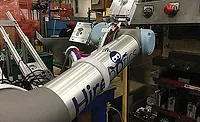
The robotics industry has been developing new technology that will allow humans to work in close proximity to robots without the risk of getting hurt.
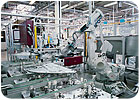
Robots have traditionally been confined to enclosed workcells to keep humans out of harms way. But, even with precautions, accidents can happen.
For instance, in November 2006, a worker was killed when a robot accidentally pulled him into some machinery. The 46-year-old man was performing routine maintenance at an auto parts manufacturer near Grand Rapids, MI, when the accident occurred.
Some day, such incidents may be impossible, thanks to advanced motors, drives, sensors, software and microprocessor technology. The robotics industry has been developing systems that will allow people to work in close proximity to robots without the risk of getting hurt. By eliminating safety fences, safety mats, light curtains, cages and other safeguards, manufacturers will also be able to reduce overall floor space and improve productivity.
In the future, humans will work side by side on assembly lines with versatile, adaptable robots that perceive the geometry, location, color, features, and movements of items and people in their vicinity. Robots will have an intrinsic ability to adjust for variations in parts, environment and other conditions, rather than relying on fixed automation and costly infrastructure.
“Automakers have been pushing for this technology,” says Sal Spada, research director for discrete automation at ARC Advisory Group Inc. (Dedham, MA). “They see a tremendous productivity gain in workcells where an operator can be within the work envelope to perform setup, changeover and some maintenance operations while the machine remains under control.” Spada also believes the aerospace industry will be eager to implement safe robots on their future assembly lines, because there’s a major initiative underway to automate processes such as airframe fabrication.
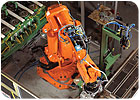
Those types of products allow operators to work in close proximity to machines while performing routine tasks, such as loading parts or maintaining equipment. Traditionally, those functions could only be performed if power was completely removed from the drives.
“In the past, the only safe way to have a human operator interact with a robot was to ‘park’ the robot with drive power off,” explains Michael Gerstenberger, senior engineer at KUKA Robotics Corp. (Clinton Township, MI). “With the new safe technologies, several applications support direct human interaction with the robot.
“For example, it is now possible to park the robot at a load-unload station, leaving drive power on with the assurance that the robot will not move-even if there is a programming error or a malfunction in the robot controller,” adds Gerstenberger. “Safe motion in this application is used to ensure that the robot stands still reliably.”
Traditionally, safeguarding is applied around the restricted envelope of a robot or the potential area where the robot could reach. “With safe motion, the safeguarding can be applied to the operating envelope, which is where the robot is actually programmed to go,” says Chris Anderson, thermal technology leader at Motoman Inc. (West Carrollton, OH). “The use of safe motion opens up the application of cooperative motion with human intervention. The robot may be using its servo control to lift a heavy object and, at the same time, responding to a human operator’s pulling or pushing motion to guide it into position.”
In addition to machine tools and robots, safe motion technology applies to conveyors, material handling devices and packaging equipment. However, a new industry standard has been developed specifically for robots: ANSI/RIA/ISO 10218-1-2007, which only applies to robot manufacturers.
“The provisions in this standard will enable American manufacturers to adopt next-generation robots,” says Jeff Fryman, director of standards development at the Robotic Industries Association (RIA, Ann Arbor, MI). “Guarding will be improved by the ability to more closely control the restricted space. Not only will safety be enhanced by these new robots, but so will support of lean manufacturing techniques.”
A companion standard, ISO 10218-2, is currently being developed. It will apply to systems integrators and end users. According to Fryman, RIA’s R16.06 safety committee is closely monitoring the standard and is making inputs to the lengthy review process. However, he says 10218-2 won’t take effect until some time next year at the earliest.
In addition, engineers at the National Institute of Standards and Technology (Gaithersburg, MD) are currently working on a next-generation robot safety project that is expected to be completed by 2011. The goal is to develop “a machine that will incorporate inherent safety design and benign operating features in order to facilitate and promote lean manufacturing.”
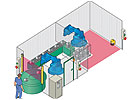
“This approach to robots should greatly improve productivity, as robots can continue their task as parts are presented or ancillary equipment is maintained,” says Brian McMorris, robotics industry manager at SICK Inc. (Minneapolis). “Any manufacturer with semirepetitive assembly processes can benefit from collaborative robots. Not only does the concept of dynamic workspace improve productivity of robots and humans working together, but the elimination of hard-guarded spaces on the factory floor will lower the fixed cost of implementing robots, lowering the point of payback.”
According to McMorris, there are several strategies for limiting robot motion. “They all depend on knowing the position of the robot arm and its tooling in 3D space at all times, and providing a means for slowing or stopping the robot arm before it becomes a hazard,” he explains. “It is an especially challenging engineering feat when the object to be avoided, such as a human, is also dynamic in time and space.”
Redundancy is key in any safe motion system. Current technology uses standard robot position feedback devices, but monitors them with multiple microprocessors. The microprocessors check each other’s results to ensure that they both agree on the robot position.
“They also control safe I/O signals in such a way that if one of the microprocessors malfunctions, the robot is commanded to stop and drive power is switched off,” says Gerstenberger. “Some hand-guiding applications make use of advanced force-torque sensors to detect the operator’s intent while guiding the robot.”
Robot manufacturers define the concept of “safe motion” differently. For example, FANUC Robotics America Inc. (Rochester Hills, MI) does not use the term. “We prefer terms like ‘safety-rated robot software’ to help describe this technology,” says Claude Dinsmoor, general manager of controller product development.
“Safety-rated robot software is software that has been designed and tested in accordance with accepted standards, such as ISO 13849, that define the operation and reliability of the software with respect to failures that may cause a dangerous condition,” explains Dinsmoor. “Using software that is constructed in such a way allows the robot (or robot controller) to monitor the motion of the robot, and is designed to prevent unusual or dangerous events from occurring. ‘Unusual’ events include unexpected motion of the robot that could occur following a single failure or common mode failure caused by misprogramming, misoperation or a failure of hardware.”
In addition to software, advanced sensors and microprocessor technology play a key role in safe motion systems. “First and foremost, the system must not have any single-point failure modes that lead to unsafe conditions,” claims Jerry Hendrickson, engineering program manager at Adept Technology Inc. (Livermore, CA). “To achieve this, several factors need to be handled [such as] redundant hardware for robot trajectory checking via a secondary processor running a trajectory generator; redundant shaft output encoders with secondary connections; and a watchdog safety circuit to monitor the health of the robot, controls, communications and I/O.”
Advanced vision and sensors may allow for localized detection of objects or events within the work envelope. Advances in processor time and communication speed also allow for better robot safety.
However, before safe motion technology is widely accepted in the robotics industry, several hurdles need to be addressed. “While ‘safe motion’ is somewhat defined, how it is to be safeguarded has yet to be addressed in safety standards,” notes Anderson. “Robots have had a reliable record of going where they are programmed, and problems occur when humans get in the way.
“Barrier guarding around the robot cell not only keeps the robot inside; more importantly, it also keeps personnel out,” adds Anderson. “Barriers will remain one of the most cost-effective safeguards.”
Another hurdle is industry acceptance. For example, plant safety personnel and regulatory groups, such as the Occupational Safety and Health Administration (OSHA), may be less likely to approve of a robot installation that looks dangerous, even though safeguards may be in place that would stop motion if a hazard is detected.
Some observers, such as RIA’s Fryman, believe the full benefits of robotic safe motion technology are still 5 to 10 years away. “I think it’s still a ways off,” he points out. “It will probably require a lengthy paradigm shift, do don’t go knocking down all those safety fences.” A
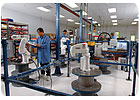
Robots have traditionally been confined to enclosed workcells to keep humans out of harms way. But, even with precautions, accidents can happen.
For instance, in November 2006, a worker was killed when a robot accidentally pulled him into some machinery. The 46-year-old man was performing routine maintenance at an auto parts manufacturer near Grand Rapids, MI, when the accident occurred.
Some day, such incidents may be impossible, thanks to advanced motors, drives, sensors, software and microprocessor technology. The robotics industry has been developing systems that will allow people to work in close proximity to robots without the risk of getting hurt. By eliminating safety fences, safety mats, light curtains, cages and other safeguards, manufacturers will also be able to reduce overall floor space and improve productivity.
In the future, humans will work side by side on assembly lines with versatile, adaptable robots that perceive the geometry, location, color, features, and movements of items and people in their vicinity. Robots will have an intrinsic ability to adjust for variations in parts, environment and other conditions, rather than relying on fixed automation and costly infrastructure.
“Automakers have been pushing for this technology,” says Sal Spada, research director for discrete automation at ARC Advisory Group Inc. (Dedham, MA). “They see a tremendous productivity gain in workcells where an operator can be within the work envelope to perform setup, changeover and some maintenance operations while the machine remains under control.” Spada also believes the aerospace industry will be eager to implement safe robots on their future assembly lines, because there’s a major initiative underway to automate processes such as airframe fabrication.
Robots have traditionally been confined to enclosed workcells to keep humans out of harms way.
Safe Motion
“Safe motion” is a concept that has been around for several years. It traces its origins to the European machine tool industry, with most of the activity based in Germany. Companies such as Bosch Rexroth AG (Lohr, Germany), Lenze AG (Aerzen, Germany) and Siemens AG (Munich, Germany) have developed a variety of drive systems, controllers and motion actuation devices that improve safety.Those types of products allow operators to work in close proximity to machines while performing routine tasks, such as loading parts or maintaining equipment. Traditionally, those functions could only be performed if power was completely removed from the drives.
“In the past, the only safe way to have a human operator interact with a robot was to ‘park’ the robot with drive power off,” explains Michael Gerstenberger, senior engineer at KUKA Robotics Corp. (Clinton Township, MI). “With the new safe technologies, several applications support direct human interaction with the robot.
“For example, it is now possible to park the robot at a load-unload station, leaving drive power on with the assurance that the robot will not move-even if there is a programming error or a malfunction in the robot controller,” adds Gerstenberger. “Safe motion in this application is used to ensure that the robot stands still reliably.”
Traditionally, safeguarding is applied around the restricted envelope of a robot or the potential area where the robot could reach. “With safe motion, the safeguarding can be applied to the operating envelope, which is where the robot is actually programmed to go,” says Chris Anderson, thermal technology leader at Motoman Inc. (West Carrollton, OH). “The use of safe motion opens up the application of cooperative motion with human intervention. The robot may be using its servo control to lift a heavy object and, at the same time, responding to a human operator’s pulling or pushing motion to guide it into position.”
In addition to machine tools and robots, safe motion technology applies to conveyors, material handling devices and packaging equipment. However, a new industry standard has been developed specifically for robots: ANSI/RIA/ISO 10218-1-2007, which only applies to robot manufacturers.
“The provisions in this standard will enable American manufacturers to adopt next-generation robots,” says Jeff Fryman, director of standards development at the Robotic Industries Association (RIA, Ann Arbor, MI). “Guarding will be improved by the ability to more closely control the restricted space. Not only will safety be enhanced by these new robots, but so will support of lean manufacturing techniques.”
A companion standard, ISO 10218-2, is currently being developed. It will apply to systems integrators and end users. According to Fryman, RIA’s R16.06 safety committee is closely monitoring the standard and is making inputs to the lengthy review process. However, he says 10218-2 won’t take effect until some time next year at the earliest.
In addition, engineers at the National Institute of Standards and Technology (Gaithersburg, MD) are currently working on a next-generation robot safety project that is expected to be completed by 2011. The goal is to develop “a machine that will incorporate inherent safety design and benign operating features in order to facilitate and promote lean manufacturing.”
By eliminating safety fences, safety mats, light curtains, cages and other safeguards, manufacturers will be able to reduce overall floor space and improve productivity.
Robotic Restrictions
Limiting robot motion in a safe manner allows robots and humans to work closely together. The term being adopted for this activity is “collaborative robots,” which is defined in the new 10218-1 standard as “robots designed for direct interaction with a human within a defined shared workspace.”“This approach to robots should greatly improve productivity, as robots can continue their task as parts are presented or ancillary equipment is maintained,” says Brian McMorris, robotics industry manager at SICK Inc. (Minneapolis). “Any manufacturer with semirepetitive assembly processes can benefit from collaborative robots. Not only does the concept of dynamic workspace improve productivity of robots and humans working together, but the elimination of hard-guarded spaces on the factory floor will lower the fixed cost of implementing robots, lowering the point of payback.”
According to McMorris, there are several strategies for limiting robot motion. “They all depend on knowing the position of the robot arm and its tooling in 3D space at all times, and providing a means for slowing or stopping the robot arm before it becomes a hazard,” he explains. “It is an especially challenging engineering feat when the object to be avoided, such as a human, is also dynamic in time and space.”
Redundancy is key in any safe motion system. Current technology uses standard robot position feedback devices, but monitors them with multiple microprocessors. The microprocessors check each other’s results to ensure that they both agree on the robot position.
“They also control safe I/O signals in such a way that if one of the microprocessors malfunctions, the robot is commanded to stop and drive power is switched off,” says Gerstenberger. “Some hand-guiding applications make use of advanced force-torque sensors to detect the operator’s intent while guiding the robot.”
Robot manufacturers define the concept of “safe motion” differently. For example, FANUC Robotics America Inc. (Rochester Hills, MI) does not use the term. “We prefer terms like ‘safety-rated robot software’ to help describe this technology,” says Claude Dinsmoor, general manager of controller product development.
“Safety-rated robot software is software that has been designed and tested in accordance with accepted standards, such as ISO 13849, that define the operation and reliability of the software with respect to failures that may cause a dangerous condition,” explains Dinsmoor. “Using software that is constructed in such a way allows the robot (or robot controller) to monitor the motion of the robot, and is designed to prevent unusual or dangerous events from occurring. ‘Unusual’ events include unexpected motion of the robot that could occur following a single failure or common mode failure caused by misprogramming, misoperation or a failure of hardware.”
In addition to software, advanced sensors and microprocessor technology play a key role in safe motion systems. “First and foremost, the system must not have any single-point failure modes that lead to unsafe conditions,” claims Jerry Hendrickson, engineering program manager at Adept Technology Inc. (Livermore, CA). “To achieve this, several factors need to be handled [such as] redundant hardware for robot trajectory checking via a secondary processor running a trajectory generator; redundant shaft output encoders with secondary connections; and a watchdog safety circuit to monitor the health of the robot, controls, communications and I/O.”
Advanced vision and sensors may allow for localized detection of objects or events within the work envelope. Advances in processor time and communication speed also allow for better robot safety.
However, before safe motion technology is widely accepted in the robotics industry, several hurdles need to be addressed. “While ‘safe motion’ is somewhat defined, how it is to be safeguarded has yet to be addressed in safety standards,” notes Anderson. “Robots have had a reliable record of going where they are programmed, and problems occur when humans get in the way.
“Barrier guarding around the robot cell not only keeps the robot inside; more importantly, it also keeps personnel out,” adds Anderson. “Barriers will remain one of the most cost-effective safeguards.”
Another hurdle is industry acceptance. For example, plant safety personnel and regulatory groups, such as the Occupational Safety and Health Administration (OSHA), may be less likely to approve of a robot installation that looks dangerous, even though safeguards may be in place that would stop motion if a hazard is detected.
Some observers, such as RIA’s Fryman, believe the full benefits of robotic safe motion technology are still 5 to 10 years away. “I think it’s still a ways off,” he points out. “It will probably require a lengthy paradigm shift, do don’t go knocking down all those safety fences.” A
The robotics industry has been developing systems that will allow people to work in close proximity to robots without the risk of getting hurt.
Benefits of Safe Motion
There are three main benefits to applying safe motion technology to robotics:
- Increased safety. “The ability to provide safe limits on all the robot axes add a dimension of safety that was not possible before,” says Robin Schmidt, chief engineer at ABB Robotics Inc. (Auburn Hills, MI). The concept of “safe motion” can be described as additional monitoring and safety capabilities applied in an appropriate way to ensure that the motion that is happening with the robot is exactly as planned or commanded. The system will detect any deviation in either planned path or zone and stop the robot in a safe manner.
- Reduced cell footprint. Floor space savings come from having greater flexibility to create the restricted space in which a robot can operate before it is stopped or restricted by a safety device. “This was commonly done in the past with hard stops and safety-rated limit switches on the primary axis of the robot,” notes Schmidt. “This usually was not practical for the minor axis (wrist). With a safe motion system, all the axes can be restricted in a safe manner, saving real estate and being compliant with the guarding rules. The shape can be sculpted to match the required application.”
- Faster reset and restart times. It allows the robot system to be in a “no motion” mode without disabling the motors. When the operator is clear of the area and signals the start of the next phase of the process, the robot hardware is already turned on, saving restart time. “In other cases, where stopping time and distances are determined by robot speed, the speed can be ensured to be at a specific level,” says Schmidt. “If the person can be detected to be in a nearby area, the robot could continue to move at the safe reduced speed, thereby not stopping the process unless the person entered the zone where the robot must stop. The process could continue at a reduced rate in certain cases.”
Safe motion and next-generation robots will be discussed Oct. 6-9 during RIA's National Robot Safety Conference in Indianapolis. Click www.robotics.org for more details.
To learn more about safe motion robotics technology, search for these articles on ASSEMBLY’s Web site:
- How 'Safe Motion' Works.
- New Technical Report Addresses Robot Safety Standards.
- Robot Safety Challenges and Opportunities.
Looking for a reprint of this article?
From high-res PDFs to custom plaques, order your copy today!