Human-Robot Collaboration Comes of Age
A new generation of robots are redefining man-machine interaction and rewriting the way that automation can be used in manufacturing environments. Collaborative robots can perform a variety of repetitive assembly tasks—all while safely and intelligently working next to people without the need for traditional safety barriers.
Since robots first started appearing in factories 50 years ago, they have operated autonomously. But, recent safety standards and technological advancements have allowed engineers to implement friendly features that promise to improve productivity and increase the use of robots. While the technology is still being developed in research labs around the world, some devices are already being deployed in production environments.
One of the best-known collaborative robots is Baxter, which was unveiled two years ago by Rethink Robotics Inc. The easy-to-use interactive robot was designed to handle light payloads and operate alongside people. It features advanced force sensing technology, back-drivable motors, and a moderate velocity that combine to reduce the likelihood and impact of a collision.
“We see a collaborative robot as interacting with its human counterparts on the assembly line by being simple enough for non-engineers to train it by hand,” says Eric Foellmer, product marketing manager at Rethink Robotics. “Communicating its understanding of the task, illustrating where it’s going next, and other behaviors make [the robot] ‘just another worker on the line.’”
“In fact, we often use the term ‘interactive’ instead of ‘collaborative’ when describing Baxter, because the standard definition of the term ‘collaborative’ has become overly broad,” claims Foellmer.
"The term 'collaborative' is used to distinguish robots that collaborate with humans from robots that work behind fences without any direct interaction with humans," says Martin Naumann, group manager in the robot and assistive systems department at the Fraunhofer Institute for Manufacturing Engineering and Automation. "In contrast, articulated, cartesian, delta and SCARA robots distinguish different robot kinematics.
“ISO 8373 defines collaborative operation for robots and we use the term very much in the same way,” explains Naumann. “Here, ‘collaborative robot’ refers to industrial robots that are designed to work in direct cooperation with humans within a defined workspace.
Looking for quick answers on assembly and manufacturing topics? Try Ask ASM, our new smart AI search tool. Ask ASM
“Depending on the current work load, either a human is assembling small lot sizes of a specific product at a work place or a robot is additionally put into place to support the human,” adds Naumann, who is in charge of the European Union’s Lean Intelligent Assembly Automation (LIAA) project. “This workspace sharing is possible due to new safety design, use of novel safety technology and the development of innovative safety strategies.”
The four-year LIAA project started last September. It aims to keep assembly jobs in Europe by creating and implementing a framework that enables humans and robots to work together in assembly tasks. The consortium, which is lead by Fraunhofer, comprises leading European research institutes, automation component and robot suppliers, technology providers and end users.
“[Our] overall objective is to develop cost-effective, collaborative robot systems for assembly applications,” says Naumann. “Specific solutions will be developed for the design of safe collaborative work places, shop floor programming of the robot, and intuitive interaction of robot and worker. In the end, the resulting robot system should significantly increase the productivity of current manual assembly work places and relieve [people] of tedious, nonergonomic jobs.”
Collaborative Options
Collaborative robots come in several shapes and sizes, including humanoid, robotic arm and SCARA configurations.
Small, flexible humanoids such as Baxter feature two articulated arms (each capable of 5-pound payloads) equipped with grippers and a 5-by-9-inch LCD screen mounted on a mobile pedestal that houses controllers. It uses cameras and force, sonar and rangefinder sensors to locate and grasp objects.
Unlike traditional robots that require extensive software programming, Baxter can be trained quickly, just like a person. Assemblers interact with the robot directly to teach it to do a task. The screen displays a pair of expressive eyes that react to various interactions with humans.
“Baxter is the safest, easiest, most flexible and least costly robot of its kind today,” claims Foellmer. “The robot itself is the interface, with no teaching pendant or external control system required. Plus, Baxter is made in the USA, which is a particularly appealing aspect for many of our customers looking to reshore their production operations.”
A German company called pi4 Robotics has developed a similar product called Workerbot. “Its face—a unique communication interface that can be easily understood everywhere in the world—allows users with any cultural background to sense the robot’s current status at once and without the necessity to study its instruction manual first,” claims Matthias Krinke, managing director of pi4 Robotics. “This mobile device can quickly be brought to a new work place in a factory, like a stand-in worker.”
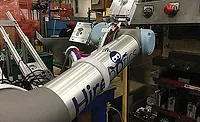
Robotic arms offer another cost-effective alternative. Universal Robots A/S developed its UR5 device to allow manufacturers to automate easily, inexpensively and flexibly. It features a six-axis robotic arm with a radius of 34 inches. The robot can handle payloads up to 11 pounds. A larger version called the UR10 can handle 22-pound payloads with a 51-inch reach.
“Our products are lighter weight, safer, easier to program and more energy-efficient than traditional robots,” claims Esben Ostergaard, chief technology officer at Universal Robots. “Advanced electronics and motor control technology makes it possible to reach a new level of safety.”
Some SCARA robots have also been deployed with collaborative features. For instance, the PF400 from Precise Automation doesn’t need any safety shielding. All forces generated are limited so that the lightweight robot cannot hurt humans, even if it collides with them at full speed.
“The [robot] is currently being employed in environments where automation could never go before, working side-by-side with human counterparts on an assembly line, on desktops of analytical labs and in clinical diagnostic environments,” says Brian Powell, vice president of sales and operations at Precise Automation.
Traditionally, robots have not been a cost-effective option for small manufacturers. However, the reshoring trend has contributed to the demand for lower cost, safer and more flexible automation technologies such as collaborative robots.
The machines have not been commercially available until now for several reasons. Part of it is technology-driven. Some key components, such as the series elastic actuators that Rethink Robotics’ engineers invented to help minimize Baxter’s force of contact, simply didn’t exist until recently.
“Computer processing power has improved over time, to the point that complex control algorithms can be executed much more quickly now, allowing safer, more responsive controls performance,” says Foellmer. “Plus, the price of certain components, such as sensors, is far lower today than it was even a few years ago, thanks to their widespread use in consumer electronics equipment.”
Safety First
Evolving safety standards are another reason why collaborative robots have come of age. Last year, the Robotic Industries Association (RIA) unveiled a new safety standard that addresses human-robot collaboration. The standard has been approved by the American National Standards Institute (ANSI).
According to ANSI/RIA R15.06-2012, robot collaboration with humans can be described in five types of applications: hand-over window; interface window; collaborative workspace; inspection; and hand-guided robot.
The standard specifies that a robot working in collaboration with a human needs to meet at least one of the following four criteria: safety-rated monitored stop; hand guiding; speed and separation monitoring; and power and force limiting.
“Certifiable safety is the most important precondition for a collaborative robot system to be applied to an industrial setting,” notes Fraunhofer’s Naumann. “Available solutions that fulfill the requirements imposed by safety standardization often show limited performance or productivity gains, as most of today’s implemented scenarios are often limited to very static processes.
“This means a strict stop and go of the robot process, when the human enters or leaves the work space,” Naumann points out. “Safety reliable 3D sensors are not yet available that allow for a dynamic switch over of human and robot operation, to have a real direct cooperation.”
According to Naumann, one of the priorities of the LIAA project is “to ensure the safety of humans in the human-robot collaboration scenario by keeping up an economic utilization of the robot process. This is done, on one hand, by considering risk assessments of the assembly systems already at the design stage, to optimize the use of the resources in the semiautomated process.
“On the other hand, adequate safety measures, like situation-dependent speed limits, are defined and supervised at the execution stage,” adds Naumann. “Then, the maximum possible speed and power of the robot system can remain active as long as possible in the collaborative operation."
To learn more about human-robot collaboration, click these ASSEMBLY Web Exclusive articles:
Looking for a reprint of this article?
From high-res PDFs to custom plaques, order your copy today!