AIA: Intake Manifold Assembly Benefits From Quality Control
Quality control cannot be overemphasized on today's automotive part assembly line. Providing parts tracking and traceability is not only a wise business move, it is often mandated by a customer.
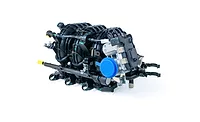
That was the case with Siemens VDO in Tilbury, ON, Canada, when it began assembling the intake manifold for a new Ford Duratec V6 engine that will be produced in Cleveland.
"Ford dictated that we record 100 percent of assembly and test data of the part, which enables us to perform full traceability in the event of a recall," says Ryan Chase, manufacturing engineer with Siemens. "If 100 percent part traceability is not accomplished, our line is basically down. It is critical to our assembly process," he adds.
Full traceability was accomplished through extraordinary teamwork between Siemens and three companies involved in the project-Innovative Automation Inc. (Barrie, ON, Canada), who completed the application integration; DVT Corp. (Norcross, GA), who provided machine vision components, and DVT distributor Rotalec Ontario (Brantford, ON, Canada).
This team had a unique design challenge. The team had to design an assembly and test unit-using machine vision for part tracking and traceability-for a part that didn't exist. (It was for a new car model.)
During the design process, the team had to deal with a moving target. Part specifications were constantly being revised to conform to changing needs for the new car, so the equipment had to be flexible enough to accommodate adjustments for revised requirements.
Another challenge was to read bar codes on moving parts without losing cycle time. If operators had to scan the parts, lost cycle time would be a given. Yet another challenge concerned the distance of the part from the bar code reader. Although the specifications called for the part to be no more than 6 inches away, one assembly station pushed the reader 20 inches away from the parts. At that distance, ambient light became a factor.
Looking for quick answers on assembly and manufacturing topics? Try Ask ASM, our new smart AI search tool. Ask ASM
Accounting for the movement of the inspection point added complexity to the vision integration. At some stations, the position of the parts could vary by up to 0.5 inch. In addition, part tolerances had to be accounted for, creating a complex situation.
The part is moving at any particular time, and the system had to be able to track it, lock in on it, read it and then feed that data to the programmable logic controller (PLC).
Beyond the inspection process was the challenge of building an assembly machine that met or exceeded all customer expectations.
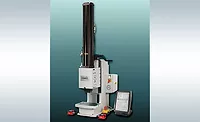
The design concept led to a final assembly process involving many components. After the part goes through the injection-molding process, a vibration welding machine and a hot insert machine, it goes to the five-station machine built by Innovative Automation for final assembly. The assembly system outputs 384 completed integrated air fuel modules per shift for three shifts, which equals 320,000 per year or a part every 50 seconds.
Dave Smith, regional manager for Rotalec, demonstrated DVT's vision system capabilities to Innovative Automation at the initial stages of the project. Innovative Automation integrated six SmartReaders at four of the five stations. With its interchangeable lenses and available lighting, the SmartReader had the flexibility to make quick changes to keep pace with numerous revisions in product specifications.
In the first assembly station, a six-digit serial number is engraved on the part with a pin stamp machine. At all subsequent stations, the serial number is read from the part using DVT's SmartReader. The SmartReader is a fully programmable, standalone CCD vision system with a CS-mount universal Cogaku lens and 12 configurable digital I/O. It has a resolution of 640 by 480 pixels. The SmartReader gathers data for date and lot code verification, documentation and part tracking. It also verifies the quality of the text marked by the pin stamper. The Ethernet-ready device contains an onboard processor, enabling it to monitor inspections without a PC.
The communications process was a crucial element in this project. Once the part is read at a station, data is transferred with a DVT Smart Link to a Siemens S7 PLC through Profibus. The PLC communicates with a PC running a tracking database using WinCC software. This ensures that the serial number is valid and that the part has passed the previous station and not already passed the current station. If these conditions are met, the operator is allowed to proceed with the next step in the assembly process.
Whenever work is done on a part, data is linked to the serial number on the part. This includes torque and leak test values. The exact torque value of a particular screw or set of screws can be logged and reviewed at a later time.
The part can run as many times as needed at a particular station until it secures approval, at which point it cannot run on that station again. At the last station, the part receives a final bar code number that is linked to the original engraved serial number. While this final bar code number may deteriorate, the initial engraved number is permanent. Part tracking and traceability can be accomplished by reading either number.
By working together from the project's inception, the companies met the challenges and produced excellent results. They combined their talents, innovation and flexibility to complete the installation on time and within budget.
Siemens also helped by modifying the part to eliminate a curve, making it easier for the SmartReader to read the serial number. In addition, the surface of the part that contained the number was made shiny. This helped SmartReader to acquire the correct image, making it look to the camera like black numbers on a white background.
With inspection and reader functions occurring simultaneously with part assembly, no cycle time was lost. With the SmartReader, the serial number is read, while the part is in motion during the assembly process.
At the station where the part was 20 inches away, the problem was resolved using a different lens and lighting technique. Again, the flexibility of the vision system made a difference.
Issues concerning position variance and part tolerances were successfully addressed with translational sensors.
The success of this application shows that teamwork is the best approach when it comes to meeting high standards of quality control.
For more information on machine vision, call 770-449-4960 or visit www.dvtsensors.com.
For more information on systems integration, call 705-733-0555 or visit www.innovativeautomation.com.
Looking for a reprint of this article?
From high-res PDFs to custom plaques, order your copy today!