Assembly Magazine logo
search
Ask ASSEMBLY AI
cart
facebook twitter linkedin youtube
  • Sign In
  • Create Account
  • Sign Out
  • My Account
Assembly Magazine logo
  • TRENDS
    • Ask ASSEMBLY AI
    • Trends
    • News
    • New Products
  • INDUSTRIES
    • Aerospace
    • Appliance
    • DFMA Assembly
    • Medical Devices
    • Green Manufacturing
    • Lean Manufacturing
    • Machinery Assembly
    • Electronics Assembly
    • Automotive
  • TECHNOLOGIES
    • Adhesives & Dispensing
    • Assembly Presses
    • Automated Assembly Systems
    • Manufacturing Management
    • Manufacturing Software
    • Motion Control
    • Screwdriving & Riveting
    • Robotics
    • Test & Inspection
    • Plastics & Metal Welding
    • Wire Processing
    • Workstations
  • AUTONOMOUS & ELECTRIC MOBILITY
    • AEM Magazine Archives
    • Autonomy
    • Electrification
    • Mobility Services
    • Assembly & Testing
    • AV/EM News
  • MEDIA
    • Ask ASSEMBLY AI
    • Podcasts
    • Assembly News Now
    • Assembly TV
    • Webinars
    • eBooks
  • EVENTS
    • Calendar
    • The ASSEMBLY Show
  • MORE
    • Exclusives >
      • Plant of the Year
      • Capital Spending
    • Buyers Guide >
      • Supplier Insights
    • Classifieds
    • Featured Products
    • Newsletters
    • Store
    • White Papers
    • Columns
    • Sponsor Insights
  • INFOCENTER
    • Assembly & Test Solutions
  • EMAGAZINE
    • eMagazine
    • Archive Issues
    • Advertise
    • Contact Us
    • Sign Up
Columns

X-Y-Z: Motor Performance Hinges on Location of Magnets
By John Sprovieri
December 1, 2006
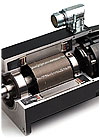
Flux focusing enables the motor to produce a high level of flux density from a low-energy magnet.


Permanent magnet synchronous servomotors are used in many types of industrial equipment, including machine tools, robots, injection molding machines, printing presses and packaging machines. These compact motors have a high air-gap flux density, high power density, high torque-to-inertia ratio and high torque capability.

Compared with induction servomotors, permanent magnet synchronous servomotors are more efficient, due to the absence of rotor losses and lower no-load current below the rated speed.

Compared with DC brush motors, permanent magnet synchronous servomotors are easier to keep cool. Because the permanent magnetic field is generated by the rotor instead of the stator, there is no current flow to generate heat in the rotor. Instead, heat is generated in the stator windings, which are close to the surface of the motor. In many applications, the motors are cooled simply through natural convection. In more demanding applications, an external blower will provide enough cooling. Because no internal ventilation is required, the motors can be built to meet high levels of environmental protection.

Permanent magnet synchronous servomotors are constructed in two main configurations: internal and external. In both, the windings are in the stator, while the rotor consists of permanent magnets and thin steel laminations clamped together to form a cylinder.

With an internal permanent magnet motor, the magnets are located inside the lamination stack. Because the lamination stack covers the magnets, these motors are also known as buried magnet motors. With the external permanent magnet synchronous servomotor, the magnets are bonded to the exterior of the lamination stack. Thus, the motors are known as surface-mount permanent magnet motors.

"Both designs are valid," says Kevin Liu, product specialist with Danaher Motion (Radford, VA). "Both have advantages and disadvantages."

A key advantage of the internal permanent magnet motor is the ability to focus the flux through the controller. "With an internal permanent magnet motor, you're able to channel the flux more directly," explains Liu. "With the surface-mount motor, the flux just goes across the air gap."

Looking for quick answers on assembly and manufacturing topics? Try Ask ASM, our new smart AI search tool. Ask ASM →

Flux focusing enables the motor to produce a high level of flux density from a low-energy-and therefore less expensive-magnet. "As far as performance goes, it's not a huge benefit, because there are other limitations," says Liu. "You can only channel the flux so much, and then you run into saturation of the materials and stator teeth. There is a point of diminishing return on increasing flux density."

Another advantage of the internal permanent magnet design is a phenomenon known as field-weakening. "That let's you misalign the commutation angle," says Liu. "You can really offset it, so that you're applying some of the coil flux in the opposite direction to the permanent magnet. That lets you get a little more speed out of the motor. As long as the controller can support that, it's not uncommon for the motor to achieve operational speeds that are beyond the base speed or no-load speed."

Surface-mount permanent magnet motors can achieve comparable performance to internal permanent magnet motors. However, their biggest advantage is that they don't need complicated control schemes and firmware for the drive. These motors can often be controlled with legacy drives and controllers, so engineers may not need to replace the control system when replacing an existing motor with a permanent magnet synchronous servomotor.

"Another benefit of the surface-mount design is that the inductance changes less than with an internal permanent magnet motor," says Liu. "That means the current loop scheme inside the drive doesn't need to be quite as complex. With an internal permanent magnet motor, you have to control the current path very closely, which adds complexity to your commutation loop. The inductance changes are much greater on an internal permanent magnet motor, and you need to account for those inside your current loop."

Share This Story

Looking for a reprint of this article?
From high-res PDFs to custom plaques, order your copy today!

John has been with ASSEMBLY magazine since February 1997. John was formerly with a national medical news magazine, and has written for Pathology Today and the Green Bay Press-Gazette. John holds a B.A. in journalism from Northwestern University, Medill School of Journalism.

Recommended Content

JOIN TODAY
To unlock your recommendations.

Already have an account? Sign In

  • Made in the U.S.A.

    Consumer Products Manufacturing: Made in the USA

    Supply chain lessons learned during the coronavirus...
    Automated Assembly Systems
    By: Austin Weber
  • Best Practices for Press-Fit Assembly

    Best Practices for Press-Fit Assembly

    In manufacturing, ironclad formulas for success are hard...
    Assembly Presses
    By: Jim Camillo
  • aem0523leader-tesla1.jpg

    Tesla Rethinks the Assembly Line

    Engineers at Tesla Inc. have developed a new process that...
    Assembly and Testing
    By: Austin Weber
Manage My Account
  • eMagazine Subscription
  • Assembly Newsletters
  • Online Registration
  • Subscription Customer Service
  • Manage My Preferences

More Videos

Sponsored Content

Sponsored Content is a special paid section where industry companies provide high quality, objective, non-commercial content around topics of interest to the ASSEMBLY audience. All Sponsored Content is supplied by the advertising company and any opinions expressed in this article are those of the author and not necessarily reflect the views of ASSEMBLY or its parent company, BNP Media. Interested in participating in our Sponsored Content section? Contact your local rep!

close
  • ultrasonic welding
    Sponsored bySonobond Ultrasonics

    Engineering Efficiency in High-Performance Assembly: How Ultrasonic Welding Enhances Throughput, Reliability and Quality

  • UV curing system
    Sponsored byDymax

    Why UV Intensity Alone Doesn’t Define Curing Performance

  • wooden pallets
    Sponsored byLEAN Manufacturing Products

    Eliminating Waste on the Shop Floor: Applying Lean Principles to Improve Manufacturing Efficiency

Popular Stories

ASSEMBLY News Now, episode-30: Volvo Redesigns EV Manufacturing

Volvo Redesigns EV Manufacturing

Boeing CEO Kelly Ortberg announces 1 billion investment

Boeing Plans $1 Billion Wichita Investment, Workforce Training Center

automated consumer goods assembly system

Best Practices for Cycle Time Optimization

Watch the latest episode of ANN now!

Events

July 24, 2025

From Shop Floor to CFO: How Manufacturers Are Closing the Loop Between Operations and Finance

On Demand Learn how manufacturers are bridging the gap between the shop floor and ERP systems to gain real-time visibility, streamline operations, and kick-start digital transformation—without waiting years.

Sponsored by:

PicoStratusGreen
July 30, 2025

Buffer Analysis and Design Fundamentals for Manufacturing Excellence

On Demand In this presentation, Dr. Herman Tang shares practical insights from his industry experience and research on buffer management in manufacturing operations.

View All Submit An Event

Poll

Difficult Assembly Processes

Which assembly process gives you the most difficulty?
View Results Poll Archive

Products

Manufacturing Cost Policy Deployment (MCPD) Profitability Scenarios: Systematic and Systemic Improvement of Manufacturing Costs

Manufacturing Cost Policy Deployment (MCPD) Profitability Scenarios: Systematic and Systemic Improvement of Manufacturing Costs

See More Products
Register for webinar - Modernizing Automotive Assembly: Why Upgrading Legacy MES is a Business Imperative

Related Articles

  • Fate of GM’s Ontario Assembly Plant Hinges on Contract Talks

    See More
  • moser

    Reshoring and skilled workforce: One hinges on the other

    See More
  • Assembly in Action: Design Hinges on a Hinge

    See More

Related Products

See More Products
  • foreman.jpg

    The Foreman on the Assembly Line

  • smart.jpg

    Handbook of Smart Manufacturing Forecasting the Future of Industry 4.0

  • Joining and Assembly of Medical Materials and Devices, 1st Edition

See More Products

Related Directories

  • Empire Magnetics

    Empire Magnetics provides quality motor products designed to perform in environments and applications where ordinary motors are unsuitable. Custom systems and modifications are available upon request.
×

Never miss the latest news and trends driving the manufacturing industry

Stay in the know on the latest assembly trends.

JOIN TODAY!
  • RESOURCES
    • Advertise
    • Contact Us
    • Directories
    • Manufacturing Division
    • Store
    • Want More?
  • SIGN UP TODAY
    • Create Account
    • eMagazine
    • Newsletters
    • Customer Service
    • Manage Preferences
  • SERVICES
    • Marketing Services
    • Reprints
    • Market Research
    • List Rental
    • Survey/Respondent Access
  • STAY CONNECTED
    • LinkedIn
    • Facebook
    • Instagram
    • YouTube
    • X (Twitter)
  • PRIVACY
    • PRIVACY POLICY
    • TERMS & CONDITIONS
    • DO NOT SELL MY PERSONAL INFORMATION
    • PRIVACY REQUEST
    • ACCESSIBILITY

Copyright ©2026. All Rights Reserved BNP Media, Inc. and BNP Media II, LLC.

Design, CMS, Hosting & Web Development :: ePublishing