Automation Profiles: This Assembly System Is a Real Beauty
Vision-guided robots and linear synchronous motors anchor an automation system for assembling compacts.
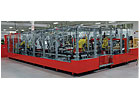
The U.S. market for cosmetics is immense. If every woman in America purchases just one compact for her purse each year, that’s approximately 118 million compacts worth at least $1 billion. Automation is the only way to keep up with that kind of volume.
Recently, Lanco Assembly Systems designed and built a multistation automation system to assemble compacts. The base of the system is Lanco’s HFL 2002 asynchronous pallet-transfer system. This modular platform can be reconfigured to match changing requirements. Because it’s asynchronous, it can accommodate manual, semiautomatic or fully automatic assembly stations.
Pallets are moved via the QuickStick linear synchronous motor system from MagneMotion Inc. The system consists of a series of linear motors located between the rails of a guideway. Wheeled vehicles can ride the rails, or rollers can be placed on the guideway to support multiple pallets. Permanent magnets placed on the underside of each vehicle or pallet interact with the electromagnetic force generated by the motors, propelling and positioning payloads to any spot along the guideway. The motion and positioning of each pallet is programmed via software.
The system for assembling the compacts is approximately 35 feet long and 19 feet wide. Pallets are indexed 90 millimeters every 0.25 second. Vision-guided robots pick and place parts onto the pallets. The system assembles 75 compacts per minute.
In this profile, Timothy C. Neale, vice president of Lanco, talks about the “makeup” of the assembly system.
For more information on automated assembly systems, call Lanco at 207-773-2060 or visit www.lanco.net.
For more information on linear transfer systems, call MagneMotion at 978-757-9100 or visit www.magnemotion.com.
How many parts are assembled to complete the product? Five components, which vary in color and format.
What materials are the various parts made of? Plastic, steel, powder, paper and labels.
What equipment feeds the parts? A flexible feeding system randomly distributes components onto a flat belt. Machine vision detects the components, and six-axis robots pick them up and transfer them into the compact. At the start of the system, the compacts are transferred from cardboard boxes, and at the end, the completed product is transferred back into the boxes.
What methods are used to assemble the product? The parts are bonded with adhesives. Laser marking is used for product identification. Six-axis robots and a delta-style robot transfer parts during assembly.
What checks or inspections are included in the assembly process? Vision systems detect all components during assembly and after completion of assembly. In some cases, through-beam photoelectric sensors verify some component and system positions.
All totaled, how many stations are part of the system? Fifteen operations complete the entire assembly sequence. At the first station, compacts are transferred into the system. At the next two stations, the compact is opened, and adhesive is applied. At the next four stations, pans of powder in different colors are inserted into the compact. A dust cover and applicator are inserted at the next two stations. Finally, the compact is closed; a label is printed, applied and inspected; and the compact is off-loaded to a packaging conveyor.
Can the system accommodate product variants? Because the system is equipped with vision-guided, six-axis robots and flexible feeding, it can accommodate new products with relatively little cost and downtime.
What was the most challenging aspect of designing and building the assembly system? Communication between the various components. All the robots, vision systems and linear drives need to communicate in unison. It was a challenge to make such a complex system appear simple.
Editor’s note: Whether you’re a systems integrator or the in-house automation team of an OEM, if you’ve designed a system that you’re particularly proud of, tell us about it. Send an e-mail to John Sprovieri, editor of ASSEMBLY, at sprovierij@bnpmedia.com, or call 630-694-4012.
Recently, Lanco Assembly Systems designed and built a multistation automation system to assemble compacts. The base of the system is Lanco’s HFL 2002 asynchronous pallet-transfer system. This modular platform can be reconfigured to match changing requirements. Because it’s asynchronous, it can accommodate manual, semiautomatic or fully automatic assembly stations.
Pallets are moved via the QuickStick linear synchronous motor system from MagneMotion Inc. The system consists of a series of linear motors located between the rails of a guideway. Wheeled vehicles can ride the rails, or rollers can be placed on the guideway to support multiple pallets. Permanent magnets placed on the underside of each vehicle or pallet interact with the electromagnetic force generated by the motors, propelling and positioning payloads to any spot along the guideway. The motion and positioning of each pallet is programmed via software.
The system for assembling the compacts is approximately 35 feet long and 19 feet wide. Pallets are indexed 90 millimeters every 0.25 second. Vision-guided robots pick and place parts onto the pallets. The system assembles 75 compacts per minute.
In this profile, Timothy C. Neale, vice president of Lanco, talks about the “makeup” of the assembly system.
For more information on automated assembly systems, call Lanco at 207-773-2060 or visit www.lanco.net.
For more information on linear transfer systems, call MagneMotion at 978-757-9100 or visit www.magnemotion.com.
How many parts are assembled to complete the product? Five components, which vary in color and format.
What materials are the various parts made of? Plastic, steel, powder, paper and labels.
What equipment feeds the parts? A flexible feeding system randomly distributes components onto a flat belt. Machine vision detects the components, and six-axis robots pick them up and transfer them into the compact. At the start of the system, the compacts are transferred from cardboard boxes, and at the end, the completed product is transferred back into the boxes.
What methods are used to assemble the product? The parts are bonded with adhesives. Laser marking is used for product identification. Six-axis robots and a delta-style robot transfer parts during assembly.
What checks or inspections are included in the assembly process? Vision systems detect all components during assembly and after completion of assembly. In some cases, through-beam photoelectric sensors verify some component and system positions.
All totaled, how many stations are part of the system? Fifteen operations complete the entire assembly sequence. At the first station, compacts are transferred into the system. At the next two stations, the compact is opened, and adhesive is applied. At the next four stations, pans of powder in different colors are inserted into the compact. A dust cover and applicator are inserted at the next two stations. Finally, the compact is closed; a label is printed, applied and inspected; and the compact is off-loaded to a packaging conveyor.
Can the system accommodate product variants? Because the system is equipped with vision-guided, six-axis robots and flexible feeding, it can accommodate new products with relatively little cost and downtime.
What was the most challenging aspect of designing and building the assembly system? Communication between the various components. All the robots, vision systems and linear drives need to communicate in unison. It was a challenge to make such a complex system appear simple.
Editor’s note: Whether you’re a systems integrator or the in-house automation team of an OEM, if you’ve designed a system that you’re particularly proud of, tell us about it. Send an e-mail to John Sprovieri, editor of ASSEMBLY, at sprovierij@bnpmedia.com, or call 630-694-4012.
Looking for a reprint of this article?
From high-res PDFs to custom plaques, order your copy today!