Tracking Production at BMW
The BMW assembly plant in Spartanburg, SC, is a model of flexibility.
In May, the facility produced 27,205 vehicles. Approximately 75 percent of those vehicles were exported, and at least 80 percent were made to order.
There are two assembly lines at the 1,150-acre, 4-million-square-foot facility. One produces the X3. The other produces the X5 and X6—at the same time. Thus, an X5 could be followed by two X6’s and three more X5’s, one of which might have a right-hand drive. The vehicles are assembled in the sequence in which the production planning system processes customer orders.
“When you consider all the unique combinations of exterior and interior colors, engines, options and upgrades, we could run two shifts a day, seven days a week, for six months and never build the same vehicle twice,” a tour guide boasts to a visitor.
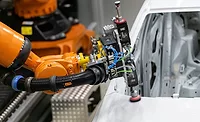
High-mix, high-volume production challenges BMW’s engineers to ensure that the right parts are installed in the right vehicles at the correct specifications. Particularly critical are threaded fasteners. A torque setting that works for one set of fasteners may not be the optimal setting for the next vehicle down the line.
To error-proof the fastening process, BMW uses a radio frequency identification (RFID) system from Ubisense, cordless tools from Bosch Production Tools, and computer-controlled DC electric tools from Atlas Copco Tools and Assembly Systems LLC.
Until the introduction of the RFID system, a vehicle arriving at an assembly station was identified by the worker using a bar code scanner to scan a paper label fixed to the car. Based on the vehicle identification, software would load the appropriate torque program into the tool.
The system worked, but the scanning operation wasted valuable production time—as much as six seconds for each tool operation. The assembler had to pick up the scanner, scan the label, and return the scanner back to its holder. With each vehicle containing hundreds of fasteners, the total amount of time spent scanning bar codes was significant.
The system developed by Ubisense and Atlas Copco eliminated the scanning process, improved efficiency, and helped to error-proof assembly.
Going Wireless
The Ubisense real-time location system uses ultra-wideband radio to locate and track small tags. These tags can be attached to objects or persons and tracked in three-dimensional space with an accuracy of ±15 centimeters and an update rate of 10 times per second.
|
The Ubisense system operates like a highly accurate indoor GPS. Sensors are placed around the areas in which tracking is to take place. The sensors are connected using a standard local area network. Short radio pulses are sent by the tags and received at the sensors. The system locates the tags by determining the direction from which the signals are received and measuring tiny differences in signal travel time between pairs of sensors.
The number of tags and the number of sensors connected together can be scaled up to meet specific application requirements. The ultra-wideband signals will not interfere with other wireless systems in operation at an assembly plant. The system also operates at very low power levels—less than 1,000th of the power level of a mobile phone.
“The range of the sensors varies,” says Adrian Jennings, vice president of technology for Ubisense. “The maximum is about 100 feet, but metal will block the signal, and assembly plants are highly metallic environments. So, you won’t necessarily see these sensors spaced 100 feet apart on an assembly line. In many cases, too, there aren’t convenient locations to hang the sensors.”
At the Spartanburg plant, each vehicle on the assembly line has an RFID tag attached to its hood, at the location where the BMW emblem will finally be placed. This tag contains the vehicle identification number and enables the Ubisense system to precisely calculate the location of the vehicle in the plant.
An RFID tag is also attached to each fastening tool. With the Atlas-Copco tools, the tag is integrated into the tool and operates off the tool’s power supply.
RFID sensors are placed along the assembly line at strategic locations to track the movement of vehicles and fastening tools. The sensors create predefined zones along the assembly line. Each zone is tied to a particular set of tools.
When an assembler brings a tool to within 40 centimeters of the car, the Ubisense system reports this proximity event to the control software, identifying both the vehicle and the tool. The system detects these proximity events with a confidence level of 99.99 percent.
The software loads the correct fastening program for that particular operation into the tool, and the assembler receives a signal to begin the operation. Assemblers no longer need to interrupt their usual work to scan a label, so the efficiency of the process has been significantly improved.
As each fastener is installed, the system records who installed the fastener, when it was installed, and that it was tightened to the correct specifications. All that data is then recorded to that vehicle’s RFID tag as well as to a database for that tool or assembly station.
The system works in the opposite way, as well. When a fastening tool leaves its predefined zone, the system disables the tool so it cannot be used on the wrong application.
The Utility of RFID
According to Jennings, RFID technology can do more than just error-proof fastening. It can help manufacturers find things, monitor production, and control equipment. It can work at the micro level—finding a tool on the shop floor—or the macro level—tracking global production of large subassemblies for jetliners.
“If you don’t have visibility into your processes, you’re really not in control,” he says. “In manufacturing, visibility means knowing where everything is with sufficient accuracy to do something useful.”
In lean manufacturing, time spent looking for things, such as tools or parts, is waste. An RFID system can tell manufacturers exactly where a tagged item is, whether that item is a nutrunner, a container of parts, a large jig for an aerospace assembly, a finished vehicle awaiting rework, or an empty trailer waiting to be filled.
RFID can also play a role in another aspect of lean—just-in-time parts delivery. Reusable containers can be equipped with RFID tags to create an automatic kanban system.
An RFID system doesn’t have to be tied solely to inanimate objects, either. It can also be used to track people. Engineers can ask workers to wear RFID tags for time-and-motion studies of the assembly process.
|
SOME FACTS ABOUT THE SPARTANBURG BMW PLANT |
RFID technology is particularly useful for manufacturing large, complex products, such as cars, trucks, tractors and planes, that are built from numerous subassemblies and require a high degree of customization, says John Lawson, Ubisense’s director of sales for the motor vehicle industry, aerospace and heavy manufacturing.
For example, the Ubisense system is instrumental in the production of the Airbus A380 jumbo jet. The jet’s major subassemblies are made at Airbus facilities in Hamburg, Germany; Saint-Nazaire, France; and Broughton, England. These subassemblies are then shipped to a fourth Airbus facility in Toulouse, France, for final assembly.
At the subassembly sites, RFID sensors are installed at key assembly stations, providing engineers in Toulouse with automatic updates on the progress of each component in real time. The system even provides estimated delivery dates.
If a subassembly is at a station longer than expected, the system automatically e-mails a manager for follow-up. And, the system can produce reports on work-in-process and for defined time periods, so engineers can analyze and optimize production processes.
For more information on real-time location systems for manufacturing, call Ubisense at 720-249-4149 or visit the company's website.
For more information on Atlas Copco fastening tools, call at 800-859-3746 or visit their website by clicking here.
For more information on Bosch fastening tools, call at 248-267-4000 or visit their website.
SIDEBAR
The Ultimate Driving School |
|
My formative driving years were spent behind the wheel of a rusty ’68 Pontiac held together with hanger wire, duct tape and spray-foam sealant. It had black vinyl seats, a leaky windshield, no air-conditioning, and a steering linkage so loose that turning a corner felt like spinning a fortune wheel. As a result, I’ve never had a jones for cars. They’ve always just been a means of getting from point A to point B. Even so, when Johan Schwartz, an instructor at the BMW Performance Driving School, handed me the keys to a $90,000, 400-hp BMW 650i, I could not wait to get behind the wheel. I would be racing against another student on a short track, about six car-lengths long and three wide. All I had to do was complete three laps faster than the other guy. There was just one catch—the track would be soaking wet. This race would be more about control than speed. Floor it too soon out of a curve, and I would be doing donuts. Fortunately, the car’s stability control system and multilink front and rear suspension kept me out of trouble. My next test was to run a timed lap around the test track in a 300-hp 325i. I would start the lap from a dead stop and end it a dead stop—in a box approximately two car-lengths long. I must say, I got around the track all right. My problem was stopping in the box. I missed it every time! As if to show me just how inadequate my driving skills are, Schwartz took me for a real lap in a 560-hp M5. For heart-stopping thrills, I’ll pit one power-sliding, white-knuckle lap in an M5 against any roller coaster in the world. While the sports cars were incredible, I had the most fun driving slow—on an off-road course in the X3. This SUV may be luxe, but it’s no pretender. It’s a legit off-roader. Climbing rocky hills and fording creeks were no problem. The vehicle’s automatic hill-descent control system tested my nerves, but performed brilliantly. |
Looking for quick answers on assembly and manufacturing topics? Try Ask ASM, our new smart AI search tool. Ask ASM
Looking for a reprint of this article?
From high-res PDFs to custom plaques, order your copy today!