Assembly Magazine logo
search
Ask ASSEMBLY AI
cart
facebook twitter linkedin youtube
  • Sign In
  • Create Account
  • Sign Out
  • My Account
Assembly Magazine logo
  • TRENDS
    • Ask ASSEMBLY AI
    • Trends
    • News
    • New Products
  • INDUSTRIES
    • Aerospace
    • Appliance
    • DFMA Assembly
    • Medical Devices
    • Green Manufacturing
    • Lean Manufacturing
    • Machinery Assembly
    • Electronics Assembly
    • Automotive
  • TECHNOLOGIES
    • Adhesives & Dispensing
    • Assembly Presses
    • Automated Assembly Systems
    • Manufacturing Management
    • Manufacturing Software
    • Motion Control
    • Screwdriving & Riveting
    • Robotics
    • Test & Inspection
    • Plastics & Metal Welding
    • Wire Processing
    • Workstations
  • AUTONOMOUS & ELECTRIC MOBILITY
    • AEM Magazine Archives
    • Autonomy
    • Electrification
    • Mobility Services
    • Assembly & Testing
    • AV/EM News
  • MEDIA
    • Ask ASSEMBLY AI
    • Podcasts
    • Assembly News Now
    • Assembly TV
    • Webinars
    • eBooks
  • EVENTS
    • Calendar
    • The ASSEMBLY Show
  • MORE
    • Exclusives >
      • Plant of the Year
      • Capital Spending
    • Buyers Guide >
      • Supplier Insights
    • Classifieds
    • Featured Products
    • Newsletters
    • Store
    • White Papers
    • Columns
    • Sponsor Insights
  • INFOCENTER
    • Assembly & Test Solutions
  • EMAGAZINE
    • eMagazine
    • Archive Issues
    • Advertise
    • Contact Us
    • Sign Up

Lead-Free BGA Rework
October 1, 2006
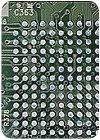
The choice of rework technique can affect the reliability of ball grid arrays assembled with lead-free solder.


It's now common knowledge that lead-free solder does not wet surfaces as well as traditional tin-lead solder. Among other consequences, this fact is affecting how assemblers rework ball grid arrays (BGAs).

There are two ways to resolder a BGA on a printed circuit board (PCB) assembly. In one method, the solder balls are placed on dots of solder paste. In the other, the solder balls are placed on dots of liquid or paste flux. The question is: Which works better with lead-free assemblies?

The issue of whether joint reliability is better when BGAs are soldered with solder paste or flux paste is controversial. Some studies indicate that the shape of the solder joint has a greater impact on reliability than the volume of solder in the joint. Other studies claim that the extra metal provided by the solder paste will produce stronger, more reliable joints, assuming the joint geometry is correct. However, the additional metal provided by the solder paste at a typical print thickness is usually minimal compared with the amount of metal provided by the balls themselves. The paste actually has little effect on the characteristics of the joint.

Another issue is whether the use of solder paste can improve the yield of the BGA rework process compared with the use of flux only. Coplanarity can be critical during the rework process. If the solder balls of the BGA are not coplanar, it can result in an open connection-a ball that has not contacted and wetted the land while surrounding balls have made contact.

Many factors can affect coplanarity. Variations in surface finish height, warp in the board, and warp in the device itself can create coplanarity problems. The use of solder paste may help to overcome variations in solder ball height.

Finally, some evidence indicates that solder paste may have an edge over flux alone when laser-drilled microvias are present in the BGA lands. The paste reduces voiding and prevents loss of solder ball volume as a result of filling the via.


Settling the Issue

We designed a study to get a definitive answer to the paste vs. flux question. We also wanted to determine whether variations in the dimensions of the BGA lands adversely affected the reliability of reworked BGAs.

Looking for quick answers on assembly and manufacturing topics? Try Ask ASM, our new smart AI search tool. Ask ASM →

To reduce expenses and simulate a very common BGA package, we selected a lead-free, daisy-chained, plastic BGA-256 for the study. The solder ball diameter for this device was 0.76 millimeter, with a pitch of 1.27 millimeters.

The test PCB had a corresponding daisy-chained land pattern to allow for electrical testing once the BGAs were installed. The boards were supplied in eight-up arrays to facilitate testing. Eight arrays (64 boards) were fabricated with lands 0.55 millimeter in diameter, as an example of small lands. Eight arrays (64 boards) were fabricated with lands 0.84-millimeter in diameter, as an example of large lands. The PCBs were fabricated from standard FR-4 laminate, 1.57 millimeters thick. Liquid photo-imageable solder mask was used to cover with bare copper traces. The surface finish was immersion silver.

Each board had a unique identification label. Lead-free solder was applied to all the BGA land patterns on all the test vehicles, then wicked off. This process eliminated the need to test different surface finishes, and it created an accurate representation of a rework site that had been cleaned and readied for BGA replacement. An additional advantage was that we were able to match the solder paste to the surface finish to provide the best opportunity for wetting.

We used laser-cut stainless steel stencils to print solder paste on two sets of boards (large and small lands). We manually applied no-clean flux paste to two other sets of boards (large and small lands). The stencils were 0.2 millimeter thick, and the apertures were cut 1-to-1 for the two different land diameters. The solder paste was a no-clean, lead-free alloy consisting of 96.5 percent tin, 3 percent silver and 0.5 percent copper.

After the solder paste was printed on the boards, the BGAs were placed using automated equipment. The entire array was then processed through a convection reflow oven with a peak temperature of 240 C. After reflow, the boards were X-rayed, visually inspected and electrically tested for continuity through the daisy-chained pattern.


Results

The first-pass yield for the paste-printed BGAs was 100 percent, while the first-pass yield for the flux-only BGAs was 87.5 percent.

Testing was accomplished in a thermal chamber with ambient humidity. The assemblies were subjected to a low temperature of -25 C and a high temperature of 125 C. The dwell time at each extreme was 30 minutes, and the ramp time to each extreme was 30 minutes.

To date, the samples have completed 672 cycles. To this point, there have been no failures in any of the groups. Testing will continue to at least 1,000 cycles in an attempt to create failures.

Our data indicate that variations in the dimensions of the BGA lands had no detrimental effect on reliability for a variety of processing methods in normal environments. With the exception of first-pass yield, both the solder paste and the flux paste rework methods performed well.

Share This Story

Looking for a reprint of this article?
From high-res PDFs to custom plaques, order your copy today!

Recommended Content

JOIN TODAY
To unlock your recommendations.

Already have an account? Sign In

  • Made in the U.S.A.

    Consumer Products Manufacturing: Made in the USA

    Supply chain lessons learned during the coronavirus...
    Automated Assembly Systems
    By: Austin Weber
  • Best Practices for Press-Fit Assembly

    Best Practices for Press-Fit Assembly

    In manufacturing, ironclad formulas for success are hard...
    Assembly Presses
    By: Jim Camillo
  • aem0523leader-tesla1.jpg

    Tesla Rethinks the Assembly Line

    Engineers at Tesla Inc. have developed a new process that...
    Electrification
    By: Austin Weber
Manage My Account
  • eMagazine Subscription
  • Assembly Newsletters
  • Online Registration
  • Subscription Customer Service
  • Manage My Preferences

More Videos

Sponsored Content

Sponsored Content is a special paid section where industry companies provide high quality, objective, non-commercial content around topics of interest to the ASSEMBLY audience. All Sponsored Content is supplied by the advertising company and any opinions expressed in this article are those of the author and not necessarily reflect the views of ASSEMBLY or its parent company, BNP Media. Interested in participating in our Sponsored Content section? Contact your local rep!

close
  • ultrasonic welding
    Sponsored bySonobond Ultrasonics

    Engineering Efficiency in High-Performance Assembly: How Ultrasonic Welding Enhances Throughput, Reliability and Quality

  • UV curing system
    Sponsored byDymax

    Why UV Intensity Alone Doesn’t Define Curing Performance

  • wooden pallets
    Sponsored byLEAN Manufacturing Products

    Eliminating Waste on the Shop Floor: Applying Lean Principles to Improve Manufacturing Efficiency

Popular Stories

ASSEMBLY News Now, episode-30: Volvo Redesigns EV Manufacturing

Volvo Redesigns EV Manufacturing

Boeing CEO Kelly Ortberg announces 1 billion investment

Boeing Plans $1 Billion Wichita Investment, Workforce Training Center

automated consumer goods assembly system

Best Practices for Cycle Time Optimization

Watch the latest episode of ANN now!

Events

July 24, 2025

From Shop Floor to CFO: How Manufacturers Are Closing the Loop Between Operations and Finance

On Demand Learn how manufacturers are bridging the gap between the shop floor and ERP systems to gain real-time visibility, streamline operations, and kick-start digital transformation—without waiting years.

Sponsored by:

PicoStratusGreen
July 30, 2025

Buffer Analysis and Design Fundamentals for Manufacturing Excellence

On Demand In this presentation, Dr. Herman Tang shares practical insights from his industry experience and research on buffer management in manufacturing operations.

View All Submit An Event

Poll

Difficult Assembly Processes

Which assembly process gives you the most difficulty?
View Results Poll Archive

Products

Manufacturing Cost Policy Deployment (MCPD) Profitability Scenarios: Systematic and Systemic Improvement of Manufacturing Costs

Manufacturing Cost Policy Deployment (MCPD) Profitability Scenarios: Systematic and Systemic Improvement of Manufacturing Costs

See More Products
Register for webinar - Modernizing Automotive Assembly: Why Upgrading Legacy MES is a Business Imperative

Related Articles

  • Lead-Free BGA Assembly

    See More
  • Aerospace Rework in a Lead-Free World

    See More
  • Lead-Free Soldering by Hand

    See More

Related Products

See More Products
  • additive manu.jpg

    Additive Manufacturing, Second Edition

  • design.jpg

    Design for Manufacturability, 2nd Edition

  • pocket.jpg

    How To Implement Lean Manufacturing, Second Edition

See More Products

Events

View AllSubmit An Event
  • December 4, 2025

    Cut Scrap and Prevent Rework: Smarter AI Inspection for Manufacturing

    On Demand If you’re ready to cut scrap, prevent rework, and build with confidence, this is a conversation you won’t want to miss. Sponsored by:
View AllSubmit An Event

Related Directories

  • FreePoint Technologies Inc.

  • Aimtron

    Aimtron Corporation, headquartered in Palatine, Illinois, leads the Aimtron Group, including Aimtron Systems, Electronics, Foundation, and American Pinball. We specialize in electronics design and manufacturing, with a focus on quality and customer satisfaction. Our Chicago-area facility excels in PCB assembly, quick-turn prototyping, BGA expertise, and high-volume production.
×

Never miss the latest news and trends driving the manufacturing industry

Stay in the know on the latest assembly trends.

JOIN TODAY!
  • RESOURCES
    • Advertise
    • Contact Us
    • Directories
    • Manufacturing Division
    • Store
    • Want More?
  • SIGN UP TODAY
    • Create Account
    • eMagazine
    • Newsletters
    • Customer Service
    • Manage Preferences
  • SERVICES
    • Marketing Services
    • Reprints
    • Market Research
    • List Rental
    • Survey/Respondent Access
  • STAY CONNECTED
    • LinkedIn
    • Facebook
    • Instagram
    • YouTube
    • X (Twitter)
  • PRIVACY
    • PRIVACY POLICY
    • TERMS & CONDITIONS
    • DO NOT SELL MY PERSONAL INFORMATION
    • PRIVACY REQUEST
    • ACCESSIBILITY

Copyright ©2026. All Rights Reserved BNP Media, Inc. and BNP Media II, LLC.

Design, CMS, Hosting & Web Development :: ePublishing