Fastening: Assembly With Press-In Fasteners
Several types of threaded fasteners are installed not with a power tool, but a press. Self-clinching nuts, threaded inserts and similar fasteners are pressed into thin, soft or otherwise fragile materials to provide strong threads for mating hardware.

Last June, a large appliance manufacturer was working on a new washing machine design when a problem arose with the leveling legs. The 3/8-inch nuts used to attach the legs were not meeting reliability test requirements.
The nuts secured the leveling legs to two stamped steel rails at the base of the washer. One rail went across the front of the machine; the other went across the rear. One nut was located on the ends of each rail.
The appliance maker turned to BAS Components Inc., the manufacturer of Flangeform nuts and studs, for an alternative. BAS recommended a 3/8-inch Flangeform nut, which could be pressed into the rails as they were being stamped and formed. After testing the fastener on prototype parts, BAS found the nut exceeded the appliance maker’s requirements. Even when the fasteners were overinserted or underinserted, the assembly did not fail.
In production, the fasteners are installed at a rate of 35 per minute. To keep up with cycle time requirements, a single vibratory feeder bowl supplies the nuts to two automatic insertion heads-one for the front rail, the other for the rear. The appliance maker now expects to consume some 15 million Flangeform nuts annually.
The Flangeform nut is one example of a threaded fastener that is installed not with a power tool, but a press. Self-clinching nuts, threaded inserts and similar fasteners are pressed into thin, soft or otherwise fragile materials to provide strong threads for mating hardware.

Self-clinching studs come in sizes M2 to M14 and can join one or more metal sheets. They can be used on aluminum, steel and stainless steel, as well as laminated and precoated materials.
PennEngineering makes studs for sheets as thin as 0.02 inch. BAS makes the Flangeform stud, which can be used in sheets of mild steel or aluminum from 0.5 to 3.5 millimeters thick.
“The Flangeform stud offers high-strength attachment points, particularly in 5000 series aluminums,” says Bob Mangapora, general manager of BAS. “Although the stud usually is installed in one layer, it can be installed in multiple layers.”
Stud head designs vary. For example, PennEngineering makes studs with flush, nonflush and concealed heads. Also available is a stud with a nonflush head and a swaged collar. The standard Flangeform stud has a cylindrical head with a hexagonal flange and six splines.
Self-clinching nuts come in many variations, but, generally, they have load-bearing threads that are stronger than mild-steel screws. The nuts are usually installed on the inside surface of the sheet. The opposite side remains smooth. An assembler adds a mating screw to finish the job.
“Automakers tend to use clinch studs and nuts mostly in place of weld nuts,” says Bruno Maczynski, engineering manager for Tox-Pressotechnik LLC. “They’re installed mostly around hoods, fenders and sunroof frames.”
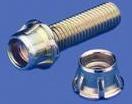
BAS offers two types of nuts. Like the head of the Flangeform stud, the Flangeform nut has a hexagonal flange and a cylindrical body with six splines. Also available is a closed-end nut for use with M6 and M8 bolts. This nut, which comes with a removable plastic cap, is designed for applications where water and paint ingress is a concern.
Unique varieties of clinching nuts offered by PennEngineering include floating, flush and right angle. The threads on floating nuts permit up to 0.03 inch of adjustment to compensate for mating hole misalignment. Flush nuts are used when the application requires both sides of the metal sheet to be smooth. The threads on right-angle nuts are perpendicular to the installation surface. By providing right-angle attachment points, they obviate the need for bent tabs or angle brackets.
Standoffs are used primarily to stack components or keep them a fixed distance from each other. They come in sizes up to M8. Some types have a concealed head, while others contain a spring action to hold circuit boards and subassemblies securely in place.
PennEngineering also offers specialty clinching products such as unthreaded pins, SpotFast fasteners, micro pins and standoffs for electronic assemblies, captive panel screws, tie-mounts and hooks. Tie-mounts secure wires and cables to electronic chassis and enclosures without screws or adhesives. Captive panel screws are preassembled, multipiece fasteners for attachment to removable sheet metal panels. The screw can be untightened, but not detached, so the panel can be removed without fear of losing any hardware.
“Captive panel screws feature spring-loaded M3 to M6 screws,” says Jay McKenna, global product manager of new and micro products for PennEngineering. “The spring allows for easy release and removal. Some even feature heads that assemblers can grab and manually unscrew.”

First, the fastener shank is placed in a mounting hole in one or more thin metal sheets. Then, as the fastener is pressed into place, displaced sheet material cold-flows into the shank recess and locks the fastener in place. When installation is complete, the fastener is flush with the sheet or touching the top of it.
Some fasteners, such as the Flangeform, require the insertion of an alignment tool into the lower die to facilitate alignment and installation. In addition, every self-clinching fastener has a gripping element that embeds in the pierced material and prevents the fastener from rotating when assemblers tighten the mating hardware. Usually located beneath the fastener head, this gripping element could be a set of splines or a serrated clinching ring. In the case of Flangeform fasteners, the hexagonal shape of the head also prevents the fastener from rotating.
Fastener type and production requirements determine whether installation is done manually or automatically. However, some self-clinching fasteners can only be installed in one manner; micro self-clinching fasteners, for example, are too small to be inserted manually.
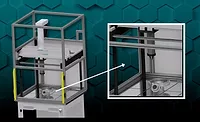
Some companies, like Haeger Inc., make presses specifically for installing self-clinching fasteners. For example, the 824 OneTouch-3 can install up to four different fasteners in a part during a single handling cycle. The automatic tool changer can switch between fasteners in 3 seconds. The fasteners can vary by type, size and length, and are automatically supplied to the insertion point via modular vibratory feeder bowls.
The press can be tended by an operator-a laser light aids in positioning-or it can be tended by a robot for fully automatic operation. For quality assurance, sensors confirm that a fastener is present and that it’s the correct length. The press applies 1,000 to 16,000 pounds of force. It has a throat depth of 24 inches and a throat height of 17 inches.
PennEngineering also supplies semiautomatic and fully automatic presses specifically for installing self-clinching fasteners. For example, the Pemserter Series 4 is a semiautomatic pneumatic press for fasteners ranging in size from M2 to M12. It has an 18-inch throat depth, an insertion force ranges from 1,000 to 12,000 pounds.
The optional QX4 turret tool system provides an efficient method to quickly change between four different anvil tools. The turret allows an operator to install four different types and sizes of fasteners with one setup. The turret is easily rotated by hand and positively locks in place. For error-proofing, each tooling position is color-coded to match corresponding fastener trays.
Of course, assemblers don’t necessarily require a special press to install self-clinching fasteners. Any standard assembly press can do the job.
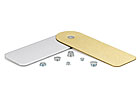
 Schmidt Technology makes more than 25 manual, pneumatic, hydropneumatic and servo electric presses, any of which can be equipped for force-stroke monitoring.
“Pneumatic presses provide a more efficient method of installing fasteners than automated screwdriving equipment,” says Dave Zabrosky, North American sales and marketing manager of Schmidt Technology. “These involve more insertion time and maintenance.”
BalTec Corp. also offers a complete line of manual and pneumatic presses. The company’s direct-acting pneumatic presses deliver uniform power over the entire punch stroke length to optimize compressed-air consumption. Models are available to apply 340 to 7,640 pounds of force.
“Market changes have resulted in new Tier 1 auto suppliers that, up to now, have done primarily stamping,” says Chuck Rupprecht, vice president of BalTec. “Some will have to learn about fastening, including using press-in fasteners to assemble their components.”
Tox-Pressotechnik offers several models of manual, hydraulic, hydropneumatic and servo electric presses. C-frame fastener insertion units can produce up to 2,000 pounds of force and install fasteners from 3.3 to 9 millimeters long.
Promess Inc. specializes in servo electric presses. The company’s Electromechanical Assembly Press (EMAP) comes in 27 models having force capacities from less than an ounce to more than 200,000 pounds. The EMAP combines a servo-controlled, ballscrew-driven ram with a multiaxis motion control system for high-precision fastener installation. This press allows users to run multiple fastener types in one station and switch from one type to another on the fly. Programming is done through Windows-based software, which lets engineers set, monitor and analyze parameters, such as force, speed and distance.
“The technology used in servo electric presses gets better and less expensive every year,” says Glenn Nausley, vice president and general manager of Promess.
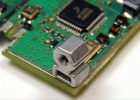
Emhart Teknologies makes Dodge-brand standard expansion, Spred-Lok and Ultrasert inserts. The first two types require very little insertion force-3 to 35 pounds-and usually are installed with a manual arbor press and simple tools.
Standard expansion inserts consist of a threaded insert and captivated spreader plate. When this plate is depressed during installation, the knurled portion expands and anchors the insert in the boss. Thread sizes range from #4 (M3) to 5/16 (M6).
Spred-Lok is a one-piece insert with a slotted outside diameter and internal thread of #4 (M3) to 5/16 (M6). This insert expands and locks in place after screw insertion.
Ultrasert inserts can be installed into thermoplastic in one of three ways. The first is to directly mold the insert into the plastic. The inserts can also be installed with an ultrasonic welder or a heated tool. Either way, the inserts can be placed in the insertion point manually, or they can be supplied via carrier tape or a vibratory bowl. Depending on method, typical cycle time is 15 to 35 seconds. Internal thread size ranges from M2 to M10.
“As a general guideline, the diameter of the boss opening should be no less than 1.5 to two times the diameter of the insert thread,” says John Botelle, applications engineering manager for Emhart Teknologies.
Most standard inserts are less than ½-inch long and handle M2 to M8 screws. Emhart also makes custom inserts, which have been as long as 1 inch.
Last June, a large appliance manufacturer was working on a new washing machine design when a problem arose with the leveling legs. The 3/8-inch nuts used to attach the legs were not meeting reliability test requirements.
The nuts secured the leveling legs to two stamped steel rails at the base of the washer. One rail went across the front of the machine; the other went across the rear. One nut was located on the ends of each rail.
The appliance maker turned to BAS Components Inc., the manufacturer of Flangeform nuts and studs, for an alternative. BAS recommended a 3/8-inch Flangeform nut, which could be pressed into the rails as they were being stamped and formed. After testing the fastener on prototype parts, BAS found the nut exceeded the appliance maker’s requirements. Even when the fasteners were overinserted or underinserted, the assembly did not fail.
In production, the fasteners are installed at a rate of 35 per minute. To keep up with cycle time requirements, a single vibratory feeder bowl supplies the nuts to two automatic insertion heads-one for the front rail, the other for the rear. The appliance maker now expects to consume some 15 million Flangeform nuts annually.
The Flangeform nut is one example of a threaded fastener that is installed not with a power tool, but a press. Self-clinching nuts, threaded inserts and similar fasteners are pressed into thin, soft or otherwise fragile materials to provide strong threads for mating hardware.
Self-clinching studs come in sizes M2 to M14 and can join one or more metal sheets. Photo courtesy PennEngineering
It's a Clinch!
Self-clinching fasteners attach components to thin sheet metal. Made of steel, stainless steel or aluminum, the fasteners create permanent load-bearing connections.Self-clinching studs come in sizes M2 to M14 and can join one or more metal sheets. They can be used on aluminum, steel and stainless steel, as well as laminated and precoated materials.
PennEngineering makes studs for sheets as thin as 0.02 inch. BAS makes the Flangeform stud, which can be used in sheets of mild steel or aluminum from 0.5 to 3.5 millimeters thick.
“The Flangeform stud offers high-strength attachment points, particularly in 5000 series aluminums,” says Bob Mangapora, general manager of BAS. “Although the stud usually is installed in one layer, it can be installed in multiple layers.”
Stud head designs vary. For example, PennEngineering makes studs with flush, nonflush and concealed heads. Also available is a stud with a nonflush head and a swaged collar. The standard Flangeform stud has a cylindrical head with a hexagonal flange and six splines.
Self-clinching nuts come in many variations, but, generally, they have load-bearing threads that are stronger than mild-steel screws. The nuts are usually installed on the inside surface of the sheet. The opposite side remains smooth. An assembler adds a mating screw to finish the job.
“Automakers tend to use clinch studs and nuts mostly in place of weld nuts,” says Bruno Maczynski, engineering manager for Tox-Pressotechnik LLC. “They’re installed mostly around hoods, fenders and sunroof frames.”
BAS offers two types of nuts. Like the head of the Flangeform stud, the Flangeform nut has a hexagonal flange and a cylindrical body with six splines. Also available is a closed-end nut for use with M6 and M8 bolts. This nut, which comes with a removable plastic cap, is designed for applications where water and paint ingress is a concern.
Unique varieties of clinching nuts offered by PennEngineering include floating, flush and right angle. The threads on floating nuts permit up to 0.03 inch of adjustment to compensate for mating hole misalignment. Flush nuts are used when the application requires both sides of the metal sheet to be smooth. The threads on right-angle nuts are perpendicular to the installation surface. By providing right-angle attachment points, they obviate the need for bent tabs or angle brackets.
Standoffs are used primarily to stack components or keep them a fixed distance from each other. They come in sizes up to M8. Some types have a concealed head, while others contain a spring action to hold circuit boards and subassemblies securely in place.
PennEngineering also offers specialty clinching products such as unthreaded pins, SpotFast fasteners, micro pins and standoffs for electronic assemblies, captive panel screws, tie-mounts and hooks. Tie-mounts secure wires and cables to electronic chassis and enclosures without screws or adhesives. Captive panel screws are preassembled, multipiece fasteners for attachment to removable sheet metal panels. The screw can be untightened, but not detached, so the panel can be removed without fear of losing any hardware.
“Captive panel screws feature spring-loaded M3 to M6 screws,” says Jay McKenna, global product manager of new and micro products for PennEngineering. “The spring allows for easy release and removal. Some even feature heads that assemblers can grab and manually unscrew.”
Spred-Lok inserts expand and lock in place after screw insertion. Photo courtesy Emhart Teknologies
Installation
Self-clinching fasteners are installed during fabrication or final assembly. The fasteners are installed with a parallel-acting press in a simple two-step process.First, the fastener shank is placed in a mounting hole in one or more thin metal sheets. Then, as the fastener is pressed into place, displaced sheet material cold-flows into the shank recess and locks the fastener in place. When installation is complete, the fastener is flush with the sheet or touching the top of it.
Some fasteners, such as the Flangeform, require the insertion of an alignment tool into the lower die to facilitate alignment and installation. In addition, every self-clinching fastener has a gripping element that embeds in the pierced material and prevents the fastener from rotating when assemblers tighten the mating hardware. Usually located beneath the fastener head, this gripping element could be a set of splines or a serrated clinching ring. In the case of Flangeform fasteners, the hexagonal shape of the head also prevents the fastener from rotating.
Fastener type and production requirements determine whether installation is done manually or automatically. However, some self-clinching fasteners can only be installed in one manner; micro self-clinching fasteners, for example, are too small to be inserted manually.
The SpotFast self-clinching fastener installs smooth with the top sheet, and flush or sub-flush with the bottom sheet. A single fastener can act as a hardened pivot point if desired. Photo courtesy PennEngineering
Start the Presses
Self-clinching fasteners can be installed with manual, pneumatic, hydropneumatic and servo electric presses. The force required to install these fasteners ranges from 400 to 36,000 pounds, depending on fastener type and dimensions, and the materials to be joined.Some companies, like Haeger Inc., make presses specifically for installing self-clinching fasteners. For example, the 824 OneTouch-3 can install up to four different fasteners in a part during a single handling cycle. The automatic tool changer can switch between fasteners in 3 seconds. The fasteners can vary by type, size and length, and are automatically supplied to the insertion point via modular vibratory feeder bowls.
The press can be tended by an operator-a laser light aids in positioning-or it can be tended by a robot for fully automatic operation. For quality assurance, sensors confirm that a fastener is present and that it’s the correct length. The press applies 1,000 to 16,000 pounds of force. It has a throat depth of 24 inches and a throat height of 17 inches.
PennEngineering also supplies semiautomatic and fully automatic presses specifically for installing self-clinching fasteners. For example, the Pemserter Series 4 is a semiautomatic pneumatic press for fasteners ranging in size from M2 to M12. It has an 18-inch throat depth, an insertion force ranges from 1,000 to 12,000 pounds.
The optional QX4 turret tool system provides an efficient method to quickly change between four different anvil tools. The turret allows an operator to install four different types and sizes of fasteners with one setup. The turret is easily rotated by hand and positively locks in place. For error-proofing, each tooling position is color-coded to match corresponding fastener trays.
Of course, assemblers don’t necessarily require a special press to install self-clinching fasteners. Any standard assembly press can do the job.
Flangeform nuts and studs are examples of self-clinching threaded fasteners installed not with a power tool, but a press. Photo courtesy BAS Components Inc.
“Pneumatic presses provide a more efficient method of installing fasteners than automated screwdriving equipment,” says Dave Zabrosky, North American sales and marketing manager of Schmidt Technology. “These involve more insertion time and maintenance.”
BalTec Corp. also offers a complete line of manual and pneumatic presses. The company’s direct-acting pneumatic presses deliver uniform power over the entire punch stroke length to optimize compressed-air consumption. Models are available to apply 340 to 7,640 pounds of force.
“Market changes have resulted in new Tier 1 auto suppliers that, up to now, have done primarily stamping,” says Chuck Rupprecht, vice president of BalTec. “Some will have to learn about fastening, including using press-in fasteners to assemble their components.”
Tox-Pressotechnik offers several models of manual, hydraulic, hydropneumatic and servo electric presses. C-frame fastener insertion units can produce up to 2,000 pounds of force and install fasteners from 3.3 to 9 millimeters long.
Promess Inc. specializes in servo electric presses. The company’s Electromechanical Assembly Press (EMAP) comes in 27 models having force capacities from less than an ounce to more than 200,000 pounds. The EMAP combines a servo-controlled, ballscrew-driven ram with a multiaxis motion control system for high-precision fastener installation. This press allows users to run multiple fastener types in one station and switch from one type to another on the fly. Programming is done through Windows-based software, which lets engineers set, monitor and analyze parameters, such as force, speed and distance.
“The technology used in servo electric presses gets better and less expensive every year,” says Glenn Nausley, vice president and general manager of Promess.
The threads on right-angle nuts are perpendicular to the installation surface. By providing right-angle attachment points, they obviate the need for bent tabs or angle brackets. Photo courtesy PennEngineering
Threaded Inserts for Plastics
Made of brass, threaded inserts enable plastic parts to be securely fastened with machine screws, rather than self-threading screws. The former can be removed and reinstalled repeatedly without damaging the part. The latter carry the risk of crossed or stripped threads each time the screw is reinstalled. Another advantage of threaded inserts is that they spread loads over a large area, especially when used in soft thermoplastics.Emhart Teknologies makes Dodge-brand standard expansion, Spred-Lok and Ultrasert inserts. The first two types require very little insertion force-3 to 35 pounds-and usually are installed with a manual arbor press and simple tools.
Standard expansion inserts consist of a threaded insert and captivated spreader plate. When this plate is depressed during installation, the knurled portion expands and anchors the insert in the boss. Thread sizes range from #4 (M3) to 5/16 (M6).
Spred-Lok is a one-piece insert with a slotted outside diameter and internal thread of #4 (M3) to 5/16 (M6). This insert expands and locks in place after screw insertion.
Ultrasert inserts can be installed into thermoplastic in one of three ways. The first is to directly mold the insert into the plastic. The inserts can also be installed with an ultrasonic welder or a heated tool. Either way, the inserts can be placed in the insertion point manually, or they can be supplied via carrier tape or a vibratory bowl. Depending on method, typical cycle time is 15 to 35 seconds. Internal thread size ranges from M2 to M10.
“As a general guideline, the diameter of the boss opening should be no less than 1.5 to two times the diameter of the insert thread,” says John Botelle, applications engineering manager for Emhart Teknologies.
Most standard inserts are less than ½-inch long and handle M2 to M8 screws. Emhart also makes custom inserts, which have been as long as 1 inch.
Looking for a reprint of this article?
From high-res PDFs to custom plaques, order your copy today!