Inspection: Ensuring Reliability in Vision Systems
Producing a reliable vision system is no accident. It begins with creating a strong specification that carries through to component selection, system development and, finally, deployment.

Like a Hollywood star surrounded by paparazzi, a vehicle is photographed by multiple vision-system cameras at various points along the assembly line. Early on, one of the cameras helps guide a robot to retrieve the proper passenger-side-door mirror from a large tray of mirrors.
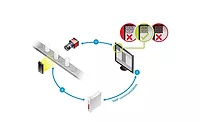
Then, another camera verifies that a mirror is present on the door and that it’s installed properly. A third camera reads a bar code on the vehicle roof and sends the code to a controller, which checks the OEM’s database and verifies that the correct mirror has been installed.
In another example, a manufacturer of disposable hygienic consumer products uses a vision system and innovative lighting to identify defective dome-shaped parts. Ten parts are in each pallet that moves along a linear transfer system.
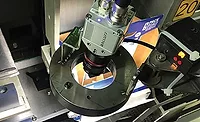
Space restrictions prevent standard lighting from illuminating both sides of the parts, so two strobe lights are used. One strobe light flashes, and a photo is taken of one side of the parts. Just 16 milliseconds later, the other strobe flashes and the same camera photographs the parts’ other side. Within the controller, the two photos are combined and analyzed to determine which parts are good. About 10 seconds later, the next pallet passes through the vision system, and the process is repeated.
For many years, OEMs and Tier 1 suppliers in many industries have used vision systems to inspect and error-proof parts and assemblies. Traditionally, these systems have been installed by integrators. However, in recent years cameras and related vision-system components have dropped in price and become easier to use-enabling many manufacturers and suppliers to install their own systems.
The challenge of such an undertaking is to design the most reliable vision system possible. And that challenge can only be met through proper system specifications, component selection and daily monitoring.
The typical vision system consists of a dumb or smart camera, image sensor, lens, lighting, PC or programmable logic controller (PLC), image-processing software, connection cables and mounting hardware. A smart sensor can be used in place of a camera.
Reliable vision systems boost product quality and profits. An unreliable vision system can result in assemblies containing missing or defective parts.
Specifications for a vision system need to be extensive and cover many things-beginning with the project budget, assembly or manufacturing application and performance requirements for each component.
Specifications also need to clearly state the function of each component. Failure to do so can result in “application creep,” says Mark Sippel, product marketing manager for Balluff Inc.
“This happens when the company, for example, specifies a camera to do one thing, but after installation, wants it to do more things,” says Sippel. “That company will design a system that has many problems and produces many failed parts.”
Regarding cameras, the specifications should say how many cameras the system will have and when each camera will be triggered by a moving part. Information about the parts being inspected should include how they are positioned on the assembly line, line speed, volume throughput and a definition of good and bad parts.
Henson says it’s also important to note all interferences-such as people-that may be present near the vision system and the amount of space needed for the system.
“If a manufacturer provides us with specs and samples, we’ll provide an evaluation report that includes a component list,” says Jonathan Ludlow, product manager of machine vision for Microscan Systems Inc. “We also offer a printed setup guide, Web help and training videos.”
Not all components are equal in a vision system, and manufacturers must remember this as they develop performance requirements. Lighting, for example, is the most important component because it provides the contrast necessary for the camera to find part defects or verify part presence or proper orientation.
For many years, fluorescent lighting was used extensively, but today LED lighting is preferred because it is effective in a wide range of vision applications and lasts much longer.
“Lighting must make sure a good part looks very different from a bad one,” says Ludlow. “Be sure the lighting is consistent and provides a lot of contrast but not a lot of reflection.”
Types of LED lighting include backlight, high intensity, ring, area array, bar and dome.
The lighting comes in various wavelengths, including red, blue, ultraviolet, infrared and white.
Often, more than one angle or type of lighting is required to illuminate an application. Some cameras and smart sensors, for example, have built-in ring lighting that needs to be supplemented.
The XCG series camera from Sony Electronics Inc. features a bulk and sequential trigger mode that enhances visualization of a part illuminated by different types of lighting. This mode rapidly captures up to 16 images of a stationary part, ensuring accurate inspection of the part for each type of lighting, says Drew Buttress, product manager for visual imaging at Sony.
Part size, material and color can also influence which lighting is best. Equally important is whether the camera produces monochrome or color images.
“If a color camera is being used to capture a color part, you usually need a white light,” says Rick Roszkowski, senior director of marketing for Cognex. “Usually, a monochrome camera used with monochrome lighting produces the sharpest image.”
Roszkowski says many manufacturers use red LED lighting because most image sensors are sensitive to red and it works for a wide variety of applications. Blue light is best for finding scratches and other surface defects.
The XG-7000 vision system from Keyence Corp. of America offers high dynamic range (HDR), which takes multiple images with different exposures and combines them to create an image with a wide range of colors so it more closely represents what is seen by the human eye. Bob Ochiai, machine vision support engineer for Keyence, says HDR lets users set parameters such as illumination level increments, image tone values and number of images they wish to capture on each part. As each part is viewed, illumination and tone levels are automatically varied for the number of image captures specified.
Finally, a properly setup vision system will allow enough clearance space for lighting to fully illuminate the part and will be unaffected by ambient light.
As for cameras, manufacturers need to first decide if they prefer a dumb or smart unit. A dumb camera must be connected to a PC or PLC, whereas a smart camera is self-contained and features an internal processor. Dumb cameras require an external image sensor, which initiates image capture. Smart cameras feature an internal sensor.
More than any other components, smart cameras and smart sensors have enabled manufacturers to install their own vision systems. Workstation operators can log on to these smart devices and check all types of stored data, including number of failed parts for a specified time. The devices also store images of good and bad parts.
These devices also save on space and IT costs associated with PCs or PLCs, such as purchasing and running antivirus software and weekly security updates. However, they do have one drawback: Their processing capability is limited to what is inside the device.
Balluff makes the Sharpshooter smart sensor, which can perform many part-inspection functions. These include checking brightness and contour, comparing contrast and 360-degree position detection. A panel-mount graphic interface is available to set up and monitor multiple Sharpshooter sensors.
Having decided on a camera type, the manufacturer next needs to focus on pixel resolution and tolerance, and function algorithms. Standard pixel resolution is 640 by 480, and most suppliers offer cameras that can produce 5-megapixel images.
“Always bring enough pixels to the party,” says Roszkowski. “Don’t skimp on resolution to save a few bucks. Resolution determines how well you can see the object and how accurately you can measure it.”
For example, if a manufacturer needs to inspect a small area of a part with high accuracy, a high-resolution camera should be used to obtain a clear image. When performing measurements, the measurement unit-a pixel-should be 10 times greater than the measurement tolerance.
In vision, this means if the plus minus tolerance is one millimeter, camera resolution should provide 10 pixels per millimeter for the field of view. Most vision systems can measure objects with sub-pixel accuracy, which can reduce the pixels per millimeter required. However, the 10-to-1 rule is a good place to start.
All cameras feature image processing and analysis algorithms that yield point or line data to locate a feature on a part. The most common algorithms detect edges, connectivity and correlation for applications such as part location, gauging and flaw detection. Manufacturers need to make sure the algorithms in their cameras match the application.
Lenses do not come with the cameras. Several camera and vision-system suppliers offer both traditional and special lenses, such as microscopic. This lens might be needed to properly view a very tiny part or area of a part.
Liquid lenses, which alter focal length by changing shape, are growing in popularity because they are more robust and accurate than standard lenses. A liquid lens uses one or more fluids to create an infinitely variable lens without any moving parts.
The Vision HAWK smart camera features a fully integrated liquid lens imaging system that provides focus flexibility of 1 inch to infinity, says Ludlow. During operation, electrostatic pressure creates currents that react quickly with two liquids to produce an appropriate lens curvature.
Another important component is image-processing software, which comes with various vision tools that allow users to set up, change and monitor part-inspection functions and parameters. Manufacturers need to make sure the software allows them to extract whatever data and images they want, whenever they want, such as selected images of bad parts. If long-term storage of images and data is needed, Roszkowski recommends it be done on a PC or file server rather than a PLC.
Recently, Cognex introduced TestRun, a new software tool for its In-Sight product line. TestRun lets users quickly verify that vision system input parameters haven’t changed, that libraries of good and bad parts are classified correctly, and that the entire image formation system (lighting, lens, image sensor) is set up correctly.
After discussing component performance requirements with suppliers, a manufacturer might realize that the system it hoped to install is more complex than expected or exceeds the specified budget. This can happen because the system requires more advanced components, more components or more labor than expected. The manufacturer can either downsize its system specifications or increase its vision department and budget.
However, choosing to spend more money will likely lessen the cost-effectiveness of installing the vision system themselves-and may lead manufacturers to consider having the system installed by an integrator.
During this time, the manufacturer needs to measure accuracy and repeatability by making sure the system clearly and consistently differentiates bad from good parts.
In addition, the manufacturer needs to verify that data between the camera and PC or PLC is being communicated as quickly as possible. This can be done by making sure there is no noise on the line and by not using network interface cards, which reduce processing speed and add cost.
Once system accuracy, repeatability and data communication are verified, full operation can begin. During operations, environmental problems can arise-such as the presence of dirt, dust, oil and humidity. In such conditions, it’s a good idea to put the camera in an enclosure, which is also easier to clean than the lens.
Lenses need to be cleaned regularly. Also, over time, lighting requirements and system parameters may change due to normal process or supplier variations. After several years, certain components might need to be replaced.
“Use vision as much as possible, as early as possible,” says Buttress. “Don’t wait to use it after steps one, two and three of the assembly. Use it at each step to ensure quality.”
Like a Hollywood star surrounded by paparazzi, a vehicle is photographed by multiple vision-system cameras at various points along the assembly line. Early on, one of the cameras helps guide a robot to retrieve the proper passenger-side-door mirror from a large tray of mirrors.
Then, another camera verifies that a mirror is present on the door and that it’s installed properly. A third camera reads a bar code on the vehicle roof and sends the code to a controller, which checks the OEM’s database and verifies that the correct mirror has been installed.
In another example, a manufacturer of disposable hygienic consumer products uses a vision system and innovative lighting to identify defective dome-shaped parts. Ten parts are in each pallet that moves along a linear transfer system.
Space restrictions prevent standard lighting from illuminating both sides of the parts, so two strobe lights are used. One strobe light flashes, and a photo is taken of one side of the parts. Just 16 milliseconds later, the other strobe flashes and the same camera photographs the parts’ other side. Within the controller, the two photos are combined and analyzed to determine which parts are good. About 10 seconds later, the next pallet passes through the vision system, and the process is repeated.
For many years, OEMs and Tier 1 suppliers in many industries have used vision systems to inspect and error-proof parts and assemblies. Traditionally, these systems have been installed by integrators. However, in recent years cameras and related vision-system components have dropped in price and become easier to use-enabling many manufacturers and suppliers to install their own systems.
The challenge of such an undertaking is to design the most reliable vision system possible. And that challenge can only be met through proper system specifications, component selection and daily monitoring.
The typical vision system consists of a dumb or smart camera, image sensor, lens, lighting, PC or programmable logic controller (PLC), image-processing software, connection cables and mounting hardware. A smart sensor can be used in place of a camera.
Reliable vision systems boost product quality and profits. An unreliable vision system can result in assemblies containing missing or defective parts.
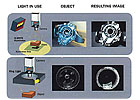
Types of lighting include backlight, high intensity, ring, area array, bar and dome. As these graphics illustrate, each type changes how a part is captured by the camera. Graphics courtesy Microscan Systems Inc.
Importance of Specifications
“When writing specifications, consider the effects of process variation on the vision system, not just want you want to accomplish,” says Brian Henson, senior vision engineer for Zynergy Solutions, a vision-system integrator. “The process surprises you don’t expect will happen.”Specifications for a vision system need to be extensive and cover many things-beginning with the project budget, assembly or manufacturing application and performance requirements for each component.
Specifications also need to clearly state the function of each component. Failure to do so can result in “application creep,” says Mark Sippel, product marketing manager for Balluff Inc.
“This happens when the company, for example, specifies a camera to do one thing, but after installation, wants it to do more things,” says Sippel. “That company will design a system that has many problems and produces many failed parts.”
Regarding cameras, the specifications should say how many cameras the system will have and when each camera will be triggered by a moving part. Information about the parts being inspected should include how they are positioned on the assembly line, line speed, volume throughput and a definition of good and bad parts.
Henson says it’s also important to note all interferences-such as people-that may be present near the vision system and the amount of space needed for the system.
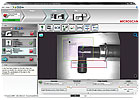
Image-processing software comes with various vision tools that allow users to set up, change and monitor part-inspection functions and parameters. Photo courtesy Microscan Systems Inc.
Performance Requirements
Manufacturers must develop realistic performance requirements for each component to determine the feasibility of installing their own vision system. Suppliers can help in this process by providing detailed product information, including features, benefits and capabilities. These suppliers also may request examples of good and bad parts to help them better understand the scope of the vision system and determine which of their products are best suited for the application in light of the manufacturer’s budget.“If a manufacturer provides us with specs and samples, we’ll provide an evaluation report that includes a component list,” says Jonathan Ludlow, product manager of machine vision for Microscan Systems Inc. “We also offer a printed setup guide, Web help and training videos.”
Not all components are equal in a vision system, and manufacturers must remember this as they develop performance requirements. Lighting, for example, is the most important component because it provides the contrast necessary for the camera to find part defects or verify part presence or proper orientation.
For many years, fluorescent lighting was used extensively, but today LED lighting is preferred because it is effective in a wide range of vision applications and lasts much longer.
“Lighting must make sure a good part looks very different from a bad one,” says Ludlow. “Be sure the lighting is consistent and provides a lot of contrast but not a lot of reflection.”
Types of LED lighting include backlight, high intensity, ring, area array, bar and dome.
The lighting comes in various wavelengths, including red, blue, ultraviolet, infrared and white.
Often, more than one angle or type of lighting is required to illuminate an application. Some cameras and smart sensors, for example, have built-in ring lighting that needs to be supplemented.
The XCG series camera from Sony Electronics Inc. features a bulk and sequential trigger mode that enhances visualization of a part illuminated by different types of lighting. This mode rapidly captures up to 16 images of a stationary part, ensuring accurate inspection of the part for each type of lighting, says Drew Buttress, product manager for visual imaging at Sony.
Part size, material and color can also influence which lighting is best. Equally important is whether the camera produces monochrome or color images.
“If a color camera is being used to capture a color part, you usually need a white light,” says Rick Roszkowski, senior director of marketing for Cognex. “Usually, a monochrome camera used with monochrome lighting produces the sharpest image.”
Roszkowski says many manufacturers use red LED lighting because most image sensors are sensitive to red and it works for a wide variety of applications. Blue light is best for finding scratches and other surface defects.
The XG-7000 vision system from Keyence Corp. of America offers high dynamic range (HDR), which takes multiple images with different exposures and combines them to create an image with a wide range of colors so it more closely represents what is seen by the human eye. Bob Ochiai, machine vision support engineer for Keyence, says HDR lets users set parameters such as illumination level increments, image tone values and number of images they wish to capture on each part. As each part is viewed, illumination and tone levels are automatically varied for the number of image captures specified.
Finally, a properly setup vision system will allow enough clearance space for lighting to fully illuminate the part and will be unaffected by ambient light.
As for cameras, manufacturers need to first decide if they prefer a dumb or smart unit. A dumb camera must be connected to a PC or PLC, whereas a smart camera is self-contained and features an internal processor. Dumb cameras require an external image sensor, which initiates image capture. Smart cameras feature an internal sensor.
More than any other components, smart cameras and smart sensors have enabled manufacturers to install their own vision systems. Workstation operators can log on to these smart devices and check all types of stored data, including number of failed parts for a specified time. The devices also store images of good and bad parts.
These devices also save on space and IT costs associated with PCs or PLCs, such as purchasing and running antivirus software and weekly security updates. However, they do have one drawback: Their processing capability is limited to what is inside the device.
Balluff makes the Sharpshooter smart sensor, which can perform many part-inspection functions. These include checking brightness and contour, comparing contrast and 360-degree position detection. A panel-mount graphic interface is available to set up and monitor multiple Sharpshooter sensors.
Having decided on a camera type, the manufacturer next needs to focus on pixel resolution and tolerance, and function algorithms. Standard pixel resolution is 640 by 480, and most suppliers offer cameras that can produce 5-megapixel images.
“Always bring enough pixels to the party,” says Roszkowski. “Don’t skimp on resolution to save a few bucks. Resolution determines how well you can see the object and how accurately you can measure it.”
For example, if a manufacturer needs to inspect a small area of a part with high accuracy, a high-resolution camera should be used to obtain a clear image. When performing measurements, the measurement unit-a pixel-should be 10 times greater than the measurement tolerance.
In vision, this means if the plus minus tolerance is one millimeter, camera resolution should provide 10 pixels per millimeter for the field of view. Most vision systems can measure objects with sub-pixel accuracy, which can reduce the pixels per millimeter required. However, the 10-to-1 rule is a good place to start.
All cameras feature image processing and analysis algorithms that yield point or line data to locate a feature on a part. The most common algorithms detect edges, connectivity and correlation for applications such as part location, gauging and flaw detection. Manufacturers need to make sure the algorithms in their cameras match the application.
Lenses do not come with the cameras. Several camera and vision-system suppliers offer both traditional and special lenses, such as microscopic. This lens might be needed to properly view a very tiny part or area of a part.
Liquid lenses, which alter focal length by changing shape, are growing in popularity because they are more robust and accurate than standard lenses. A liquid lens uses one or more fluids to create an infinitely variable lens without any moving parts.
The Vision HAWK smart camera features a fully integrated liquid lens imaging system that provides focus flexibility of 1 inch to infinity, says Ludlow. During operation, electrostatic pressure creates currents that react quickly with two liquids to produce an appropriate lens curvature.
Another important component is image-processing software, which comes with various vision tools that allow users to set up, change and monitor part-inspection functions and parameters. Manufacturers need to make sure the software allows them to extract whatever data and images they want, whenever they want, such as selected images of bad parts. If long-term storage of images and data is needed, Roszkowski recommends it be done on a PC or file server rather than a PLC.
Recently, Cognex introduced TestRun, a new software tool for its In-Sight product line. TestRun lets users quickly verify that vision system input parameters haven’t changed, that libraries of good and bad parts are classified correctly, and that the entire image formation system (lighting, lens, image sensor) is set up correctly.
After discussing component performance requirements with suppliers, a manufacturer might realize that the system it hoped to install is more complex than expected or exceeds the specified budget. This can happen because the system requires more advanced components, more components or more labor than expected. The manufacturer can either downsize its system specifications or increase its vision department and budget.
However, choosing to spend more money will likely lessen the cost-effectiveness of installing the vision system themselves-and may lead manufacturers to consider having the system installed by an integrator.
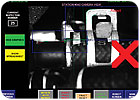
TestRun is a new vision tool that lets users quickly verify that the entire image formation system (lighting, lens, and sensor) is set up correctly. Photo courtesy Cognex
Up and Running
The startup period for a vision system will vary depending on volume, says Ochiai. For high-volume applications, this period could be as little as a few hours. In contrast, weeks may be required to thoroughly verify lower-volume or irregular applications.During this time, the manufacturer needs to measure accuracy and repeatability by making sure the system clearly and consistently differentiates bad from good parts.
In addition, the manufacturer needs to verify that data between the camera and PC or PLC is being communicated as quickly as possible. This can be done by making sure there is no noise on the line and by not using network interface cards, which reduce processing speed and add cost.
Once system accuracy, repeatability and data communication are verified, full operation can begin. During operations, environmental problems can arise-such as the presence of dirt, dust, oil and humidity. In such conditions, it’s a good idea to put the camera in an enclosure, which is also easier to clean than the lens.
Lenses need to be cleaned regularly. Also, over time, lighting requirements and system parameters may change due to normal process or supplier variations. After several years, certain components might need to be replaced.
“Use vision as much as possible, as early as possible,” says Buttress. “Don’t wait to use it after steps one, two and three of the assembly. Use it at each step to ensure quality.”
Looking for a reprint of this article?
From high-res PDFs to custom plaques, order your copy today!