U.S. Army Invests in New Assembly Technology to Boost Drone Production
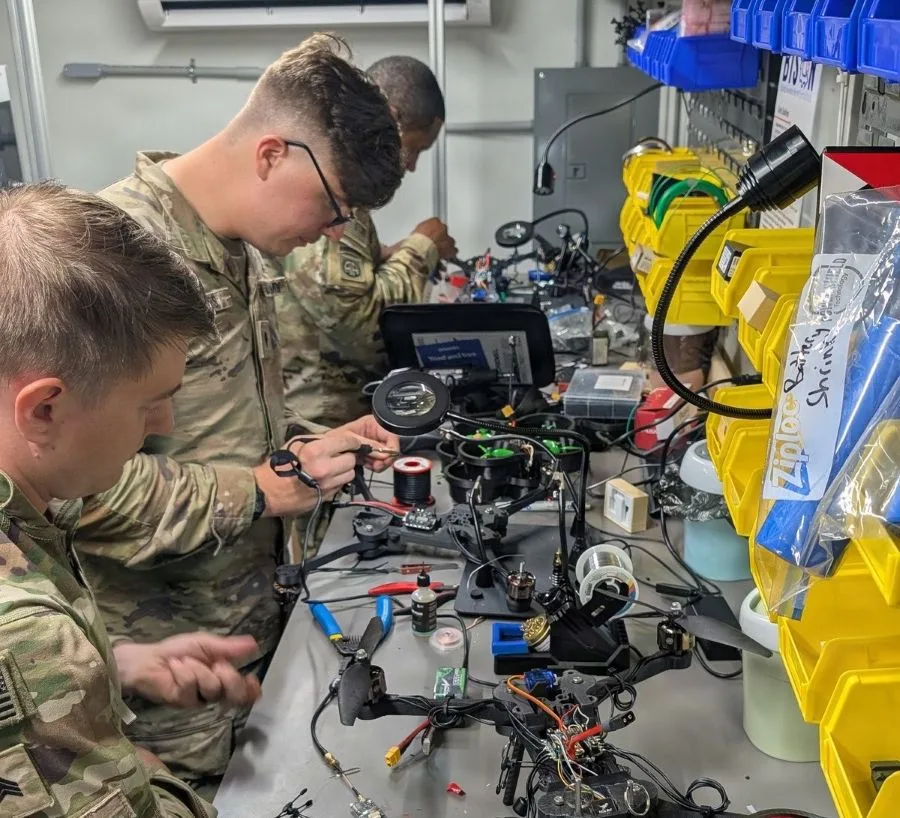
The U.S. Army is exploring new ways to mass-produce drones for military applications. Photo courtesy DEVCOM Army Research Laboratory
TOBYHANNA, PA—As part of a new Drone Dominance initiative, the U.S. Army is scaling up parts production at its facility here. The goal is to create a vertically integrated supply base for electric motors, power electronics and other critical components needed to mass-produce unmanned aerial vehicles for military applications.
The Tobyhanna Army Depot (TYAD) recently ramped up a new brushless motor assembly line that is capable of making 500,000 devices annually. The facility is also in the process of installing a state-of-the-art assembly line for printed circuit boards.
“This is our most modern depot, and Team Tobyhanna is our most aggressive and forward-thinking workforce,” says Lt. Gen. Christopher Mohan, commanding general of Army Materiel Command. “TYAD’s ability to rapidly surge production, deploy field support teams and scale for contingency or theater-level operations makes it a vital contributor to strategic readiness and operational reach.”
In addition, TYAD is installing automated wire harness assembly equipment, using five-axis robots supplied by Q5D Technologies. According to Mohan, the goal is to “support production modernization and manufacturing readiness by introducing automated wiring technologies designed to complement the highly skilled depot workforce and improve the speed, repeatability and scalability of electrical assembly operations.”
"Advanced manufacturing is changing how critical systems are produced, repaired and modernized," adds Pat Sullivan, chief revenue officer at Molrix, a systems integrator working on the project. “Complex wire harness manufacturing and electrical integration have long represented bottlenecks for both production and depot repair activities, particularly as system designs become increasingly sophisticated.
“The initiative reflects the growing need to leverage commercial technologies to transition advanced manufacturing capabilities into operational use,” explains Sullivan. “By combining commercial innovation with engineering integration and workforce enablement, [we will] establish a foundation for more resilient, responsive and digitally enabled production capabilities.”
One system scheduled for delivery next month will support the Army’s SkyFoundry drone manufacturing initiative, which eventually hopes to mass-produce 1 million small drones annually using additive manufacturing technology. Two additional systems are due to be delivered to TYAD in September.
Looking for quick answers on assembly and manufacturing topics? Try Ask ASM, our new smart AI search tool. Ask ASM
Looking for a reprint of this article?
From high-res PDFs to custom plaques, order your copy today!