Flexible Assembly: Fact vs. Fiction
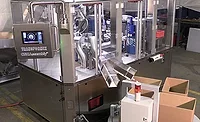
Wouldn’t it be great if high-speed, automated assembly systems were like the galley aboard the starship Enterprise in the TV show "Star Trek"? Just as the crew could enter any meal they wanted and get it in seconds, an OEM could enter an order for, say, 2 million electrical connectors one day and 1 million cigarette lighters the next, and the machine would produce both quickly and cheaply.
Such a machine is unlikely, of course, even in the far distant future. Still, given the six-digit price tag of a typical automated assembly system, OEMs can reasonably expect a certain amount of flexibility from their equipment.
"Assembly machines are generally limited by attributes such as processes, motions, precision, cycle rates, part size and weight, and component feeding," says James Smith, engineering manager with Sibos Ascor Inc. (York, PA). "When another product has characteristics that fit within these parameters, [even if it is not] within the same industry, the machine has the potential for conversion."
Ralph Vatterott, executive vice president of Rapid Development Services Inc. (Chesterfield, MO), agrees. "You can expect to run similar, but completely different products interchangeably on the same system," he says. "We’ve done systems that can run seven or eight different products. The products typically have to be in the same family, but they’re not necessarily the same product."
Automotive rectifiers are a good example, says Vatterott. His company recently built a system that assembles six models of rectifier for an automotive aftermarket supplier. Regardless of the vehicles for which the rectifiers are made, they all share similar parts and circuits. "At the same time, they may have completely different shapes, part locations and even assembly methods. Some might require epoxy, and some might require press fits," he explains.
SomeArial it’s not the arrangement or variety of parts that requires flexibility, but the size of the parts. Vatterott recalls a system that Rapid Development built to assemble wire nuts. The system produces six sizes of wire nut interchangeably, despite a significant size difference between the largest and smallest nuts. Adjustable tooling makes this possible.
There are other reasons to seek flexibility in automated assembly systems, besides the need to assemble a family of products. One is the ability to cope with short product life cycles. Consider the cell phone, says Paul Beduze, manager of business development at Mikron Corp. Denver (Aurora, CO).
"Cell phones are obsolete in a year," he points out. "A manufacturer like Nokia...does not want to make a huge investment every year in an assembly line for a product that will be similar, but different, than the last product."
Looking for quick answers on assembly and manufacturing topics? Try Ask ASM, our new smart AI search tool. Ask ASM
Another benefit of flexibility is that the product and processes can be developed concurrently with the assembly system. In fact, manufacturers often use flexible, standardized systems to introduce new products to the market, until dedicated machines can be brought on-line. This gets the products to the market quickly. If market feedback alters the product design, the risk to capital investment is minimal. When the design is finalized and production volume increases, the product and its tooling are migrated to the dedicated system.
Howard Speiden, customer dialog section head for Sortimat Technology (Schaumburg, IL), recalls working with a customer on such a solution.
"The manufacturer knew his volume would eventually be high enough to justify a fully automated system," Speiden says. "However, he knew there was a big risk in committing to a dedicated system before the product design was frozen, so he went with a flexible system initially and planned for a dedicated system later.
"It turned out to be a good decision, because the design engineers discovered they needed to add some components to the assembly. Because they invested in a flexible system, we simply added another module to process the new components. When the company was ready for a dedicated system, we included the new module in the design before any steel was cut."
The Flip Side
Flexibility doesn’t come without some trade-offs, and the biggest is cost. "Typically, a flexible machine is going to be more expensive [than a dedicated machine]," admits Vatterott. "But, it’s not going to be 50 percent higher. It’s more like 15 percent or 20 percent higher, and instead of buying two or three systems, you only buy one."Why are flexible machines more expensive than dedicated systems? It all boils down to the hardware, says Scott Bellows, CMfgE, president of Eastern Automation Systems Inc. (Farmingdale, NJ). Servomotors are more expensive than pneumatic actuators. Multipiece, adjustable fixtures are more expensive than fixtures that have simply been milled out.
Efficiency is another trade-off. Highly flexible systems may be unable to match the speed of dedicated systems. And, time spent on changeover is time that the system isn’t building product.
"Component feeding and machine utility are issues that can detract from the advantages of flexibility," says Smith. "If component supply via feeder bowls, reels or trays is significantly different from one product to the next, flexibility may be too extreme to be practical. For machines that are designed to run multiple products, the time and resources required to convert the machine vs. the length of production runs may result in higher operating expenses and low productivity."
Other trade-offs are space utilization and maintainability. Compared with a dedicated machine, a flexible machine often has a larger ratio of size vs. throughput. And, because flexible systems have many adjustable mechanisms, ease of maintenance and setup is a concern.
Not every manufacturer needs flexibility, adds Speiden. At very high volumes, equipment utilization will be so high there will not be time or need for frequent changeovers. If annual production volume is at least 5 million units, or if the product’s market life is expected to be at least 5 years, manufacturers are better off with a dedicated machine.
The Elements of Flexibility
One way to make assembly systems flexible is to separate assembly processes into modules, says Joerg Starkmann, vice president of engineering and sales at Teamtechnik Corp. (Tucker, GA). These modules can be stand-alone units connected with pallet conveyors, or they can be individual machines that plug into base stations. Either way, standardized I/O and control software enable the modules to communicate with each other and a central controller."Standardization provides flexibility," Starkmann says. "It’s not what you add, but how you add it."
Another way to achieve flexibility is to control motion with servo-driven actuators instead of pneumatic actuators or cams. Although more expensive, servo-driven actuators enable assemblers to change motions simply by entering a new value in the control software.
Another ingredient of flexibility is robotics. "If you want a highly flexible system, robotics is absolutely key," says Vatterott. "The programmability of a robotic system gives you the ability to change locations on an assembly or change center distances between assemblies quickly and easily. You just change the program."
The fixtures in a flexible assembly system are critical for fast changeovers. For example, a fixture can be made so that product variations overlap within it. When designing such fixtures, machine builders look for common features within the product family. "It might be a registration hole or it might be an edge, and all the progressions or size increases are biased toward one side, away from that feature," Speiden explains.
Alternatively, the fixtures can be adjustable. One or more sides of the fixture can be built on slides, so that the length and width of the fixture can be changed. Engraving a scale or tick marks on the slides will help operators during changeover.
If fixtures must be moved or changed, dowel pins, keys and integrated measuring instruments will ensure that new fixtures are located correctly.
As for processes, machine builders agree that no one process is more flexible than another. However, they do advise manufacturers to standardize processes and operation sequences whenever possible.
"If product engineers are exposed to the methods and limitations of the assembly equipment, the time and expense associated with introducing new or revised products to production can be minimized," says Smith.
Making it Happen
Maximizing flexibility in an automated assembly system requires more than just robotics or servo drives. It takes careful planning, too, beginning with the product design. Engineers should anticipate how the product might evolve 1 to 3 years in the future. Which features will change? Which will stay the same? Features that will likely carry over from one iteration to the next are ideal fixturing keys."Once you make a machine a certain way, you can’t make it for anything else," warns Bellows. "So if you know, at design, what your product may look like in 5 years, you can leave extra room or tap extra holes to accommodate that change. Machine builders can design a system to handle alternatives without debugging it for those alternatives. They can design alternative tools without making them. That way, when the original part becomes obsolete, you don’t have to pay for a new machine, you just have to pay for new tooling."
Bellows remembers a customer who wanted a machine to assemble two electrical connectors. One was in current production; the other was for a product that would debut in several years. "The two parts didn’t look anything alike," he recalls. "Fortunately, our feeder bowl supplier was able to make a bowl flexible enough to handle both pieces. That enabled us to use servo-driven controls and hardware on the assembly machine.
"When it was time to produce the new connector, we easily reprogrammed the machine to handle the new part. The connector company did not have to buy a new machine, but it paid for that flexibility years earlier."
One way to create a family of products that can be assembled on the same system is to design the products around a constant housing or packaging profile, Speiden advises. Features can then be added or removed to delineate products within the family.
Source List
Eastern Automation Systems Inc.Farmingdale, NJ
732-938-2002
Mikron Corp. Denver
Aurora, CO
303-364-5222
www.mikron-tg.com
Rapid Development Services Inc.
Chesterfield, MO
636-519-1444
www.roboticintegrator.com
Sibos Ascor Inc.
York, PA
717-428-0994
www.sibosascor.com
Sortimat Technology
Schaumburg, IL
847-925-1234
www.sortimat.com
Teamtechnik Corp.
Tucker, GA
877-233-5198
www.teamtechnik.com
Looking for a reprint of this article?
From high-res PDFs to custom plaques, order your copy today!