Manufacturing Fact vs. Science Fiction
Here’s a look at some manufacturing technologies of today that were once predicted in science fiction stories

For more than 200 years, science fiction writers have speculated about future technologies and their impact on society.
Many technologies that we take for granted today were originally “invented” in science fiction. These include mobile phones, smart watches, tablet computers, holograms, electric submarines, antidepressants, radio, television, nuclear weapons, lasers, video conferencing, credit cards, wireless headphones, self-driving cars, unmanned aerial vehicles, escalators, radar, automatic doors, Tasers, virtual reality, space travel, individually targeted advertising, and even insect-derived foods.
Science fiction has not solely been about spaceships, aliens and time travel. A few writers have extended their creative vision to manufacturing.
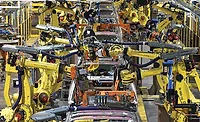
“My father’s dream! The complete utilization of mechanical power. With a single press of a button, the work of a whole factory begins without anyone to watch or guide it.” So brags a quintessential “mad scientist” in Otfrid von Hanstein’s science fiction short story, “The Hidden Colony,” published in 1935. More than 80 years later, von Hanstein’s vision isn’t that far from reality.
For example, at Merit Medical Systems’ assembly plant in South Jordan, UT, some products go from resin to finished, sterile packages with almost no manual labor. The factory is equipped with 61 injection molding machines that run 24/7 in clean rooms. When a batch of parts is finished and accepted, those totes—there could be 10 or 20—get placed on a conveyor, which automatically transfers them to a warehouse 500 yards away. The system reads a bar code on the totes—recording the part number, lot number and quantity—and stores them automatically. Operators don’t need to touch them.
There are 22,000 tote locations in the factory’s raw material parts inventory. When Merit gets an order for finished assemblies, an operator scans a bar code on the bill of materials, and the system automatically retrieves what’s needed, taking the oldest lots first. The operator consolidates the parts into a large bin and delivers the entire lot to the assembly line.
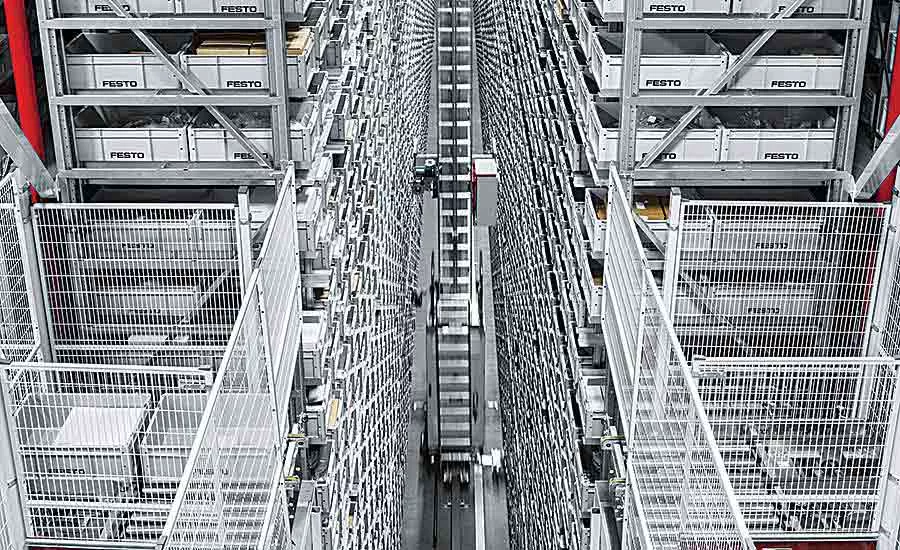
Similarly, Festo Corp.’s state-of-the-art distribution and manufacturing center in Mason, OH, features a highly automated order-picking system comparable to the sophisticated warehouse systems of major retailers like Amazon. With a storage capacity of 65,000 bins, the highly automated warehouse system features seven high-performance picking stations, enabling workers to pick and pack 1,000 items per hour. The stations were developed according to strict ergonomic specifications. Each workstation can handle up to four customer orders at the same time. A pick-to-light system and an integrated scale ensure accurate order fulfillment.
Looking for quick answers on assembly and manufacturing topics? Try Ask ASM, our new smart AI search tool. Ask ASM
Components are stored in a ten-aisle automated storage and retrieval system with 73,000 locations. Totes of various sizes are in constant motion along a highway of automated roller conveyors. Buffers provide ordered goods to the workstations at an optimal workload for logistics personnel.
Such highly automated operations might not be the complete embodiment of von Hanstein’s imagination, but they’re close. (For more on “lights-out” automation, see senior editor Austin Weber’s article beginning on page 90.) Here’s a look at some other manufacturing technologies of today that were once predicted in science fiction stories.
Exoskeletons
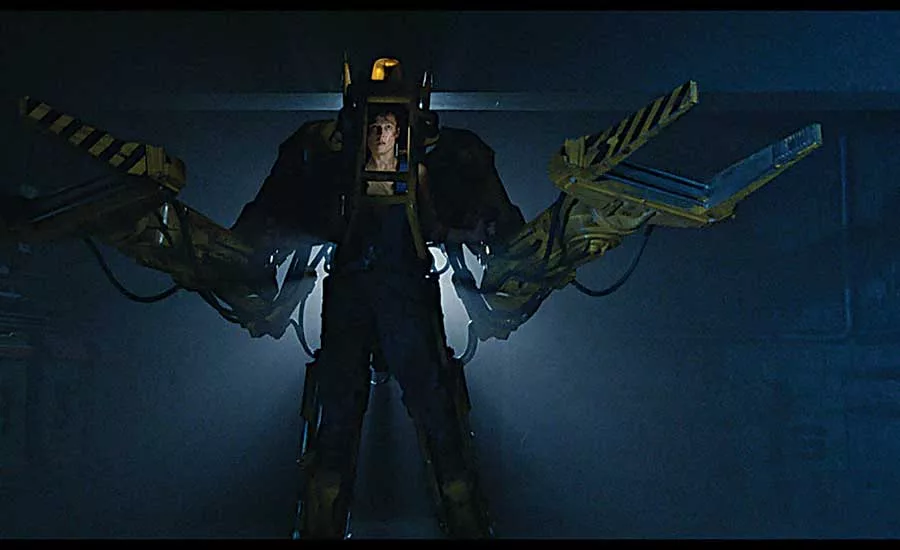
In the climactic scene of James Cameron’s 1986 sci-fi action movie “Aliens,” Lt. Ellen Ripley dons a heavy-duty robotic exoskeleton to combat the alien queen. While engineers are a long way from developing an electromechanical suit that can enable a person to lift hundreds of pounds, several companies have introduced exoskeletons that can at least reduce strain and fatigue on the assembly line.
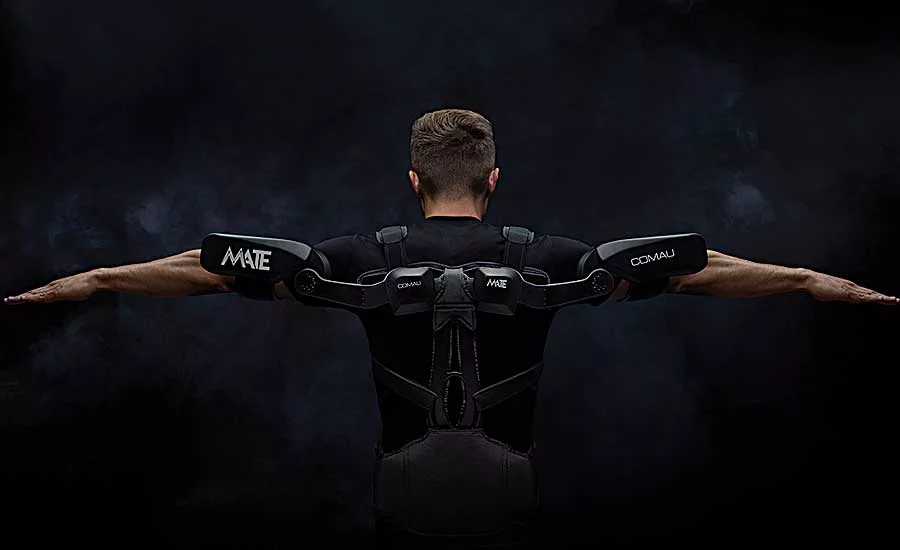
For example, Comau recently unveiled the MATE, a wearable exoskeleton that assists and supports workers performing repetitive and strenuous tasks on the assembly line. The exoskeleton has an advanced, spring-based passive structure. The lightweight structure fully follows the movements of the upper limb without resistance or misalignment. Compact and breathable, the device delivers postural support without the need for batteries, motors or other failure-prone devices. The exoskeleton is fully able to replicate any movement of the shoulder while adhering to the body like a second skin.
The device enables assemblers to perform repetitive, strenuous tasks with less fatigue, and less fatigue equates to better quality and higher precision over the course of a shift. Tests have shown that the MATE reduces shoulder muscle activity by up to 50 percent.
“MATE has been designed in close collaboration with factory workers, responding directly to their specific needs,” says Tobias Daniel, Comau’s vice president for global sales and marketing of robotics and automation products. “With our exoskeleton, they will be able to do the same tasks, but with less fatigue.”
A similar new product is the EksoVest from Ekso Bionics. Made from carbon-fiber composites and fabric mesh materials, the vest weighs just 9.5 pounds. Like the MATE, the EksoVest is designed to strengthen the movement of the upper arms when carrying out repetitive, overhead tasks. And, like the MATE, the EksoVest is a passive exoskeleton with no electrical power. The lift support is supplied by the potential energy stored in gas springs that are installed in the actuators at each shoulder. The springs can be swapped out to achieve different levels of lift support to suit different applications and operator preferences.
“The EksoVest provides 5 to 15 pounds of lift assistance to each arm to support a wide range of workers and applications,” says Zach Haas, industrial product manager at Ekso Bionics. “The biggest benefit of using upper-body exoskeletons on assembly lines is that workplaces experience increased endurance and reduced fatigue. Over time, the assistance provided by exoskeletons can lead to fewer on-site injuries, as well as some tasks being completed faster and with higher quality results.”
The projected lifespan of the device is 5 million to 7 million cycles, which translates into somewhere between three to five years of everyday use on a typical automotive assembly line.
Unlike the robotic exoskeleton in “Aliens,” neither the MATE nor the EksoVest allow workers to lift more weight than they could before. Rather, the devices are designed to improve assemblers’ endurance and reduce the amount of fatigue they experience over the course of the work day.
Ford, BMW, Boeing, AGCO and Whirlpool are among several manufacturers that have already begun testing exoskeletons on their assembly lines.
Additive Manufacturing
In the original “Star Trek” television series, the USS Enterprise was equipped with machines called replicators that could create virtually any object on demand. Replicators were originally seen used to synthesize meals on demand, but in later series they took on other uses, such as producing spare parts and clothing.
A replicator supposedly worked by rearranging subatomic particles to form molecules and then arranging those molecules to form an object. For example, to create a pork chop, the replicator would first form atoms of carbon, hydrogen, nitrogen and other elements; arrange them into amino acids, proteins and cells; and finally assemble the particles into the form of a pork chop.
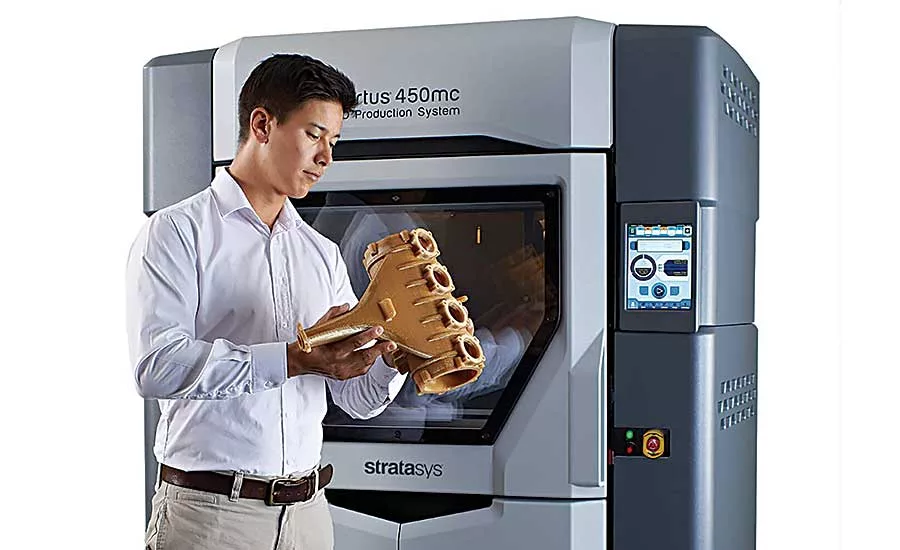
Alas, that technology will likely never exist. Today, however, a variety of 3D printing technologies are enabling manufacturers to create—on demand—prototypes, tooling and production parts in plastic, metal, silicone, thermoplastic elastomer, wax, ceramic or composite materials. There are even 3D printers for chocolate and human tissue.
Additive manufacturing has evolved from a low-volume prototyping tool to a high-volume process that can mass-produce parts that can be bolted onto a plane or attached under the hood of a car. The technology has been used to produce parts ranging from custom-made prostheses to cabin walls for jetliners.
In 2016, engineers at Oak Ridge National Laboratory manufactured the world’s largest 3-D printed object: a large-scale trim tool for the Boeing 777X. Measuring 17.5 feet long, 5.5 feet wide and 1.5 feet tall, the tool will hold the jet’s composite wing skin while it’s drilled and machined. The tool, which weighs 1,650 pounds, was made by spraying layer upon layer of a mixture consisting of 80 percent ABS and 20 percent carbon fiber.
Automatic Guided Vehicles
“The truck regarded them calmly, its receptors blank and impassive. It was doing its job. The planetwide network of automatic factories was smoothly performing the task imposed on it five years before. …Cut into the base of the mountains lay the vast metallic cube of the Kansas City factory. …Most of the factory was buried subsurface, only its entrance stages visible. The truck was a speck rumbling at high speed toward the expanse of black metal. Presently an opening formed in the uniform surface; the truck plunged into it and disappeared inside.”
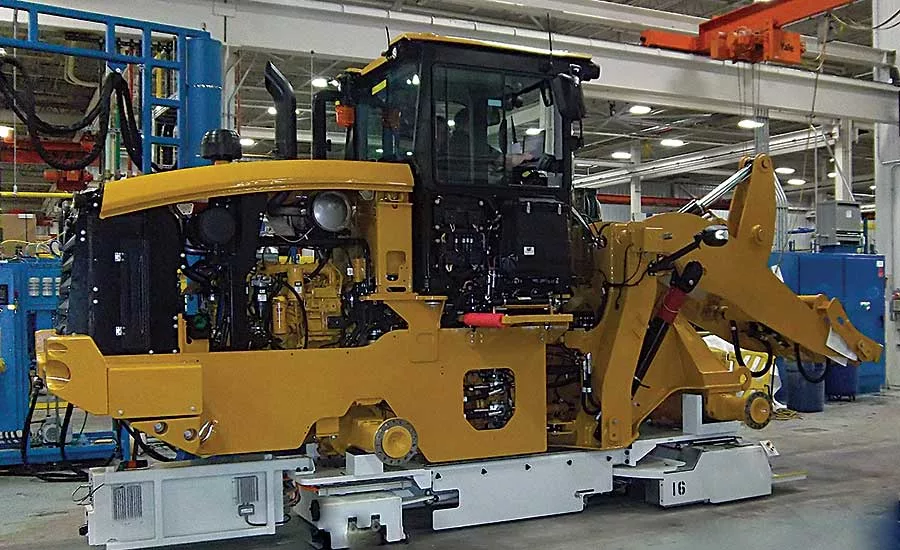
So wrote Philip K. Dick in his short story “Autofac,” published in Galaxy magazine back in 1955. While we are not yet at the point where autonomous vehicles deliver truckloads of parts to factories, automatic guided vehicles (AGVs) are now efficiently transporting parts and assemblies within assembly plants.
AGVs are transforming the way materials are moved within factories and warehouses. In a production environment where several operations are carried out simultaneously, these vehicles can ensure predictable and reliable transfer of raw materials and manufactured products from one point to another within the facility, eliminating potential disruptions in production.
Equipped with vision systems, LiDAR and other sensors, AGVs can operate safely around structures, machinery and employees. They detect intersections, identify floor signs, and avoid collisions with obstacles.
According to Grand View Research Inc., worldwide sales of AGVs are expected to grow at a cumulative annual rate of 15.8 percent over the next five years, reaching $7.28 billion by 2025.
Looking for a reprint of this article?
From high-res PDFs to custom plaques, order your copy today!