Lean + Flexibility = Throughput
Achieving continuous improvement in high-mix, variable-demand manufacturing is never easy. An evolving manufacturing philosophy that focuses on mapping processes and identifying ways to eliminate potential bottlenecks generally yields better results than simply introducing a new program or process to the floor.
In addition, cost alone may be misleading if potential throughput improvements are not considered in evaluating capital equipment acquisitions. Equipment manufacturers can be valuable partners in an improvement process when they work with their customers to increase production flexibility through equipment modification. Employees are also key elements in enhanced production flexibility, provided that training, information system support and compensation are aligned with the broadened job expectations.
Synchronous flow manufacturing incorporates lean principles such as inventory minimization, visible production status indicators and a pull system on the factory floor. However, it also relies on core manufacturing philosophies that predate lean. It focuses on increasing scheduling flexibility through standardization of production processes instead of increased standardization of products. This focus on integrating multiple philosophies to increase scheduling flexibility and improve throughput is especially beneficial to manufacturing companies with higher mix production environments, particularly those with variable demand because this environment contains inherent bottlenecks that are not well addressed by limited-focus lean implementation or by strategies that involve extensive product redesign.
High-volume low-mix manufacturers design and manufacture a limited number of products. Consequently, when they initiate continuous improvement efforts, they enjoy a wide range of options for optimizing processes and their supply base.
However, it's a different story for electronics manufacturing services (EMS) providers and OEMs in industries with lengthy product qualification cycles, long product life cycles or high-mix, low-volume production quantities. They are limited in the degree to which they can modify existing products or processes. In such environments, potential barriers to implementing continuous improvement initiatives can include:
- Inability to fully control or rationalize the supply base.
- Frequently conflicting demand requirements over a limited pool of production resources.
- Significant variance in product forecast preferences.
- Variances in project team support of continuous improvement efforts.
- Difficulty in recovering the costs of redesign either due to product requalification costs or low volumes.
To overcome these barriers, the high-mix variable-demand manufacturer must focus on the single philosophy of optimizing throughput by increasing production resource flexibility. This approach involves four key elements:
- Use detailed process mapping to understand the key processes involved in transforming production inputs to customer-desired outputs.
- Develop specific strategies to eliminate constraints. These include working with equipment suppliers, material suppliers and employees to develop unique solutions for maximum flexibility.
- Standardize the manufacturing process through common equipment selections with minimal changeover time between products and focus on smaller lot sizes.
- Develop simple tools that ensure rapid exchange of real-time information.
The philosophy of increasing production resource flexibility to optimize throughput has been applied successfully in an EPIC Technologies manufacturing plant in Juarez, Mexico. This plant will serve as the manufacturing model to illustrate by example how these four elements can be implemented.
Identify Constraints Through Process Mapping
Process mapping must consider all elements of production from supply base through customer acceptance of product. The basic assumption is that less resources and smaller lot sizes drive greater flexibility because simpler systems are easier to manage. Fundamentally this translates to:
- Smaller lot sizes reduce raw material inventories, work-in-process and finished goods inventories.
- Equipment selection and modification should focus on minimum changeover time.
- A smaller, highly trained workforce can be mobile and capable of staffing a varying mix of factory processes based on current production demand.
- A core set of metrics that allows for real-time measurement of internal improvements is needed to support focus on rapid continuous improvement.
Develop Strategies to Eliminate Constraints
Many lean manufacturing initiatives are derailed by making improvements in small steps rather than taking a big picture approach. Process mapping provides a roadmap for internal change. Armed with a roadmap, engineers can develop specific strategies for eliminating constraints by collaborating with equipment suppliers, developing a supply base management strategy, and developing a mobile workforce.
At the Juarez plant, collaboration with equipment suppliers eliminated bottleneck processes in several ways. Higher cost equipment was selected for the wave soldering and reflow processes because it provided broader process windows. The wave soldering machine was further modified by the manufacturer to allow soldering of multiple board types from several lines simultaneously with instantaneous profile changes. Placement bottlenecks were minimized by installing standardized placement equipment with minimized changeover and programming requirements. Test equipment was arranged as workcells instead of dedicated to specific lines. Component programming equipment was added to increase flexibility in raw material inventory options.
Looking for quick answers on assembly and manufacturing topics? Try Ask ASM, our new smart AI search tool. Ask ASM
Engineers should develop a supply base management strategy that ensures availability of material for current demand, and focuses both internal and supply base efforts on dealing with long-term issues. In the Juarez plant, MRP software is used only to generate the raw material forecast that represents potential demand, not actual delivery schedule. Orders are released by scanning bar codes on kanban cards. Buffer quantities are established, and suppliers submit weekly bond reports that represent their net buffer position over time.
Each part in the bond reports is color-coded green, yellow or red to represent how the future availability matches the most recent forecast. The buffer quantity of green-coded items is above the minimum targeted amount. The buffer quantity of yellow-coded items is less than the targeted amount. If the buffer quantity falls to zero the items are coded red. Thus, suppliers are warned of an impending buffer shortage early enough to take effective proactive measures well in advance of potential production interruptions.
Engineers also should develop a mobile workforce capable of supporting demand in multiple operations, so that employees can migrate across multiple work areas depending on the production requirements of a given shift. The fundamental support system includes cross training, an intranet accessible from the production floor, and a job focus that places responsibility for output in the hands of each production operator.
Core processes should be mapped throughout each facility, and this information should then be integrated into quality policies, work instructions and job descriptions. Work instructions, quality manuals and other production documentation for every project should be available from a central database and accessible to production operators via computer terminals on the production floor. Any employee in production should be able to pull up a job description that graphically outlines important information, including the tools and documentation needed to perform the job, other functions with which this job interfaces, the processes used, the methodology used to measure results, and the critical criteria used to measure quality of output.
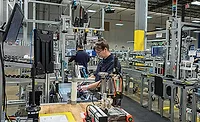
All production operators in the Juarez plant are cross-trained in several production processes and certified for a range of skills. An intranet system provides documentation in both English and Spanish, and the system is accessible in both U.S. and Mexican factories. Work instructions are displayed on workstation monitors instead of being distributed as paper copies in some assembly areas. This facilitates quick line changeover and documentation integrity, as all documentation is stored in a central location with tight revision control. An added benefit is that production operators can magnify work instruction photos to better display their portion of the assembly operation.
Standardize the Manufacturing Process
Within the synchronous flow philosophy, great emphasis is placed on standardization of production resources. Instead of having several production lines configured to a variety of different placement strategies, the emphasis shifted to increasing the flexibility of a finite amount of equipment, while improving throughput by running smaller lots. All component placement equipment in the Juarez plant has been standardized to a single manufacturer. Extra feeders have been purchased and raw material is loaded directly onto feeders from point-of-use stocking locations. These feeders are set up off-line for an entire product family and quickly loaded onto the line as the prior project clears each machine.
Multiple lines of placement equipment feed into a single wave soldering system. The wave soldering equipment was modified for changing process parameters on the fly, allowing multiple products to run over a single wave soldering machine simultaneously with virtually zero changeover time. The machine supplier modified the machine so it can change temperature profiles based on signals received from a bar code scanner. The wave soldering machine is linked to the conveyor system with a bar code reader that transmits data to change process parameters dynamically based on individual product characteristics. The automated conveyor line changes speed to accommodate temperature profile adjustments. Multiple lines with a diverse range of products now feed into one wave soldering system.
The vapor phase system uses an inert Teflon-based fog. Because the high moisture content atmosphere has superior thermal transfer properties compared to traditional infrared or convection systems, the entire board reaches the same temperature at the same time. This eliminates shadowing effects or hot spots, and allows one thermal profile to fit all applications. An additional benefit of this focus on equipment optimization is the ability of the vapor phase oven to support lead-free soldering at conventional reflow temperatures.
Develop Tools for Real-Time Information Exchange
Production order status in the Juarez plant is easily visible by referring to simple color-coded cards held in slots adjacent to each workcell. Operators are empowered to prioritize the production sequence for each line based on the color-coded pull signal, with red having highest scheduling priority, yellow the next highest and green representing the lowest priority. A factory with a high number of green cards in queue is running optimally. The intranet supports extended visibility into production status at other facilities.
Management performance information is shared via a plant operating review system that monitors approximately 50 metrics companywide down to the floor level. These metrics are reviewed on a daily and weekly basis by project personnel, monthly by the plant managers and vice president of operations, and quarterly by the senior management team. Where multiple plants are involved, the same metrics should be used in every plant, which allows comparisons in plant performance.
Quantify Throughput Improvements
In determining whether this strategy is appropriate for a given facility, there are cost factors to be considered. Modified or customized equipment, such as the wave soldering and solder reflow systems, is typically about double the price of standard systems used in electronics manufacturing. If a manufacturer is deciding whether to purchase modified equipment, these costs must be weighed against the savings associated with significantly higher throughput on the factory floor. Just as importantly, the savings associated with reduced raw material inventories, work-in-process and finished goods must be considered.
While capital cost can double per machine, increased throughput with fewer machines minimizes that expense factor. The facility in Juarez assembles 26,000 to 28,000 printed circuit boards per day, on average. The product mix on these assemblies is typically 30 to 40 unique part numbers per day. The average cycle time from soldering to shipping box is 7.5 hours per board type, and there is no more than 4 hours of work-in-process at any given point in the process.
By increasing production resource flexibility to optimize throughput, the Juarez facility has saved money in several ways, including:
- Machine downtime. Because the wave soldering machine changes parameters automatically by reading the bar code on each board, there is no machine changeover downtime between board types. Because up to 12 lines feed a single machine, there is no line downtime factor in machine utilization. In a traditional model, a line making three changeovers per day could have up to 6 hours of downtime attributable to changeovers, either related to changing equipment parameters or simply changing work instructions and material used on the line.
- Preventative maintenance (PM) cost. Fewer machines require less PM expense, fewer technicians, less spare parts inventory and fewer solder pots to maintain. PM time averages less than 2 hours per day. In a traditional system using several machines, spare parts inventory and PM time can be two or three times greater, depending on the number of machines. The reliability track record of this modified equipment has been excellent; the wave soldering system has had only 3 hours of unscheduled downtime on in the past 3 years.
- Environmental benefits. Less downtime equals more efficient machine utilization and therefore minimizes dross accumulation and waste disposal. Fewer machines use less electricity and consume less solder. They also generate less heat to be offset by the climate control system.
- Factory floor space. Factory space utilization improves because fewer wave soldering machines require less floor space. The improved efficiency from feeding multiple lines into a single machine also minimizes work-in-process, which also consumes floor space.
The pace of change in technology and cost pressure created by globalization will continue to challenge production management to apply existing manufacturing philosophies and resources in new ways. The most efficient production facilities aren't the result of a single program, process or technique but the combination of proven practices and innovation driven through manufacturer and supply base collaboration.
Looking for a reprint of this article?
From high-res PDFs to custom plaques, order your copy today!