Error-Proofing Manual Assembly
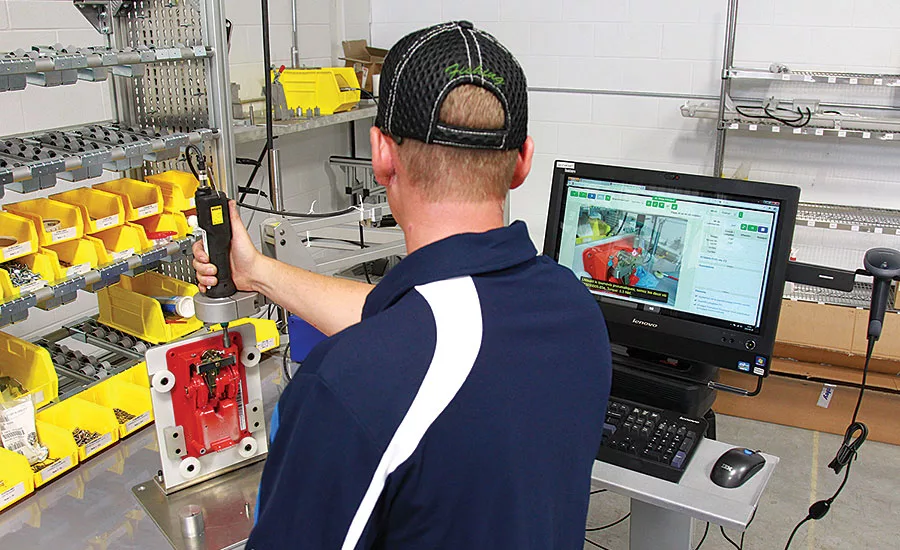
Today, flexibility is more important than ever because of shrinking product life cycles and increasing demand for built-to-order products. Photo courtesy Visual Knowledge Share Ltd.
When it comes to manufacturing, the best assembly process in the world can still fall prey to such prosaic constraints as operator fatigue, inattentiveness, time pressure, and plain-old carelessness. The results-scrap, waste and decreased profits-are something manufacturers can ill afford in a competitive world.
To maximize quality and efficiency, U.S. manufacturers are increasingly embracing the Japanese concept of poka-yoke (pronounced POH-kah YOH-kay), or mistake-proofing. Poka-yoke devices are mechanisms that prevent mistakes from being made or that make mistakes obvious at a glance. Besides reducing the cost of scrap, rework and warranty claims, mistake-proofing provides a less obvious benefit: It gives workers time to think about how to improve the assembly process. Instead of acting as mere extensions of their machines, operators are free to manage their environment.
The most common sources of product defects are errors in setting up workpieces and equipment, omitted processing steps, processing errors, missing parts and wrong parts. More often than not, the devices for preventing these errors are simple and inexpensive, especially in the context of manual assembly. In some cases, errors can be prevented by changing the shape of the part or the fixture. In others, electronics come into play. A sensor can be installed to ensure that an assembly process won't begin until the correct part has been installed in the correct position; a limit switch can be used to make certain that the correct number of assembly steps has been performed.
A classic example of a poka-yoke device is a parts kit. All the parts required for an assembly are loaded into the kit, which is typically a thermoformed plastic tray. Cavities in the tray are designed to match the shape and number of parts in the assembly. Before beginning an assembly, the operator immediately knows if any parts are missing. Similarly, if any parts are left over after assembly, the operator knows it was done incorrectly.
In the book Poka-Yoke: Improving Product Quality by Preventing Mistakes (Productivity Press, 1988), editor Nikkan Kogyo Shimbun offers an example of how a product design can be modified to prevent mistakes. An electrical products company made a timer switch that was equipped with a frequency selection mechanism allowing it to be used in areas with either 50- or 60-hertz power. The 50- and 60-hertz gears were installed next to each other on the same shaft. The only difference between the two gears was three teeth, making it difficult to tell the gears apart with the naked eye. Because the gears fit interchangeably on the shaft, assembly errors were common.
To error-proof the assembly, engineers modified the holes in the gears and the shape of the shaft to that the gears could only fit on the shaft one way. In addition, the 50-hertz gear was molded in white plastic and the 60-hertz gear was molded in blue plastic, so they could be identified at a glance. Installation errors were eliminated at no increase in product cost.
In this same vein, mistakes can often be prevented by re-examining the assembly entire line for sources of error. For example, in a modular workstation environment, a manufacturer can set up a progressive system in which each operator is responsible for adding just one component of the assembly. This helps with error-proofing, because each operator has only one task to do and can be trained to do it very well.
Looking for quick answers on assembly and manufacturing topics? Try Ask ASM, our new smart AI search tool. Ask ASM
Similarly, by better organizing the workstations on a line, a manufacturer can reduce the chance that operators will make simple, but expensive mistakes. For example, a workstation's uprights can be equipped with clearly marked, color-coded part bins. Document holders can display assembly drawings or instructions. A manufacturer might even install a flat-screen computer monitor to display the different steps in an assembly process, making it easy for operators to access information via a touch-screen interface.
When installing threaded fasteners, engineers should take a good hard look at their product designs with an eye toward reducing the number and types of fasteners being used. In addition, setting up a line so that one operator is responsible for installing one type of fastener will reduce the possibility that an operator will install the wrong hardware.
In our next issue: Error proofing using electronic process monitoring and in automated assembly.
Looking for a reprint of this article?
From high-res PDFs to custom plaques, order your copy today!