Manual Assembly Presses Are Simple and Flexible
Manual assembly presses continue to outsell pneumatic and servo-driven presses for three reasons: lower price, greater flexibility and simpler operation.
Like soldiers, rows of BalTec Corp. manual assembly presses stand ready to work at electronic manufacturing plants throughout North America. Workers there use the presses to crimp wires to terminals and connectors.
The company’s presses are also used extensively in the auto industry. Chuck Rupprecht, vice president and general manager for BalTec Corp., says the presses are often located near, and used in conjunction with, riveting equipment.
“One of our Tier 1 customers in Michigan makes linkages for cars and trucks,” notes Rupprecht. “Their assemblers use a pneumatic machine to insert rivets and then use a manual press to insert a bushing.”
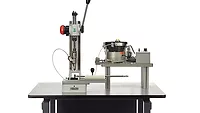
At its simplest, a manual press consists of a metal frame, ram and lever. The worker mounts a part in the base fixture and sets the ram height. He then pulls on the lever to press the ram (with tooling) down onto the part.
Simple operation is not the only appeal of manual presses, explains Rupprecht. They also cost much less and offer greater flexibility than pneumatic or servo-driven presses.
Over the last 20 years, suppliers have further increased the appeal of manual presses by increasing their output-force capacity, and offering quality-control options such as process monitoring.
“A manual press can be used in a plethora of assembly applications, from punching to marking and forming,” says Rupprecht. “It is a very cost-effective piece of equipment.”
Looking for quick answers on assembly and manufacturing topics? Try Ask ASM, our new smart AI search tool. Ask ASM
Three Types
There are three types of manual presses: rack-and-pinion, toggle and toggle with pneumatic assist. A rack-and-pinion press produces a constant linear force over the entire length of the stroke.
In a toggle press, the ram is connected via a toggle mechanism. The lever action of the toggle multiplies the force applied by the ram exponentially. The press produces little force at the start of the stroke, but delivers maximum force at the end.
Schmidt Technology Corp.’s rack-and-pinion presses include models 305 and 307 that produce a maximum force of 0.4 kilonewton to 12 kilonewtons. The presses have a throat depth from 128 to 248 millimeters and a working height from 50 to 600 millimeters.
“For quality control, the presses feature an electric stroke-return locking mechanism,” says David J. Zabrosky, North American sales manager for Schmidt. “It locks the press until the operator pulls the lever all the way down to complete a cycle.”
Schmidt also makes the 6R rack-and-pinion press. One manufacturer uses this press to insert a bowl-fed steel pin (0.062 inch by 0.057 inch) and complete a multicomponent assembly. The operator loads all components into a slide fixture and then pulls down the lever to insert the pin.
Durable Mecco has made rack-and-pinion impact presses for several decades. Manufacturers use the supplier’s MC stand-alone and U-model inline presses for marking, riveting, punching, crimping and other assembly operations. The inline presses are horizontal units that have a short stroke (1 to 2 inches) and a small square base.
“Because the presses operate on a spring-actuation principle, the degree of impact is easily adjustable and offers consistency,” says Matt Martin, director of sales and marketing for Durable Mecco. “Press capacity is adjusted by increasing or decreasing spring size or the tension setting. Various sizes of springs are available for each model.”
The MC stand-alone benchtop units include the 11D, 18D and 30D, which offer a maximum force of 1,333, 6,500 and 13,000 pounds, respectively. Inline presses 19U, 21U and 35U offer the same maximum forces as the MC units.
The press ram has a collet with threaded shank. Application-specific tooling is screwed onto the shank, which ranges in length from 6 to 16 millimeters.
Schmidt’s latest toggle press is the model 311. It has the same force, throat depth and working height capacities as the 305 and 307. The company makes 10 other toggle presses that produce 2.5 to 22 kilonewtons of force.
Among these is the 13RF, which one medical device manufacturer uses to insert four tiny marker-rivets into eyelets of a titanium stent. The operator loads a marker-rivet (0.027-inch in diameter) into the nest, lays the stent into a v-block for support, and places an eyelet over the marker-rivet. He pulls down the press handle, allowing the upper forming tool to contact the marker-rivet and form it to a fixed position in the eyelet. The operator then lifts the v-block and repositions the stent for the next marker-rivet installation.
A couple years ago, BalTec introduced the EP and L-EP 1200-60 toggle presses. They produce 12 kilonewtons of force and complement the company’s 7.5- and 15-kilonewton presses.
The L-EP model is specifically designed to handle tall or long parts. It has a daylight range of 75 to 338 millimeters. (Daylight is the distance from the bottom of the fully retracted ram to the fixture.) Rupprecht says the lever on both presses allows 360-degree variable adjustability, can be refitted for right- or left-handed operation and is laterally offset to ensure an unobstructed view of the work area.
Only TOX-Pressotechnik LLC makes toggle presses with pneumatic-assist. The company also makes rack-and-pinion and standard toggle presses with maximum force capabilities of 4 kilonewtons and 33 kilonewtons, respectively.
Manufacturers use a pneumatic-assist press to shorten cycle time and lessen worker strain, explains Bruno Maczynski, marketing manager for TOX-Pressotechnik LLC. It has a maximum force of 8.5 to 57.5 kilonewtons, depending on model, and is available with increased open height or throat depth.
The operator pulls the lever to complete a 54-millimeter approach stroke, leaving the ram positioned slightly above the fixtured part. He then presses a button on the lever to activate a 6-millimeter power stroke that ends when the lever or button is released.
How Does it Feel?
“Despite a manual press’s appearance, pulling its lever is not the same as pulling the arm on a slot machine,” claims Maczynski. “It’s definitely harder. How much depends on the size of the press and whether or not it’s oversized for the specific application.”
He says the closer to capacity a press is operated at, the greater its lever resistance. For example, the lever on a 3-ton-capacity press that assembles a part requiring 1.5 tons will be easier to pull than when the press assembles a part requiring 2.5 tons.
“There is more resistance when you pull on the toggle press lever because it delivers maximum force at the end of the stroke—similar to stapling a thick stack of paper,” notes Rupprecht. “The press needs to be properly sized and have the right tooling to prevent worker strain and maintain productivity.”
Baltec’s largest toggle press has a force capacity of 30 kilonewtons. Rupprecht says customers use it sparingly for very large crimping or bushing applications. “Having the operator use this press daily would give him arms like Popeye. Realistically, he’s using it maybe 10 to 15 times a week.”
Selection Process
A manufacturer needs to decide press type before researching and comparing specific models. In general, a rack-and-pinion press is recommended for pressing and forming, while a toggle is preferred for riveting, punching, flaring and crimping.
Several factors should be considered to select the right model. First and foremost, the press must produce more than enough force for the application. The main challenge, according to Maczynski, is to make sure the press is oversized but not too oversized (more than 25 percent) for every application. Failing to meet this challenge is costly because larger presses are more expensive.
Another challenge is making sure the press can be cycled quickly enough to meet required production levels—withoutputting workers at risk of arm strain or other injuries. If more workers and presses are needed to meet production levels, it might be more economical to use powered presses.
Ram type is another factor. Round rams are standard on all presses. Schmidt and BalTec offer a square ram as an option on its toggle presses. Both types of rams are made of case-hardened steel, but the square one costs about 50 percent more.
Zabrosky says the square ram offers greater precision and is 100 percent fixed, whereas a round ram often has some play. Rupprecht says the square ram increases precision and torsion resistance without affecting stroke. It also provides a larger support surface for tooling.
TOX-Pressotechnik presses feature a linear ball rail guide that ensures precise alignment of the ram with the part. The ram places constant pressure on the rail guide, which Maczynski says functions similar to those used with CNC machines.
He recommends manufacturers find out exactly how much lead time a supplier needs to make and deliver a press. Rough estimates can lead to unplanned downtime and lost production.
In addition, end-users need to learn if the press comes with options, if the options can be retrofitted and if the press can be customized. For the last several years, TOX-Pressotechnik has been making custom rack-and-pinion presses for a Tier 1 auto supplier. The presses feature a special steel frame and are used to insert the valve in shock absorbers.
Finally, manufacturers need to discuss these factors and all application requirements with their suppliers. Manufacturers should also have the suppliers perform part testing on each prospective press to verify its capability.
Monitoring and Other Options
Process monitoring is often used with powered presses to verify proper tooling force and stroke distance during an assembly process, and to ensure its repeatability. The technology is rarely used with manual presses because it is relatively expensive, and most applications don’t require this data.
For applications that do, Schmidt offers the PressControl 600 option. This modular control features an integrated PLC and operator panel, plus data acquisition and management capabilities. Programming software is installed on a PC that connects to the control via an Ethernet cable.
Zabrosky says the control processes force-distance data in real time without the need for peripheral equipment. Operators easily input parameters on a touchscreen monitor, which also displays process data and clearly indicates OK and not OK processes.
By using a special tool fixture with a force sensor, companies can monitor all assembly work done on any TOX-Pressotechnik manual press. The same tool fixture allows micrometer-size nest adjustments to ensure accurate workpiece position for toggle presses. BalTec offers a similar option on its rack-and-pinion presses.
Stroke adjustment is optional on TOX’s rack-and-pinion presses. BalTec’s presses can be equipped with a table bore that allows rapid changing, setup and securing of lower tooling.
“The need for more force and higher production are the main reasons manufacturers switch to powered presses,” says Zabrosky. “But most times they start with a manual press.”
Looking for a reprint of this article?
From high-res PDFs to custom plaques, order your copy today!