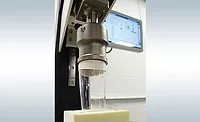
Ultrasonic Welding With a Twist
Now there’s the Soniqtwist torsional ultrasonic welding (TUW) system, a technology that has—literally—added its own unique twist to this time-tested process.
A traditional ultrasonic welding system applies linear vibrations at the joint interface. In contrast, TUW applies the linear vibrations in combination with a twisting motion at the same frequency. The result is a strong weld at the molecular level.
“This technology offers greater access than other welding methods,” says Saeed Mogadam, president of Telsonic Solutions Inc., a division of the Swiss firm, Telsonic AG, which developed TUW. “The sonotrode’s long-cylindrical shape enables end-users to reach down and weld components in a confined space.”
Mogadam says TUW also offers other important advantages over linear welding. The Soniqtwist can be equipped with four converters, increasing its maximum output to 10 kilowatts and enabling it to weld very large parts. In addition, the system has minimal vibration impact on welded parts and produces welds that are 30 percent narrower.
When introduced in 2002, TUW was mainly used to hermetically seal round parts made from nonferrous metals, such as cylindrical batteries, and air bag and seat belt sensors. Since 2009, this technology has been used for conventional metal welding applications, such as battery tabs, wire splicing and wire termination.
One automotive supplier uses TUW to seal-weld 50,000 sensors on air bags and seat belts every day. Other suppliers perform TUW on metal air bag inflators, seat belt pretensioners, sunlight sensors, threaded bus bar studs, spray valves, capacitor connectors and battery connections. Plastic welding applications include camshaft sensors, medical parts, foil valves and swaging. The system can simultaneously punch out a circular piece of fabric or foil and weld it onto a plastic part.
System Basics
The Soniqtwist system looks like an ultrasonic plastic welder, but its sonotrode vibrates with a torsional motion rather than an axial motion. The system features one or more converters, a torsional head, a high-power torsional sonotrode and an optional booster.
The converter is connected horizontally to the torsional head and to the sonotrode, which is located under the torsional head. The length of a 20-kilohertz torsional sonotrode is about the same as a 35-kilohertz linear sonotrode.
Telsonic Solutions uses finite element analysis (FEA) to specially design the torsional sonotrode for each application. However, the sonotrode can sometimes be used for more than one application.
FEA involves creating a mesh of points (in the shape of the sonotrode), each of which contain stress information about the sonotrode at that location. The analysis can also determine the effect of vibrations, fatigue and heat transfer.
For metal welding, the sonotrode is usually made of high-quality, hardened tool steel that can be specially coated. For plastic welding, the sonotrode may be made of tool steel, aluminum or titanium.
Soniqtwist comes in three sizes. The smallest is the TSP750, which applies a maximum force of 750 newtons and a maximum power of 500 watts. Next in line is the TSP3000, which applies a maximum force of 3 kilonewtons and a maximum power of 6.5 kilowatts. The largest system is the TSP8000, which applies a maximum force of 8 kilonewtons and a maximum power of 10 kilowatts. In general, metal welding applications require a more powerful system than plastic welding applications.
Like the fixtures for linear ultrasonic welding, the fixtures for TUW securely hold, position and support the weldment right underneath the welding area. TUW also uses the same measurement parameters to optimize welding performance and quality: amplitude, force, time, energy, welding distance and maximum power consumption.
The Process
Torsional ultrasonic welding usually takes just a few milliseconds, says Mogadam. The welding generator sends a high-frequency (20 kilohertz) sinusoidal signal to one or more converters. Inside each converter is a series of piezoceramic discs that create linear vibrations as they expand and contract under positive and negative voltage.
These vibrations travel down to the torsional head, which oscillates. The torsional oscillations are transferred to the sonotrode and maximized at the sonotrode tip, where the welding occurs.
“Imagine rolling a stick between your hands to light a camp fire,” says Mogadam. “In the same manner, the torsional head transforms linear vibrations from the converter into torsional oscillations.”
When multiple converters are used, they work together to create synergistic motion. Multiple converters also speed up the process so it’s faster than linear ultrasonic welding. Up to four converters can be used with one sonotrode. The optional booster amplifies the vibrations and creates a high angular oscillation.
In general, the sonotrode tip does not have to be positioned in the center of the welding area. However, this can be done if required by the application. All components are tuned to the same frequency and work in harmony to deliver energy efficiently to the weld area.
During plastic welding, the sonotrode oscillates perpendicular to the welding plane. This action produces an interface friction that plasticizes the two surfaces at the molecular level, resulting in a strong weld.
During metal welding, the sonotrode oscillates parallel to the welding plane. Welding pressure and interface friction produce a cold weld without significant temperature rise. The Soniqtwist creates helium-tight circular welds on metal parts. TUW can weld aluminum cross sections as large as 200 square millimeters and copper cross sections up to 160 square millimeters.
Because TUW produces narrow welds, automotive suppliers are able to weld terminals close together. This saves space within a hybrid or electric vehicle, which requires an extensive amount of wiring and terminations.
Weldable Parts: Materials and Shapes
As a general rule, TUW can weld most thermoplastics and amorphous and semicrystalline plastics. Soft, ductile nonferrous and precious metals—such as copper, aluminum, gold, silver, nickel, bronze and brass—can be welded.
However, these are general guidelines. If a manufacturer wants to be sure that a specific plastic or metal can be welded using TUW, Telsonic can test the material’s weldability.
What part shapes can be welded with TUW? Suitable parts include those with square, rectangular, circular or annular welding areas—the latter two being unique for the torsional technique. Metal parts must be relatively thin (1.5 to 2 millimeters) and welded on the sonotrode side.
Other Benefits
Because the sonotrode oscillates in a torsional mode, TUW provides constant amplitude and uniform force along the entire circumference of the welding joint. It also produces clean plastic welds and welds high-voltage connections with little power and at low temperatures.
TUW has little vibration impact on welded parts, making it a good choice for welding medical devices, sensitive electronic components, filter membranes and other thin-walled parts, such as foils. The process produces no notches, material thinning or undesirable diaphragm effect, says Home Mojal, product manager for Telsonic Solutions Inc.
When welding plastic parts, TUW is not impacted by interference media in the weld seam, such as water, grease, silicone and oil. For this reason, the procedure is very effective at seal-welding plastic enclosures with internal electronic components.
The Soniqtwist system generates few particulates and creates neat and clean edge areas during forming operations, such as swaging and riveting. It also can be used for welding filled components.
Optimizing the Process
Mojal recommends manufacturers do several things to optimize the TUW process.
- Use an energy director in most plastic welding applications. Be aware that the energy director design criteria may differ from those for linear ultrasonic welding.
- No energy director is required in most metal welding applications. The weldment, especially the one at the anvil side, should be as stiff and rigid as possible.
- Eliminate sharp corners and edges. This will prevent vibration fatigue cracks and necking.
- In metal welding, make the joining surfaces as clean as possible.
- Coatings such as silver, gold or nickel are usually no problem—and may even increase the weldability and welding strength.
- Finally, Mojal advises suppliers and OEMs to contact Telsonic as early as possible in the development process to optimize the TUW process for each application.
SIDEBAR
| The Powerwheel System: Splicing and Terminating Wires |
|
In 2011, Telsonic introduced the PowerWheel system at the Productronica Show in Munich. The PowerWheel system is an offshoot of Telsonic’s standard TUW technology, Soniqtwist. But whereas Soniqtwist is for general welding, the PowerWheel is designed specifically for splicing and terminating wires. The PowerWheel system includes a welding generator, a torsional sonotrode (which is the PowerWheel), one or more torsional heads, two or more converters, and an anvil fixture. The sonotrode is a cylinder that measures approximately 160 millimeters long and 50 millimeters in diameter. It features two or more raised welding surfaces in the center measuring 80 millimeters peak to peak. One torsional head can be connected to the sonotrode via a threaded mounting hole on each side. Two converters are attached to each torsional head. Before welding begins, the wires or terminal are placed on the anvil fixture. The welding tip is positioned on top of the wires or terminal, and clamping force is applied above the weld area. A high-frequency (20 kilohertz) sinusoidal signal is sent to the converters, which create linear vibrations that travel down to the torsional heads. As the heads oscillate, they create torsional oscillations that are transferred to the sonotrode. This causes the sonotrode’s round sections to move back and forth, while its middle section moves in a pendulum motion, and the central tip performs welding. Maximum amplitude is always concentrated at the center of the weld. The PowerWheel system produces a maximum force of 10 kilonewtons, while using up to 13 kilowatts of power. It can weld copper cables with a cross section as large as 160 square millimeters and aluminum cables with a cross section as large as 200 square millimeters. In addition, the system can weld thick substrates and terminals with complex spring configurations—without damaging or fracturing them. The ergonomic design and construction of the PowerWheel provides ample room around the tooling for the insertion of the terminals and cables. PLC controls govern the motion of the parts. The ultrasonic controller sets the weld parameters, and collects and monitors the welding data.
|
Looking for a reprint of this article?
From high-res PDFs to custom plaques, order your copy today!