Intelligent Fasteners
Virtually everything these days seems to contain a microprocessor. Your car's engine. Your refrigerator. But fasteners?
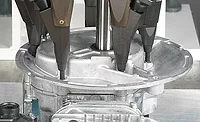
A new technology invented by TZ Ltd. (Sydney, Australia) and licensed to Textron Fastening Systems (Troy, MI) has done just that. Fasteners with embedded microprocessors can be told to grip and release by remote control. Screwdrivers or nutrunners are unnecessary.
Intelligent fasteners consist of male and female parts that draw on traditional forms, such as threaded fasteners, clips and interference pins, explains Seshu Seshasai, Ph.D., executive vice president of technology for Textron Fastening Systems. Depending on the application, the male and female parts can be made from a range of plastics and metals. They can be mounted in the assembly components, or incorporated directly into the components by molding, machining or casting.
The muscle inside intelligent fasteners consists of shape-memory alloys or polymers, or piezoelectric, magnetostrictive or electrorestrictive materials. The latter materials change their shape in response to an electric current or magnetic field. Shape-memory materials change their shape in response to heat. Once a shape-memory material has been shaped at a specific temperature, it can be severely bent or deformed, and it will automatically return to its original shape when reheated.
A microchip is embedded within each fastener, says Seshasai. When the microchip receives a radio frequency signal, it activates the material in the fastener to change its shape and grip a specially designed feature in the mating part. A different signal directs the microchip to activate the material a second time and release its hold. A mechanical tool never touches the fastener, which can be turned on and off indefinitely. The fasteners can be "monostable" (they default to a locked state) or "bistable" (they require actuation to lock or unlock).
"[The fasteners] do not apply clamping force to pull parts together," adds Seshasai. "If clamp is a requirement, preload needs to be applied to the joint at the point of assembly to engage the fastener. The fasteners do not self-stress."
The signals to activate the fasteners can be sent by a handheld remote control or a personal digital assistant.
Looking for quick answers on assembly and manufacturing topics? Try Ask ASM, our new smart AI search tool. Ask ASM
Alternatively, multiple intelligent fasteners can be networked and tied into the product's electrical system. That way, the fasteners can be controlled directly by the product itself. For example, intelligent fasteners could be used to attach the seatbelts in a car. Following an accident, sensors within the vehicle could signal the fasteners to release the belts automatically, facilitating the exit of passengers.
The two main attributes of the fasteners-onboard intelligence and remote control activation-provide a number of design and assembly advantages, says Seshasai.
One design advantage afforded by remote control actuation is that the fasteners can be hidden within the assembly. This can help prevent theft or unauthorized service. And because the fasteners are hidden, assemblers have more opportunities to use prefinished materials. Similarly, the fasteners can be installed in locations where tool access is limited.
Because the fasteners are intelligent, they can be locked or unlocked in a predetermined sequence, or they can be programmed so several fasteners can be activated simultaneously. In that way, an operator could insert several fasteners, then activate them all at once with the press of a button.
Intelligent fasteners could include sensors that monitor stress levels or whether the fasteners are engaged, says Seshasai. During assembly, the fastener could track the relative positions of the parts, providing feedback on the quality of the joint.
Intelligent fasteners could prove their worth if the assembly ever needs service. For example, the fasteners could store serial numbers and other identification information. To ensure that only authorized personnel are able to service the product, the fasteners could be hidden, out of reach of the consumer. For added security, the signal to open or close the fasteners could even be encrypted. There's no danger of marring the product during disassembly or stripping threads when the product is reassembled. And, the fastener's microprocessor could record when the product was serviced and even what repairs were done.
Intelligent fasteners could also be a boon to recycling. Because all the fasteners can be released simultaneously, disassembly is simpler.
Potential Applications
The technology holds promise for a variety of assembly applications in the automotive, aerospace and electronics industries, says Seshasai.
In cars, a major application for intelligent fasteners could be air bag assembly. Currently, air bag housings are fastened to steering columns or car chassis with screws or clips. Because the fasteners are exposed at the surface of the housing, it only takes a few minutes to remove the air bag-a fact that makes air bags one of the most commonly stolen auto parts. More than 50,000 air bags are stolen annually in the United States.
Intelligent fasteners could solve that problem. Because the fasteners are turned on and off by remote control, they can be concealed in the housing. That means there are only two ways to remove the fasteners: By transmitting the authorization code to release, or by destroying the housing and air bag, rendering them useless to potential thieves.
Similarly, intelligent fasteners could be ideal for attaching car stereos. Installing and replacing stereos usually requires dismantling the dashboard to access the mounting hardware. With intelligent fasteners, however, stereos could be slipped in and out with the touch of a button.
Besides air bags and audio equipment, intelligent fasteners could be used to install interior trim, roof racks, headlights and spare tires. In motorcycles, the fasteners could secure fairings, panniers, seats, visors and electronic devices, such as global positioning systems.
In passenger jets, intelligent fasteners could be used to attach instrument panels, interior trim and "passenger service units"-those small panels above each row of seats that contain the reading lights, air-conditioning vents and call buttons. A set of networked fasteners could even provide diagnostic information for maintenance technicians.
In electronics, intelligent fasteners could be used to install circuit boards into housings or secure cables from peripherals to computers.
Because they act as miniature remote control locks, intelligent fasteners also have a number of architectural applications. For example, they could be used to secure individual mailboxes in apartment buildings or install service and control panels. A series of intelligent fasteners could be used to securely lock windows and doors. The fasteners could also be linked with an alarm system.
For more information about intelligent fasteners, call Textron Fastening Systems at 800-544-6117 or visit www.textronfasteningsystems.com.
Looking for a reprint of this article?
From high-res PDFs to custom plaques, order your copy today!