Fasteners for Automation
The right fastener can mean the difference between an automated screwdriver that operates smoothly and one that jams constantly.
When choosing a threaded fastener for an assembly, engineers consider the length and diameter of the screw, the type of threads, the materials, the joint strength requirements, environmental conditions and aesthetics. What they don’t always think about is automation.
However, a fastener with the right characteristics can mean the difference between an automated screwdriving application that operates smoothly and one that jams constantly. To help engineers choose the best fastener for automatic screwdriving, we asked several experts for their insights. Our sources were Boris Baeumler, applications engineer at DEPRAG Inc.; Brian Droy, owner of Midwest Assembly Technologies; David Gillanders, president of D-G Industries; Dan McKeeman, technical services manager for Atlantic Fasteners; and Jarrod Neff, sales administrator at Visumatic Industrial Products Inc.
What drive styles are best for automatic screwdriving?
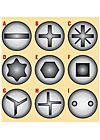
Baeumler: ACR Phillips and Torx. But, Torx should not be used for screws smaller than M4. That’s because the Torx recess and bit have straight walls. With very small screws, if the screw and bit are not perfectly in-line, the Torx bit can have trouble engaging the fastener consistently. Because the ACR Phillips bit is pointed, it will guide itself into the recess.
Droy: The Torx drive, male or female, is best for higher torques, as screws with the hex drive can sometimes wedge in the socket or bit. Then, when the drive head lifts up, it can take the part with it, or the cylinder could stall, stopping the machine. Because they are self-centering, Phillips or Robertson drives are better than the slotted drive for smaller screws with lighter torques.
Gillanders: Any self-centering drive will work fine with an automatic screwdriver-anything but a plain slotted drive. Among internal drive styles, Torx, hexagonal and square drives offer advantages over the Phillips drive because less axial effort is required to maintain bit engagement. Torx screws and bits may be a little more costly than Phillips screws and bits, however. If a customer requires a slotted drive for field repair considerations, the screw can often be changed to one that combines the Phillips and slotted drives, with the Phillips being used by the automatic screwdriver. An external drive, such as hex or Torx, does not create a problem, per se, but engineers should keep in mind that the jaws that hold the fastener will be larger to accommodate the increased diameter of a socket rather than a bit. This could create clearance issues and increase the weight of the driving mechanism.
What head styles are best for automatic screwdriving?
Droy: A pan head is the simplest style for tooling both the driver jaws and escapement
What thread styles are best?
Baeumler: Thread style is usually determined by the application and materials. There are some things to consider, though. For example, driving thread-forming screws into plastic must be done at a slow speed-less than 800 rpm-to achieve a quality joint. This type of assembly is not designed for reuse; a thread-forming screw can only be driven into the part one or two times. Parts that must be disassembled later would benefit from a reusable machine-screw thread. Such assemblies commonly have metal inserts with machine-screw threads. These inserts can be molded or pressed into the plastic.
Droy: Tightly spaced threads perform better in blow-fed jaws. Track-fed drivers perform very well with any style of thread. Vibratory bowls perform better with tightly spaced threads.
Gillanders: Thread styles are important from the perspective of the product designer, not usually the screwdriver provider. However, it is critical that the appropriate power tool be used to drive the fastener. Some applications have stringent torque specifications or unique torquing scenarios, such as a prevailing torque that is higher than the seating torque. This can have a bearing on the choice of drivers.
McKeeman: The easiest threads to run are machine screws going into tapped holes. They run like butter. There’s no reaction torque until they hit bottom. It’s when you’re trying to form threads in the material, and driving torque goes way up, that automated equipment can have difficulty.
What about the length and width of the fastener?
Baeumler: There is no limitation on length. Any screw can be automated using special methods. With that said, the most common, flexible and cost-effective way to feed a fastener is by blowing it through a tube. For blow feeding, the screw should not be excessively long (approximately 3 inches, depending on head diameter), so it can pass through bends in the hose. In addition, the screw must be longer than its head diameter, so it does not tumble or get caught in the feed hose or end tooling. DEPRAG has some unique techniques and tooling specifically for extra long and short screws.
Droy: Long fasteners can be automated. However, the issue with long screws is shank straightness, which can cause problems in hitting the target hole with the point of the screw. Additional tooling can overcome this issue. Our standard drivers can run screws as long as 5 inches or as short as 0.125 inch.
Gillanders: To blow a fastener through a tube, we like to see a fastener with a minimum length-to-diameter ratio of 1.2-to-1. There are exceptions, depending on the configuration of the fastener. Screws that are too short, relative to their diameter, for blow feeding can be tracked to a fixtured spindle, if the application permits. The only restriction on long screws is that, as their length increases, so too does the bend radius of the blow tube and the size of the bowl feeder.
What kind of point should the screw have?
Gillanders: The point style is inconsequential to the performance of an automatic screwdriver, beyond the consideration that pointed screws will hasten wear of the blow tube.
What role do platings, finishes or coatings play in automatic screwdriving?
Baeumler: Most platings and coatings are acceptable for automation. Some coatings may rub off, which could impair the performance of the feeder, but the bowl can be modified to reduce these effects. Another option for coated fasteners is the sword feeder, because of its gentle action. A sword feeder has a blade protruding from the bottom of a wedge-shaped rectangular hopper. The blade has a slot cut into it. As the blade rises on an angle through the hopper, fasteners fall into the slot, shank first, and slide down to the escapement.
McKeeman: Thread-rolling screws often run much better with a coat of wax on them. But, it’s a double-edged sword. If wax gets into the drive recess, the bit jumps out of the drive, so you’re robbing Peter to pay Paul.
How can a part be designed to facilitate assembly with automatic screwdrivers?
Baeumler: When possible, leave room for the end tooling. The best screwdriving location will have clearance of approximately twice the head diameter or more. If this is not an option, there are ways other than conventional jaws to position the screw. If the screw is located in a recess, the recess should have a lead-in to the screw hole. The diameter of the hole should be slightly larger than the head diameter of the screw. The other important point is to have part location features that are consistent with the screwdriving locations.
McKeeman: It’s important to control the consistency of your parts. Once a system has been debugged and all the fastening parameters are under control, don’t mess with it! Unfortunately, when everything is running fine, people start asking, ‘How can we reduce costs?’ And they shop the world for the cheapest screws and parts. Suddenly, it’s a whole new ballgame. Your driving torques have changed completely. One batch of parts is slightly harder than the previous one. Even slight changes in the parts or fasteners can raise hell with automatic screwdrivers.
What features can be included in automatic screwdrivers to ensure an accurate, repeatable process, regardless of the fastener?
Baeumler: For reliable automation, the fastener must remain within its specified tolerances, and the equipment must keep control of the screw at all times. To do this, DEPRAG uses pre-separators, separators, distributors and orienting devices. Sensors at every transition point verify the presence, size and orientation of the screws.
Gillanders: A lot depends on the specific application, but sensors for screw presence, driven depth, and torque and angle measurement are valuable for error-proofing an assembly.
Are there ways to adjust automatic screwdrivers to accommodate a difficult fastening application?
Baeumler: The pressing force of all DEPRAG spindles can be easily changed by exchanging a spring. When using our electronically controlled screwdrivers, driver speed and torque can simply be entered into the controller, or even modified remotely via an Ethernet connection.
Droy: Using an electric screwdriver will allow for considerable adjustment of the bit speed. For example, you could start slow, ramp up, and then slow down as the fastener approaches the seating torque. There are also methods of adjusting and varying the downward force of the bit.
Gillanders: Many variables, such as driver speed, axial force and velocity, can be altered to achieve the best performance, in addition to the hardware and instrumentation designed into the automatic screwdriver. One thing to consider, however, is whether the application will be fully automatic or a semiautomatic, handheld operation. An operator can provide the deft touch and intuitive sense to make a marginal application successful, yet will not have the consistent repeatability of a fully automated system.
McKeeman: Reducing the installation torque is the key to making automated screwdriving equipment work well. When the torque required to drive the screw is close to the torque that will knock the driver out of the recess, that’s when the headaches come.
Can you recall an application in which changing the fastener or the part design led to successful automation?
Baeumler: A cell phone manufacturer asked us to review an upcoming product. We recognized an issue with the size of a recess. This change was implemented in the final product, heading off significant manufacturing problems. In another instance, a medical instrument manufacturer used a very small Torx screw in its design. This was recognized in the preproduction stage and changed to a ACR Phillips screw, eliminating a bit engagement issue. This is a very common scenario. We wish more product designers would involve us at the development stage of a product, rather than trying to overcome design issues with elaborate automation.
Droy: One of our customers was using a standard carriage bolt in an assembly. We suggested changing to a square-shaped head to improve feeding, with the added benefit of having a known orientation of the square shoulder. The bolt was inserted vertically using a part placer, and a nut was driven onto the bolt with a track-fed driver.
Gillanders: An automotive customer recently had an application for a transmission assembly that would have required an extremely complex and high-maintenance jaw mechanism. After we studied the assembly, we determined that a small length increase in the screw would obviate the need for the special jaw. The existing hole had enough depth, and the payoff was significant, so the change was very simple. It was quickly approved and implemented.
McKeeman: We had a customer that was using automated equipment to drive Phillips-head thread-rolling screws into sheet metal. Because of the high prevailing torque, the bit was always camming out. The customer was constantly changing bits. We could have solved the problem by switching to a Torx drive, but the customer insisted on Phillips screws, because it was afraid consumers would be unable to drive Torx screws. Instead, we switched the fastener to a type B sheet-metal screw, which was able to slice into the material better, and that solved the problem.
Neff: We designed an automated assembly station for a medical equipment manufacturer. The machine incorporates an X-Y robot and an automatic screwdriving system. Sensors detect when a pallet arrives on the conveyor. The machine then lifts and locates the pallet, and installs four to five fasteners, depending on the part style. During the design review, we determined that one of the four part styles had a deep counterbore with sheer vertical walls that ended in a perfect right angle. This can sometimes allow the tip of the fastener to find its way into the “corner,” instead of passing through the hole. Based on our suggestions, the customer made minor modifications to its injection molding process to incorporate a slight draft in the counterbore shaft, a radius at the bottom, and a chamfer to the hole. The customer has been operating with a yield rate of over 99 percent, running three shifts a day, five days a week.
However, a fastener with the right characteristics can mean the difference between an automated screwdriving application that operates smoothly and one that jams constantly. To help engineers choose the best fastener for automatic screwdriving, we asked several experts for their insights. Our sources were Boris Baeumler, applications engineer at DEPRAG Inc.; Brian Droy, owner of Midwest Assembly Technologies; David Gillanders, president of D-G Industries; Dan McKeeman, technical services manager for Atlantic Fasteners; and Jarrod Neff, sales administrator at Visumatic Industrial Products Inc.
What drive styles are best for automatic screwdriving?
Baeumler: ACR Phillips and Torx. But, Torx should not be used for screws smaller than M4. That’s because the Torx recess and bit have straight walls. With very small screws, if the screw and bit are not perfectly in-line, the Torx bit can have trouble engaging the fastener consistently. Because the ACR Phillips bit is pointed, it will guide itself into the recess.
Droy: The Torx drive, male or female, is best for higher torques, as screws with the hex drive can sometimes wedge in the socket or bit. Then, when the drive head lifts up, it can take the part with it, or the cylinder could stall, stopping the machine. Because they are self-centering, Phillips or Robertson drives are better than the slotted drive for smaller screws with lighter torques.
Gillanders: Any self-centering drive will work fine with an automatic screwdriver-anything but a plain slotted drive. Among internal drive styles, Torx, hexagonal and square drives offer advantages over the Phillips drive because less axial effort is required to maintain bit engagement. Torx screws and bits may be a little more costly than Phillips screws and bits, however. If a customer requires a slotted drive for field repair considerations, the screw can often be changed to one that combines the Phillips and slotted drives, with the Phillips being used by the automatic screwdriver. An external drive, such as hex or Torx, does not create a problem, per se, but engineers should keep in mind that the jaws that hold the fastener will be larger to accommodate the increased diameter of a socket rather than a bit. This could create clearance issues and increase the weight of the driving mechanism.
What head styles are best for automatic screwdriving?
Droy: A pan head is the simplest style for tooling both the driver jaws and escapement
What thread styles are best?
Baeumler: Thread style is usually determined by the application and materials. There are some things to consider, though. For example, driving thread-forming screws into plastic must be done at a slow speed-less than 800 rpm-to achieve a quality joint. This type of assembly is not designed for reuse; a thread-forming screw can only be driven into the part one or two times. Parts that must be disassembled later would benefit from a reusable machine-screw thread. Such assemblies commonly have metal inserts with machine-screw threads. These inserts can be molded or pressed into the plastic.
Droy: Tightly spaced threads perform better in blow-fed jaws. Track-fed drivers perform very well with any style of thread. Vibratory bowls perform better with tightly spaced threads.
Gillanders: Thread styles are important from the perspective of the product designer, not usually the screwdriver provider. However, it is critical that the appropriate power tool be used to drive the fastener. Some applications have stringent torque specifications or unique torquing scenarios, such as a prevailing torque that is higher than the seating torque. This can have a bearing on the choice of drivers.
McKeeman: The easiest threads to run are machine screws going into tapped holes. They run like butter. There’s no reaction torque until they hit bottom. It’s when you’re trying to form threads in the material, and driving torque goes way up, that automated equipment can have difficulty.
What about the length and width of the fastener?
Baeumler: There is no limitation on length. Any screw can be automated using special methods. With that said, the most common, flexible and cost-effective way to feed a fastener is by blowing it through a tube. For blow feeding, the screw should not be excessively long (approximately 3 inches, depending on head diameter), so it can pass through bends in the hose. In addition, the screw must be longer than its head diameter, so it does not tumble or get caught in the feed hose or end tooling. DEPRAG has some unique techniques and tooling specifically for extra long and short screws.
Droy: Long fasteners can be automated. However, the issue with long screws is shank straightness, which can cause problems in hitting the target hole with the point of the screw. Additional tooling can overcome this issue. Our standard drivers can run screws as long as 5 inches or as short as 0.125 inch.
Gillanders: To blow a fastener through a tube, we like to see a fastener with a minimum length-to-diameter ratio of 1.2-to-1. There are exceptions, depending on the configuration of the fastener. Screws that are too short, relative to their diameter, for blow feeding can be tracked to a fixtured spindle, if the application permits. The only restriction on long screws is that, as their length increases, so too does the bend radius of the blow tube and the size of the bowl feeder.
What kind of point should the screw have?
Gillanders: The point style is inconsequential to the performance of an automatic screwdriver, beyond the consideration that pointed screws will hasten wear of the blow tube.
What role do platings, finishes or coatings play in automatic screwdriving?
Baeumler: Most platings and coatings are acceptable for automation. Some coatings may rub off, which could impair the performance of the feeder, but the bowl can be modified to reduce these effects. Another option for coated fasteners is the sword feeder, because of its gentle action. A sword feeder has a blade protruding from the bottom of a wedge-shaped rectangular hopper. The blade has a slot cut into it. As the blade rises on an angle through the hopper, fasteners fall into the slot, shank first, and slide down to the escapement.
McKeeman: Thread-rolling screws often run much better with a coat of wax on them. But, it’s a double-edged sword. If wax gets into the drive recess, the bit jumps out of the drive, so you’re robbing Peter to pay Paul.
How can a part be designed to facilitate assembly with automatic screwdrivers?
Baeumler: When possible, leave room for the end tooling. The best screwdriving location will have clearance of approximately twice the head diameter or more. If this is not an option, there are ways other than conventional jaws to position the screw. If the screw is located in a recess, the recess should have a lead-in to the screw hole. The diameter of the hole should be slightly larger than the head diameter of the screw. The other important point is to have part location features that are consistent with the screwdriving locations.
McKeeman: It’s important to control the consistency of your parts. Once a system has been debugged and all the fastening parameters are under control, don’t mess with it! Unfortunately, when everything is running fine, people start asking, ‘How can we reduce costs?’ And they shop the world for the cheapest screws and parts. Suddenly, it’s a whole new ballgame. Your driving torques have changed completely. One batch of parts is slightly harder than the previous one. Even slight changes in the parts or fasteners can raise hell with automatic screwdrivers.
What features can be included in automatic screwdrivers to ensure an accurate, repeatable process, regardless of the fastener?
Baeumler: For reliable automation, the fastener must remain within its specified tolerances, and the equipment must keep control of the screw at all times. To do this, DEPRAG uses pre-separators, separators, distributors and orienting devices. Sensors at every transition point verify the presence, size and orientation of the screws.
Gillanders: A lot depends on the specific application, but sensors for screw presence, driven depth, and torque and angle measurement are valuable for error-proofing an assembly.
Are there ways to adjust automatic screwdrivers to accommodate a difficult fastening application?
Baeumler: The pressing force of all DEPRAG spindles can be easily changed by exchanging a spring. When using our electronically controlled screwdrivers, driver speed and torque can simply be entered into the controller, or even modified remotely via an Ethernet connection.
Droy: Using an electric screwdriver will allow for considerable adjustment of the bit speed. For example, you could start slow, ramp up, and then slow down as the fastener approaches the seating torque. There are also methods of adjusting and varying the downward force of the bit.
Gillanders: Many variables, such as driver speed, axial force and velocity, can be altered to achieve the best performance, in addition to the hardware and instrumentation designed into the automatic screwdriver. One thing to consider, however, is whether the application will be fully automatic or a semiautomatic, handheld operation. An operator can provide the deft touch and intuitive sense to make a marginal application successful, yet will not have the consistent repeatability of a fully automated system.
McKeeman: Reducing the installation torque is the key to making automated screwdriving equipment work well. When the torque required to drive the screw is close to the torque that will knock the driver out of the recess, that’s when the headaches come.
Can you recall an application in which changing the fastener or the part design led to successful automation?
Baeumler: A cell phone manufacturer asked us to review an upcoming product. We recognized an issue with the size of a recess. This change was implemented in the final product, heading off significant manufacturing problems. In another instance, a medical instrument manufacturer used a very small Torx screw in its design. This was recognized in the preproduction stage and changed to a ACR Phillips screw, eliminating a bit engagement issue. This is a very common scenario. We wish more product designers would involve us at the development stage of a product, rather than trying to overcome design issues with elaborate automation.
Droy: One of our customers was using a standard carriage bolt in an assembly. We suggested changing to a square-shaped head to improve feeding, with the added benefit of having a known orientation of the square shoulder. The bolt was inserted vertically using a part placer, and a nut was driven onto the bolt with a track-fed driver.
Gillanders: An automotive customer recently had an application for a transmission assembly that would have required an extremely complex and high-maintenance jaw mechanism. After we studied the assembly, we determined that a small length increase in the screw would obviate the need for the special jaw. The existing hole had enough depth, and the payoff was significant, so the change was very simple. It was quickly approved and implemented.
McKeeman: We had a customer that was using automated equipment to drive Phillips-head thread-rolling screws into sheet metal. Because of the high prevailing torque, the bit was always camming out. The customer was constantly changing bits. We could have solved the problem by switching to a Torx drive, but the customer insisted on Phillips screws, because it was afraid consumers would be unable to drive Torx screws. Instead, we switched the fastener to a type B sheet-metal screw, which was able to slice into the material better, and that solved the problem.
Neff: We designed an automated assembly station for a medical equipment manufacturer. The machine incorporates an X-Y robot and an automatic screwdriving system. Sensors detect when a pallet arrives on the conveyor. The machine then lifts and locates the pallet, and installs four to five fasteners, depending on the part style. During the design review, we determined that one of the four part styles had a deep counterbore with sheer vertical walls that ended in a perfect right angle. This can sometimes allow the tip of the fastener to find its way into the “corner,” instead of passing through the hole. Based on our suggestions, the customer made minor modifications to its injection molding process to incorporate a slight draft in the counterbore shaft, a radius at the bottom, and a chamfer to the hole. The customer has been operating with a yield rate of over 99 percent, running three shifts a day, five days a week.
Looking for a reprint of this article?
From high-res PDFs to custom plaques, order your copy today!