The Simple Appeal of Self-Piercing Riveting
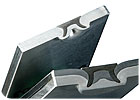
Self-piercing riveting can join similar or dissimilar materials. The top cross-section shows an aluminum to aluminum joining; the bottom, steel to aluminum. Photo courtesy Emhart Teknologies
Based on Henry David Thoreau’s famous call to “Simplify! Simplify!”, one could assume that the writer-naturalist would love self-piercing riveting (SPR), which simplifies assembly by piercing and fastening in one operation.
Unlike conventional riveting, self-piercing technology does not require a predrilled hole. Rather, the rivet makes its own hole as it is being inserted. Also, there is no need for cleaning or special treatment of the substrates, lowering component and installation costs.
These are just two of the reasons SPR has been widely accepted as an effective alternative to aluminum resistance spot welding in the automotive world since the mid-1990s. A third reason is that this technology provides a strong, reliable joint with a greater static strength and better fatigue performance.
“Although SPR has been around for about 50 years, it didn’t become commercialized until the 1980s,” says Dean Monday, North American business development manager for Henrob Corp. “At that time, the riveting equipment was made portable, which made its use assembling product of large scale possible. Today it’s used to assemble products ranging from snowmobiles to electronics, from white goods to pots and pans.”
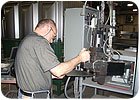
Manual
assembly is done with electric, pneumatic and battery-powered hand tools. Photo
courtesy AKH Inc.
Simple as a Staple
SPR is used to join two or more layers of materials, having similar or varying thicknesses, with a total stack height from 1.0 to 13 millimeters. These materials can be similar or dissimilar, and often are metals that are difficult or impossible to spot-weld. Basic material types include metal, plastic or even woven material.SPR is akin to stapling together sheets of paper, in that there is no predrilled hole on the top sheet. The difference is that the driven rivet traditionally does not pierce through the bottom material.
Self-piercing rivets are formed from steel, stainless steel, copper or aluminum into semitubular or solid shapes, then heat-treated and plated. Suppliers offer self-piercing rivets with diameters of 3 to 7 millimeters and body lengths of 3 to 14 millimeters but sizes are growing. Longer rivets tend to be more popular in North America, while users in Europe and Asia tend to use shorter ones. Standard head styles include countersunk, flat, pan and dome. Special heads, such as tinman, double-headed, threaded studs and stand-off pins, are also available.
Tooling includes a rivet setter, plunger and lower die mounted in a C-frame press large enough to allow access into the areas to be riveted. The plunger is a solid cylinder with a cavity whose volume is similar to the material being displaced by the rivet.
The minimum material stack should have a bottom layer at least 1 millimeter thick and a top material at least 0.5 millimeter thick, but joining thinner sections has been possible. Depending on cylinder stroke and rivet feeder type, the assembly process takes 1.3 to 3 seconds.
First, the rivet is delivered to the setter by gravity, air, magazine, or collating plastic tape. After the rivet is detected, the materials to be joined are clamped together. Next, the rivet is driven into the material stack by the plunger at a controlled force or speed to pierce the top layer or layers. Finally, the rivet forces the sheet material into a lower die and radially expands into the bottom layer or sheet to form an interlock. In this type of fastening system, the bottom surface will have a button formed by the lower die.
However, sometimes the SPR system will push the rivet though all layers and replace them. As a result, the bottom surface will be flush.
For optimum quality joints, the rivet needs to be strong enough to pierce the top layers of material without collapse, but ductile enough to flare when contact is made with the lower die. The rivet used should be 2 to 3 millimeters longer than the stack of materials to be joined.
Also, the SPR system needs to have a support structure rigid enough to endure high setting forces (up to 100 kilonewtons) and ensure rivet alignment with the lower die.
Many different types of tools and equipment are available to insert self-piercing rivets. Manual assembly is done with hydraulic, pneumatic and battery-powered hand tools. Automated assembly equipment can be stationary, robotic or integrated into an assembly cell, depending on production rates and complexity of parts joined.
Gravity-fed rivet delivery systems are commonly used with a stationary machine, whereas automated SPR assembly lines use either magazine, blow feed or collating tape feed.
To ensure quality joints, several suppliers offer technology that lets manufacturers monitor the force setting of every joint throughout the riveting process. “If something is not right with the rivet, assemblers can know in real-time rather than reacting to it after the fact,” says Cary Meloche, senior product manager for Emhart Teknologies. “This ensures they set every joint correctly.”
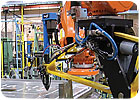
The
SPR technique is used on various transportation vehicles, including trucks.
Automated assembly of a Class 8 truck deck is performed with a C-frame. Photo
courtesy Henrob Corp.
21st Century Success
Thus far, the 21st century has been a time of progress for SPR suppliers and their assembler customers in two very important areas: material combinations and types of assembled products.Until the last few years, self-piercing rivets were primarily used to join up to 1/4-inch mild steel and 1/2-inch aluminum. “Now we can join much harder materials, even two pieces of 1/4-inch steel,” says Monday.
SPR can join such materials as rolled, cast and extruded metals; molded and sheet polymer; nylon; durable types of webbing and fabric; composites like reinforced fiberglass; and sheets with an intermediate layer of adhesive, insulation or sealants.
Some dissimilar-material combinations being joined by SPR include stainless steel to thick aluminum, rubber to steel, magnesium to aluminum, thermoplastic to aluminum, and magnesium to steel. Self-piercing rivets can even join together nonmetallic materials.
However, SPR does not work well on high-strength steels, which is why new rivet geometries are being designed. “Much work is being done with magnesium and other brittle materials to overcome material ductility concerns,” says Monday.
When introduced in the 1960s, SPR was used in Germany to assemble garage doors. Thirty years later, SPR began being used by automakers-particularly for vehicles containing aluminum components.
Today, SPR is used to assemble many products including white goods, step ladders, air cargo containers, air conditioners, office furniture, electrical busways, solar panel framing, roof decking and marine equipment, including sailboats. School bus manufacturers use SPR on the vehicle’s roof, windows, hatches and subassemblies.
Dave Caulk, sales manager of AKH Inc., says SPR is also used for casket lid hinges. Indeed, 2009 ASSEMBLY Plant of the Year winner Batesville Casket Co. uses the fasteners to assemble its products. Other applications include overhead doors and shutters designed for high wind environments.
Depending on the assembly and production volume, some manufacturers prefer using a “multi-hit” SPR where more than one rivet is installed simultaneously. Ryan Ostach, application engineer supervisor at Avdel USA LLC, says that multi-hit was widely used in the past mostly for dedicated high-volume applications.
“Multi-hit setups require dedicated tooling, and most manufacturers don’t want to invest in the capital for a single assembly,” he says. “They need the flexibility to install rivets in a wide variety of models and designs to keep up with the ever–evolving market.”
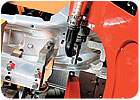
SPR
has been used extensively in automobile assembly since the 1990s Here an Audi
aluminum body structure is fastened. Photo courtesy Emhart Teknologies
Niche Knowledge...For Now
Suppliers of SPR systems say that too many OEMs in the United States know too little about the benefits of SPR-mainly because manufacturing engineers know spot welding and have been reluctant to leave their comfort zone to embrace a newer technology.Nonetheless, the suppliers have begun taking steps to increase awareness of SPR. Several allow prospective customers to send in materials for a free sample of how SPR can join them together. Shear and tensile strength testing data is often provided with the samples.
“We’ve begun promoting tape fed SPR to prospective OEMs using less than 1 million pieces per year through direct-mail campaigns and telemarketing,” says Ostach. “And we reach engineers through seminars and lunch-and-learns. We feel that at least 30 percent of the situations where spot welding is employed can be replaced beneficially by SPR.”
“The level of acceptance of SPR depends to a large extent on the level of knowledge,” says Dr. Sumanjit Singh, chief technical officer for Huys Ltd. and holder of three patents for SPR products. “In the near future, the use of material combinations such as fiber-reinforced plastics will increase. Welding will not be a viable alternative.”
“New materials are constantly being developed, and until we’re challenged, we’re not sure what SPR can join together,” says Monday.
Looking for a reprint of this article?
From high-res PDFs to custom plaques, order your copy today!