Improve Productivity With Poka-Yoke
Poka-yoke techniques prevent defects, promote job safety and prevent damage to machinery.

Legendary manufacturing guru W. Edwards Deming said, “Quality comes not from inspection, but from improvement of the process.”
Put another way, it’s much more cost-effective to prevent manufacturing defects than to look for them after the fact. This is the basis of the Japanese concept of poka-yoke (pronounced POH-kah YOH-kay), which was introduced in 1961 by Shigeo Shingo, an industrial engineer at Toyota Motor Co. (Toyota City, Japan). Shingo’s initial term was actually baka-yoke, which means “fool-proofing.” However, in 1963 a worker at what is today Toyota Auto Body Co. (Kariya, Japan) refused to use baka-yoke mechanisms in her work area, because of the term’s dishonorable and offensive connotation. Hence, the term was changed to poka-yoke, which means “error-proofing” or “mistake-proofing.”
Technically, “mistake-proofing” applies to the assembly line, while “error-proofing” applies to product design. Thus, a good example of mistake-proofing is a power tool that flashes a red light when a screw has not been tightened to the correct torque. A good example of error-proofing is to design the joint to snap together, thereby obviating the need to monitor torque altogether. However, most people use the terms interchangeably.
While I’m at it, I will define defects and errors, as well. A defect is any deviation from product specifications that may lead to customer dissatisfaction. To be considered defective, the product must deviate from manufacturing or design specifications, and it must not meet the expectations of internal or external customers. An error is any deviation from a specified manufacturing process. There can be an error without a defect, but there cannot be a defect without an error.
Poka-yoke techniques need not be confined strictly to preventing defects. The methodology can also be used to promote job safety and prevent damage to machinery.
Ideally, poka-yoke techniques ensure that the right conditions exist to make a good assembly, before a joining process is actually executed. Thus, there should be only one way two parts can be joined before they are snapped, welded, bonded or fastened together. Where this is impossible, poka-yoke techniques detect defects as soon as they are made, preventing faulty assemblies from being passed to the next station.
Many people think of poka-yoke mechanisms as limit switches, optical inspection systems, guide pins or automatic shutoffs that can only be implemented by the engineering department. This is a very narrow view. These mechanisms can be electrical, mechanical, procedural, visual, human, or any other form that prevents the incorrect execution of a process. Poka-yoke techniques can also be implemented in areas other than production, such as sales, order entry, purchasing or product development, where the cost of mistakes is much higher than on the shop floor. Truly, poka-yoke techniques for preventing, detecting and removing defects have widespread applications in most organizations.

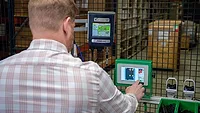
A recent error-proofing project at Ford shows how these techniques are put into practice. On one of our engine assembly lines, assemblers are required to install one of two sensors, depending on the model of engine. A DC electric nutrunner is used to install the sensors, which are threaded on one end. Although one of the sensors is long and the other is short, it’s possible for assemblers to install the wrong one.
We came up with two ways to prevent this from happening. First, photoelectric sensors monitor the bins containing each part. If the assembler selects a part from the wrong bin, an alarm will sound. Second, each part generates a unique torque signature during installation. These torque signatures are programmed into the tool’s controller. If the wrong part is installed, a red LED on the tool will illuminate and the tool will be disabled until the operator acknowledges the error.
Before engineers can prevent errors during assembly, they first need to know what errors to expect and how those errors occur. One way to do that is through failure mode effects analysis (FMEA).
The best opportunity to improve the quality and cost of a product is during the design stage. FMEA can be applied during the design of a product to ensure that potential defects and their causes are identified and addressed. Ideally, engineers should design each defect out of the product or prevent it from occurring as much as possible. In lieu of that, the defect must be detected as quickly as possible.
Engineers can use the principles of design for manufacture and assembly to ensure that a product cannot be put together incorrectly. These principles can also be used to simplify the design and therefore lower its cost.
FMEA can also be applied to the assembly process. FMEA can help cross-functional teams identify poka-yoke opportunities that will have the biggest impact on the customer and yield the best return on investment. Through FMEA, defects are ranked according to their frequency, severity, detectability and customer impact.
Assemblers are valuable resources for designing and implementing poka-yoke techniques. When every employee understands the principles of error-proofing, work teams can easily see how defects are generated, and they can effectively eliminate them.
Human error is natural. Sometimes, however, when errors are traced back to the operator’s interaction with the process, engineers and supervisors tend to blame the operator. We encourage the operator to try harder to avoid making mistakes. But, the root cause of the error is usually the failure of manufacturing and design engineers and managers to account for the possibility of errors or omissions. Few workers make errors intentionally. Most strive to prevent errors. Error-proofing alters the work environment to reduce the opportunity for human errors.
When error-proofing the work environment, it’s essential to understand human limits. These include:
Legendary manufacturing guru W. Edwards Deming said, “Quality comes not from inspection, but from improvement of the process.”
Put another way, it’s much more cost-effective to prevent manufacturing defects than to look for them after the fact. This is the basis of the Japanese concept of poka-yoke (pronounced POH-kah YOH-kay), which was introduced in 1961 by Shigeo Shingo, an industrial engineer at Toyota Motor Co. (Toyota City, Japan). Shingo’s initial term was actually baka-yoke, which means “fool-proofing.” However, in 1963 a worker at what is today Toyota Auto Body Co. (Kariya, Japan) refused to use baka-yoke mechanisms in her work area, because of the term’s dishonorable and offensive connotation. Hence, the term was changed to poka-yoke, which means “error-proofing” or “mistake-proofing.”
Technically, “mistake-proofing” applies to the assembly line, while “error-proofing” applies to product design. Thus, a good example of mistake-proofing is a power tool that flashes a red light when a screw has not been tightened to the correct torque. A good example of error-proofing is to design the joint to snap together, thereby obviating the need to monitor torque altogether. However, most people use the terms interchangeably.
While I’m at it, I will define defects and errors, as well. A defect is any deviation from product specifications that may lead to customer dissatisfaction. To be considered defective, the product must deviate from manufacturing or design specifications, and it must not meet the expectations of internal or external customers. An error is any deviation from a specified manufacturing process. There can be an error without a defect, but there cannot be a defect without an error.
Poka-yoke techniques need not be confined strictly to preventing defects. The methodology can also be used to promote job safety and prevent damage to machinery.
Ideally, poka-yoke techniques ensure that the right conditions exist to make a good assembly, before a joining process is actually executed. Thus, there should be only one way two parts can be joined before they are snapped, welded, bonded or fastened together. Where this is impossible, poka-yoke techniques detect defects as soon as they are made, preventing faulty assemblies from being passed to the next station.
Many people think of poka-yoke mechanisms as limit switches, optical inspection systems, guide pins or automatic shutoffs that can only be implemented by the engineering department. This is a very narrow view. These mechanisms can be electrical, mechanical, procedural, visual, human, or any other form that prevents the incorrect execution of a process. Poka-yoke techniques can also be implemented in areas other than production, such as sales, order entry, purchasing or product development, where the cost of mistakes is much higher than on the shop floor. Truly, poka-yoke techniques for preventing, detecting and removing defects have widespread applications in most organizations.
Implementing Poka-Yoke
Poka-yoke techniques can be classified into three categories: physical, operational and philosophical. Physical techniques involve installing components, such as fixtures or sensors, to eliminate conditions that may lead to errors. Operational techniques involve modifying or installing devices to reinforce correct assembly procedures. Philosophical techniques involve identifying situations that cause defects and doing something about them.A recent error-proofing project at Ford shows how these techniques are put into practice. On one of our engine assembly lines, assemblers are required to install one of two sensors, depending on the model of engine. A DC electric nutrunner is used to install the sensors, which are threaded on one end. Although one of the sensors is long and the other is short, it’s possible for assemblers to install the wrong one.
We came up with two ways to prevent this from happening. First, photoelectric sensors monitor the bins containing each part. If the assembler selects a part from the wrong bin, an alarm will sound. Second, each part generates a unique torque signature during installation. These torque signatures are programmed into the tool’s controller. If the wrong part is installed, a red LED on the tool will illuminate and the tool will be disabled until the operator acknowledges the error.
Before engineers can prevent errors during assembly, they first need to know what errors to expect and how those errors occur. One way to do that is through failure mode effects analysis (FMEA).
The best opportunity to improve the quality and cost of a product is during the design stage. FMEA can be applied during the design of a product to ensure that potential defects and their causes are identified and addressed. Ideally, engineers should design each defect out of the product or prevent it from occurring as much as possible. In lieu of that, the defect must be detected as quickly as possible.
Engineers can use the principles of design for manufacture and assembly to ensure that a product cannot be put together incorrectly. These principles can also be used to simplify the design and therefore lower its cost.
FMEA can also be applied to the assembly process. FMEA can help cross-functional teams identify poka-yoke opportunities that will have the biggest impact on the customer and yield the best return on investment. Through FMEA, defects are ranked according to their frequency, severity, detectability and customer impact.
Assemblers are valuable resources for designing and implementing poka-yoke techniques. When every employee understands the principles of error-proofing, work teams can easily see how defects are generated, and they can effectively eliminate them.
Human error is natural. Sometimes, however, when errors are traced back to the operator’s interaction with the process, engineers and supervisors tend to blame the operator. We encourage the operator to try harder to avoid making mistakes. But, the root cause of the error is usually the failure of manufacturing and design engineers and managers to account for the possibility of errors or omissions. Few workers make errors intentionally. Most strive to prevent errors. Error-proofing alters the work environment to reduce the opportunity for human errors.
When error-proofing the work environment, it’s essential to understand human limits. These include:
- Vision. People vary in their ability to distinguish details and colors, and to adjust their vision to lighting.
- Hearing. The upper and lower thresholds of an individual’s hearing change when background noise is added.
- Ability to perform repetitive tasks. Our muscular efficiency and mental tracking decrease as rates of repetition increase.
Looking for a reprint of this article?
From high-res PDFs to custom plaques, order your copy today!