Assembly Magazine logo
search
Ask ASSEMBLY AI
cart
facebook twitter linkedin youtube
  • Sign In
  • Create Account
  • Sign Out
  • My Account
Assembly Magazine logo
  • TRENDS
    • Ask ASSEMBLY AI
    • Trends
    • News
    • New Products
  • INDUSTRIES
    • Aerospace
    • Appliance
    • DFMA Assembly
    • Medical Devices
    • Green Manufacturing
    • Lean Manufacturing
    • Machinery Assembly
    • Electronics Assembly
    • Automotive
  • TECHNOLOGIES
    • Adhesives & Dispensing
    • Assembly Presses
    • Automated Assembly Systems
    • Manufacturing Management
    • Manufacturing Software
    • Motion Control
    • Screwdriving & Riveting
    • Robotics
    • Test & Inspection
    • Plastics & Metal Welding
    • Wire Processing
    • Workstations
  • AUTONOMOUS & ELECTRIC MOBILITY
    • AEM Magazine Archives
    • Autonomy
    • Electrification
    • Mobility Services
    • Assembly & Testing
    • AV/EM News
  • MEDIA
    • Ask ASSEMBLY AI
    • Podcasts
    • Assembly News Now
    • Assembly TV
    • Webinars
    • eBooks
  • EVENTS
    • Calendar
    • The ASSEMBLY Show
  • MORE
    • Exclusives >
      • Plant of the Year
      • Capital Spending
    • Buyers Guide >
      • Supplier Insights
    • Classifieds
    • Featured Products
    • Newsletters
    • Store
    • White Papers
    • Columns
    • Sponsor Insights
  • INFOCENTER
    • Assembly & Test Solutions
  • EMAGAZINE
    • eMagazine
    • Archive Issues
    • Advertise
    • Contact Us
    • Sign Up

Automatic Identification: Direct Part Marking
September 1, 2001
One of the most popular product identification technologies is the two-dimensional Data Matrix code. This article covers the technologies for placing these codes directly on parts and for reading them.

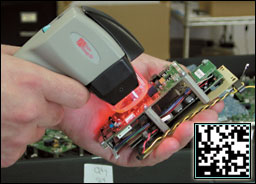
Plug-and-play scanners have been introduced specifically for reading codes marked directly on parts. These new image scanners are more akin to conventional laser scanne rs for bar codes than they are to vision systems. (Inset) A Data Matrix code consists of equal size squares in a 2D array. The more squares in the array, the more information the code can store.

Identification technologies have become an essential part of managing the life cycle of manufactured goods, from their "birth" to the scrap recovery process. The need to easily and correctly identify parts is critical for controlling and error-proofing the assembly process, tracking work in process, and building traceability. Fast, accurate identification methods are also important after the product leaves the plant. Product containment will be a major concern if manufacturing problems occur.

One of the most popular methods of identifying a part is with a two-dimensional (2D) Data Matrix code. This compact checkerboard code has become the mark of choice for the electronics, automotive and aerospace industries during the past few years. The code is in the public domain and has the support of major standards organizations.

Data Matrix codes can pack a large amount of information in a small amount of space. Each code consists of equal size squares, or elements, in a 2D array. The array can be a square, a rectangle or a group of squares. The more elements in the array, the more information the code can store. An array of 26 by 26 elements can encode 88 numbers or 64 letters.

The size of the Data Matrix code can be adjusted by changing the size of the individual elements. Because the elements are all the same size, the code can be made very small. Precise line-width ratios or minimum feature sizes do not have to be maintained.

A major advantage of Data Matrix codes is that they can be applied directly onto the surface of the parts. Compared with printing and applying labels, marking 2D codes directly on parts is more secure, more cost-effective and easier to automate. When marked directly on parts, 2D codes can withstand harsh manufacturing processes and abuse in the field.

Several technologies are available for direct part marking: ink-jet printing, laser etching, dot-peening and chemical etching. Ink-jet printing is one of the least expensive. Laser etching is popular because of its ability to produce small, precise marks. Lasers can mark 2D codes on many materials, from hardened steel to soft plastic. They can also access small, tight locations. Dot-peening is usually reserved for marking metal. This method uses a stylus to indent the part surface. Chemical etching is often used to mark printed circuit boards (PCBs), since it is already part of the normal manufacturing process.
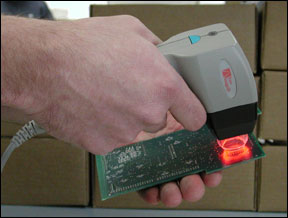
Often, the contrast for reading a 2D code must be generated solely by the application lighting.

Reading Codes on Parts

Data Matrix codes must be read using a CCD area imager. In other words, a picture must be taken of the code and then digitally processed to extract the information. Because the codes are applied directly to the part surface, the contrast is typically low and often inconsistent. This makes reading the codes more difficult than a standard black-and-white label.

Often, the contrast for reading the mark must be generated solely by specific types of lighting. By controlling the light source, variations in surface texture created by the marking method will reflect light with different intensities. Surfaces that are reflective, or yield little symbol contrast to the naked eye under general room light, can become highly visible in the right lighting.

Given the wide range of contrasts and background noise, the task of reading 2D codes has traditionally been the exclusive domain of machine vision systems. Vision systems are reliable, but they usually require customization, are relatively expensive, and need a high level of expertise to implement and maintain.

Looking for quick answers on assembly and manufacturing topics? Try Ask ASM, our new smart AI search tool. Ask ASM →

However, that is changing. Plug-and-play scanners have been introduced specifically for reading codes marked directly on parts. These new image scanners are more akin to conventional laser scanners for bar codes than they are to vision systems.

These scanners incorporate all the necessary elements for reading 2D codes, including lighting and optics. They offer high-resolution imaging and automatic setup functions to simplify installation. The scanner can be aligned by line personnel without the need for external equipment, such as a PC or video monitor. All the "system engineering" work of selecting light, optics and an operational mode is eliminated. The new scanners also cost much less than vision-based solutions.

This technology opens up many more practical uses for direct part marking and literally puts scanning in the hands of the production worker, with handheld scanners as well as fixed-position scanners for automation.
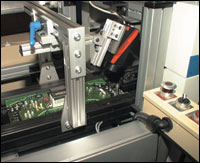
Surfaces that yield little symbol contrast to the naked eye under ambient lighting can become highly visible in the right lighting.

Applications

One popular application for this technology is the identification of PCBs. A laser can etch a Data Matrix symbol directly into the solder mask of a PCB. The marking area is very small, typically 1/8 inch square to hold a 10-digit number. Doubling that symbol size to 1/4 inch square provides space for 52 alphanumeric characters. Larger symbols are often used for permanent identification and for recording additional information, such as a serial number and lot code right on the board. This eliminates the need to access external databases for information.

In many cases, the permanent Data Matrix symbol will be used to generate a standard bar code label, which is applied after the item has undergone processes that would have destroyed the paper. This provides certain information to entities further along the way that are not equipped with scanners for direct part marking. (This is changing. As these new scanners become more ubiquitous, the need to print an additional bar code label will decrease.)

If bar codes are already part of the assembly process, manufacturers won't need two code-reading machines. Many 2D-code imagers can automatically discriminate between small bar codes and Data Matrix symbols and will read both accurately. A 2D-code imager can also be coupled with a laser scanner to read very small Data Matrix symbols and large bar codes up to 6 inches in length.

Manufacturers of components that must withstand harsh environments, such as the internal parts of a jet engine, rely on direct marking of Data Matrix codes to identify them. Marking metal parts with dot-peened or laser-etched symbols provides reliable and rugged marks for such applications. Reading these marks after years of service requires little more than cleaning off the dirt prior to scanning. Today's scanners automatically adjust for variations in contrast and background noise.

As applications expand in scope, so too will scanner configurations. Faster and lower-power processors, more sophisticated software, and lower cost imaging components will contribute to the growing use of 2D codes and scanners in the future.

For more information on automatic identification technologies, contact RVSI/Auto Image ID at 888-288-6462 or visit www.autoimageid.com.

Share This Story

Looking for a reprint of this article?
From high-res PDFs to custom plaques, order your copy today!

Recommended Content

JOIN TODAY
To unlock your recommendations.

Already have an account? Sign In

  • Made in the U.S.A.

    Consumer Products Manufacturing: Made in the USA

    Supply chain lessons learned during the coronavirus...
    Automated Assembly Systems
    By: Austin Weber
  • Best Practices for Press-Fit Assembly

    Best Practices for Press-Fit Assembly

    In manufacturing, ironclad formulas for success are hard...
    Assembly Presses
    By: Jim Camillo
  • aem0523leader-tesla1.jpg

    Tesla Rethinks the Assembly Line

    Engineers at Tesla Inc. have developed a new process that...
    Automotive Assembly
    By: Austin Weber
Manage My Account
  • eMagazine Subscription
  • Assembly Newsletters
  • Online Registration
  • Subscription Customer Service
  • Manage My Preferences

More Videos

Sponsored Content

Sponsored Content is a special paid section where industry companies provide high quality, objective, non-commercial content around topics of interest to the ASSEMBLY audience. All Sponsored Content is supplied by the advertising company and any opinions expressed in this article are those of the author and not necessarily reflect the views of ASSEMBLY or its parent company, BNP Media. Interested in participating in our Sponsored Content section? Contact your local rep!

close
  • ultrasonic welding
    Sponsored bySonobond Ultrasonics

    Engineering Efficiency in High-Performance Assembly: How Ultrasonic Welding Enhances Throughput, Reliability and Quality

  • UV curing system
    Sponsored byDymax

    Why UV Intensity Alone Doesn’t Define Curing Performance

  • wooden pallets
    Sponsored byLEAN Manufacturing Products

    Eliminating Waste on the Shop Floor: Applying Lean Principles to Improve Manufacturing Efficiency

Popular Stories

ASSEMBLY News Now, episode-30: Volvo Redesigns EV Manufacturing

Volvo Redesigns EV Manufacturing

Boeing CEO Kelly Ortberg announces 1 billion investment

Boeing Plans $1 Billion Wichita Investment, Workforce Training Center

automated consumer goods assembly system

Best Practices for Cycle Time Optimization

Watch the latest episode of ANN now!

Events

July 24, 2025

From Shop Floor to CFO: How Manufacturers Are Closing the Loop Between Operations and Finance

On Demand Learn how manufacturers are bridging the gap between the shop floor and ERP systems to gain real-time visibility, streamline operations, and kick-start digital transformation—without waiting years.

Sponsored by:

PicoStratusGreen
July 30, 2025

Buffer Analysis and Design Fundamentals for Manufacturing Excellence

On Demand In this presentation, Dr. Herman Tang shares practical insights from his industry experience and research on buffer management in manufacturing operations.

View All Submit An Event

Poll

Difficult Assembly Processes

Which assembly process gives you the most difficulty?
View Results Poll Archive

Products

Manufacturing Cost Policy Deployment (MCPD) Profitability Scenarios: Systematic and Systemic Improvement of Manufacturing Costs

Manufacturing Cost Policy Deployment (MCPD) Profitability Scenarios: Systematic and Systemic Improvement of Manufacturing Costs

See More Products
Register for webinar - Modernizing Automotive Assembly: Why Upgrading Legacy MES is a Business Imperative

Related Articles

  • Part Marking Options

    See More
  • Assembly in Action: Vision, Part Marking Integral to Quality

    See More
  • Inline Wire and Cable Identification

    See More

Related Products

See More Products
  • Kaizen Assembly: Designing, Constructing, and Managing a Lean Assembly Line

  • handbook.jpg

    Handbook of Plastics Failure Analysis

See More Products

Related Directories

  • Dixon Automatic Tool Inc.

    Specializes in automation for fastening applications, end effector robotic screwdrivers, auto-fed screwdrivers, nut runners, placer/presses, assembly cells, & handheld screwdrivers. Blow-fed screwdrivers, track-fed screwdrivers, pick and drive, and vacuum jaws. Provides equipment to machine integrators and direct. Over 75 years serving manufacturers. Will help automate your product assembly when reshoring.
×

Never miss the latest news and trends driving the manufacturing industry

Stay in the know on the latest assembly trends.

JOIN TODAY!
  • RESOURCES
    • Advertise
    • Contact Us
    • Directories
    • Manufacturing Division
    • Store
    • Want More?
  • SIGN UP TODAY
    • Create Account
    • eMagazine
    • Newsletters
    • Customer Service
    • Manage Preferences
  • SERVICES
    • Marketing Services
    • Reprints
    • Market Research
    • List Rental
    • Survey/Respondent Access
  • STAY CONNECTED
    • LinkedIn
    • Facebook
    • Instagram
    • YouTube
    • X (Twitter)
  • PRIVACY
    • PRIVACY POLICY
    • TERMS & CONDITIONS
    • DO NOT SELL MY PERSONAL INFORMATION
    • PRIVACY REQUEST
    • ACCESSIBILITY

Copyright ©2026. All Rights Reserved BNP Media, Inc. and BNP Media II, LLC.

Design, CMS, Hosting & Web Development :: ePublishing