Batteries Behaving Badly
Whether Santa delivers toys, games, cameras, electric razors, power tools or the latest electronic gizmos this time of the year, chances are the devices will run on some type of battery. The technology is also extremely popular in the auto industry these days as manufacturers around the world scramble to develop a new generation of batteries that are lightweight, powerful, robust, safe and easy to mass-produce.
Whether they’re lithium-ion, nickel-metal hydride, nickel-cadmium, silver-zinc, thin-film, or the good old alkaline or lead-acid variety, batteries contain a wide variety of volatile chemicals and inherently unstable materials that can potentially create toxic gases. Fortunately, battery manufacturers use a variety of proprietary assembly processes to ensure that their products don’t leak in day-to-day use.
They go to great lengths to seal potentially harmful cells with laser welding, ultrasonic welding and crimping processes. Some manufacturers also use epoxy to attach steel plates, gaskets and end caps. So, as long as stringent production parameters are followed, there is often little or no need for leak testing before a product is packaged and shipped.
“The best cells typically feature laser-welded caps, which rarely leak,” says Peter Roth, lead researcher in the power sources R&D group at Sandia National Laboratories (Albuquerque, NM), which is actively engaged in a major project for the U.S. auto industry. “Crimp seals can develop leaks. Adhesive seals can create problems if a battery gets too hot.”
Lithium-ion is currently the darling of the battery industry, because it allows manufacturers to reduce weight and volume by more than 30 percent. But, lithium, which is the lightest metal, is very unstable. Unlike a lead-acid battery, a lithium-ion battery contains a gelatin-like material rather than a liquid.
The batteries can pose a threat if they are used in a product that is exposed to extreme heat or is involved in an accident. Several years ago, lithium-ion batteries used in cell phones and laptop computers were scrutinized because of some well-publicized explosive incidents.
Since then, battery manufacturers have made great strides producing, safe, long-lasting and affordable batteries. For instance, significant effort has been devoted to improve the safety of lithium-ion batteries.
In particular, new electrode materials, separators and cell designs have improved safety. Battery manufacturers are also using more nickel manganese cobalt cathodes and lithium iron phosphate cathodes.
“The Achilles heel of lithium-ion technology is the electrolyte, which is flammable,” says Chris Turner, director of battery technology at Nexergy Inc.(Columbus, OH), a battery pack systems integrator that works with several different battery cell manufacturers. “Under abuse conditions, such as high voltage or high temperature, the electrolyte can react with the anode or cathode to create an unstable and potentially hazardous condition inside the cell, leading to thermal runaway and often resulting in an explosion or fire.”
Lithium-ion batteries have an inherent ability to become unstable at temperatures above 130 C. If a leak occurs, the electrolyte can be harmful to body tissue and electronic circuitry.
Harsh Lab Testing
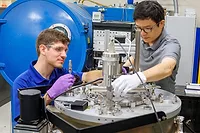
Most leak testing applications take place in research labs that expose batteries to extreme conditions. To determine how safe batteries are, Roth tests them in harsh environments to see when they fail or leak their electrolyte. He uses mass spectrometry to examine the stability of the materials, their flame-retardant performance, and the high-temperature integrity of separators between the cathode and the anode, in addition to general thermophysical properties.“We look at fundamental chemistry to discover the kinds of gases they emit when they are heated and explode,” explains Roth. He says some of the newer devices on the market, such as lithium-iron phosphate batteries used in handheld power tools, are extremely resilient and less reactive when subjected to extreme conditions, unlike other types of batteries.
Underwriters Laboratories Inc. (UL, Northbrook, IL) is another organization that tests batteries for leaks and other potential safety hazards that may create a fire or an explosion. Batteries are tested both individually and when used in consumer goods such as cameras, cell phones and laptop computers.
“Leak testing is part of our standard test program to make sure batteries conform to the UL 1642 standard,” says John Drengenberg, consumer affairs manager. “We put batteries through a wide variety of test conditions, such as altitude, heat, cold and vibration.”
Battery packs and cells are typically weighed during testing. Engineers at UL use electronic scales to measure the density of cells before and after testing. Any discrepancy indicates that a leak has occurred.
According to Drengenberg, an engineer who has been studying batteries and other products for more than 40 years, most problems occur because of a bad design or bad construction. “It’s often caused by ineffective crimping or by cracking,” he points out.
In addition to the work being done by independent labs, battery manufacturers are doing more testing to ensure the safety of their products.
“We don’t target battery or fuel cell testing specifically, but over the last year, we have seen an increase in customer demand for leak test and other process monitoring,” says Nathan Sheaff, CEO of Sciemetric Instruments Inc. (Ottawa, ON). His company focuses on air-based leak tests using pressure decay, vacuum or flow as the methodology.
Most battery leak testing applications today have shifted to electronics and medical devices. For instance, back in the 1980s, InterTech Development Co. (Skokie, IL) was actively involved in testing eight-cell automotive batteries.
“The issue was to determine if the plastic housing between compartments allowed electrolytes to leak from one cell to another,” recalls Jacques Hoffmann, president. “This is a relatively archaic application-alkaline car battery leak testing-and we haven’t had many requests for automotive battery testing for quite some time.”
Hoffmann says his company has seen more applications for testing computer batteries in recent years. “This is not leak testing per se, but rather burst testing for many components of these batteries,” he explains.
“Given the very high production rates for batteries, such as 100 units per minute, audit testing is generally used,” says Hoffmann. “But, given the high volumes, these are still automated test systems. Because the battery designs aim for lighter weights and thinner constructions, testing becomes more and more critical.
“You aren’t generally dealing with the same high volumes when you are testing medical devices,” adds Hoffmann. “Much of our work is in testing battery caps, not the complete battery. If gas builds up in a battery and cannot escape, you have a problem. The relief valves eliminate pressure in the caps. Burst testing validates that these relief valves are functioning correctly.”

Testing Challenges
Batteries come in a variety of shapes and sizes, which have their own unique leak-testing challenges. “Modern batteries tend to be hermetically sealed, with very little or no headspace inside,” says David Selin, European sales manager at Uson LP (Houston). “This makes it difficult to measure a transfer of gas through the barrier (wall) to or from the battery, as there is nowhere to go.
“Many medical devices either are not hermetically sealed, and therefore have a connection point for filling, or they are sealed but have a known headspace with which we can work,” adds Selin. “Lead-acid batteries could be tested directly, as they had removable plugs for topping up with distilled water, and therefore provided an access point for test line connection. Some smaller batteries do have a useable headspace and can be tested using trace gas by the ‘bombing’ technique.”
The type of testing method that’s used to check batteries for leaks typically depends on the type of battery and where it is used. For example, helium testing is used for cardiac pacemakers, or for any similarly internally planted medical device with batteries, where extremely tight tolerances are required. Cumulative helium leak detection is used to test very fine leaks in sealed packages.
“Batteries come in many styles, shapes and sizes and can be easy or difficult to leak test,” notes Sheaff. “They all have their difficulties, depending on the specific configuration. Issues will include upstream processes and test stability, cycle time and throughput, size and volume, and test specifications.
“It really depends on the specifics of the battery design and the process itself,” adds Sheaff. “For example, whether it is possible to perform a leak test on the dry unfilled container. If the battery cannot be leak tested without fluids present, any leaks could be masked and result in a test showing ‘good,’ but the battery then failing in service.”
Size, temperature issues, weld techniques, leak specifications, test speed and cycle time, and the number of channels to match the tooling must be addressed when testing batteries. “Fixturing and sealing of the part on the assembly line is always an important part of any leak testing,” says Sheaff.
Another big issue with battery testing is health and safety issues due to the types of materials and liquids being used, as well as the waste issue. “Batteries and fuel cells are often tested in multiples,” Sheaff points out. “Therefore, a high channel capacity system is often a more economical choice.”
Leak testing usually involves a pressure difference between the inside and outside of a part. “This can occur both when the part is charged with trace gas (helium bombing) or during the leak check test itself,” says John McLaren, strategic marketing manager at Varian Inc. (Palo Alto, CA). However, this can stress a battery casing well beyond what it will see in its lifetime.
“In addition, many batteries are designed with built-in pressure relief or vent ports that further complicate testing, because they are designed to leak on purpose,” adds McLaren. “They cannot tolerate the pressure difference involved in testing. When this is the case, we [usually] develop a partial vacuum test process that the battery can tolerate.”
To learn more about battery trends, search for these articles on ASSEMBLY’s Web site:
- Batteries May Be Included.
- Batteries Power a Robust Market.
- Charging Technology Gets Smarter, Faster.
- It’s All About the Battery.
- Nanotechnology Transforms Lithium-Ion Batteries.
- Thin-Film Batteries Hold Promise.
- Ultrasonic Welders Assemble Lithium-Ion Batteries.
Looking for a reprint of this article?
From high-res PDFs to custom plaques, order your copy today!