A Sunny Disposition
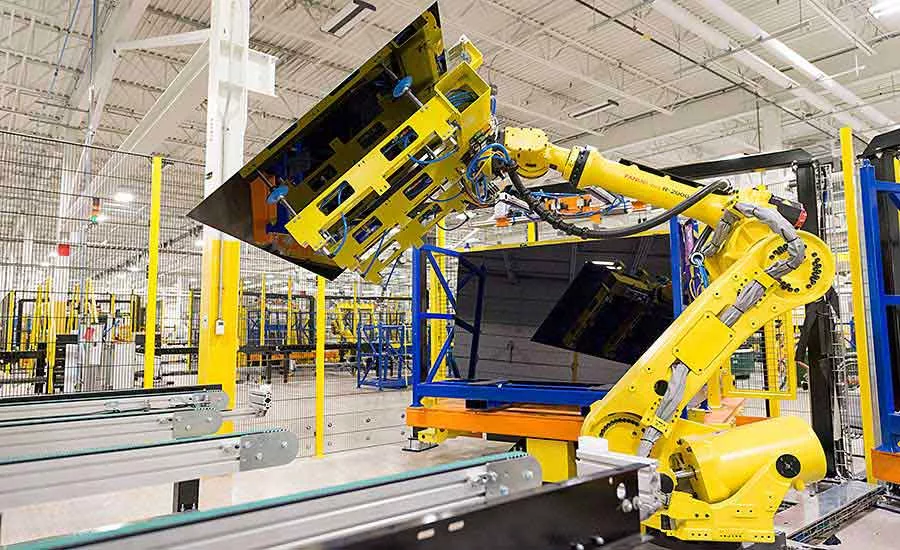
To help curb costs, solar panel manufacturers are increasingly employing robotics as much as possible.

Decades after the energy shocks of the 1970s first introduced Americans to the idea of using direct sunlight as an alternative to coal and oil, solar panels are finally becoming a legitimate contender in the marketplace.
Long relegated to satellites and light-powered calculators, photovoltaic (PV) panels, which create electrical power directly from the sun’s rays, are increasingly being employed to help power homes and businesses.
Germany is currently leading the way in PV usage with half the world’s installed capacity. However, faced with skyrocketing fuel process, a number of other countries are following suite, including the United States and China.
Since 2002, global demand for PV products has been increasing approximately 50 percent annually. In 2007, PV equipment manufacturers recorded $12.9 billion in sales. That number is expected to increase to slightly over $32 billion by 2012.
Unfortunately, PV panels are still expensive to manufacture, to the point where the cost remains dramatically higher per watt than conventional energy.
For example, the semiconductor wafers that do the actual converting, and serve as the heart of the dozens of cells making up a single crystalline silicon panel, require a number of expensive materials, including high-quality silicon. The process of integrating these cells into a single panel capable of withstanding the rigors of years of service is also both delicate and highly labor intensive.
To help curb these costs, manufacturers are increasingly employing robotics to automate the process as much as possible, whether it’s manipulating individual wafers or palletizing finished panels for shipment.
For example, each solar panel is comprised of many small photovoltaic cells, all connected electrically in a process known as stringing. Failure to correctly place or connect the cells comprising a solar panel can have a marked effect on its efficiency. By implementing robots, manufacturers ensure their products function as intended out in the field.
Along these same lines, each of the many cells comprising a single solar panel requires extensive processing-grinding, chamfering, marking, tabbing and inspection-which is often performed by automated cells that require continual tending, another area in which robots excel.
Finally, a completed solar panel can be both bulky and heavy, making it difficult for employees to handle manually. A robot equipped with a large, frame-style gripper will quickly pay for itself in terms of waste costs and breakage.
“Robots lend themselves to each process step that requires any type of cell handling or transfer from process to process or process to container,” says Jay Sachania, director of marketing at Adept Technology Inc. (Livermore, CA). “There are a number of processes, including stringing, inspection, quality controls and other manual operations that can all benefit drastically through the use of robotic automation.”
Rush LaSelle, general manager of the western office for FANUC Robotics (Rochester Hills, MI), agrees, noting robots can be especially effective at performing highly repetitive tasks, such as welding, or more awkward tasks, such as frame assembly.
“The assembly of stringers and welding processes are very time intensive. A large percentage of the stringer and tabbing processes are automated,” LaSelle says. “The other area where labor tends to slow the process is in frame assembly…. There has been a lot of work done in these areas using articulated robotics to consistently apply the required pressure, ensure that all the fastening hardware is in place and assemble the frames in a repeatable fashion.”
Robots are also well suited to solar panel assembly because of their ability to quickly adapt to product changes. The market for industrial and residential solar panels is still very much in a state of flux, with few if any standards. As a result, different solar panel model lines are continually being refined or displaced by new products more in keeping with current demand.
Of course, having to reconfigure a conventional hard automation system to accommodate this kind of change can be difficult or even possible. However, with robot-based automation, adapting to different product dimensions or configurations simply requires a change of programming and possibly a new end effector. These are both tasks that are becoming easier and easier thanks to today’s controllers and hardware. Even end effectors are becoming increasingly flexible, so that a single piece can be used with multiple product types.
“The solar industry is evolving at a blistering pace,” LaSelle says. “Robotics offers the ability to run short batches and allow for a greater product mix due to their inherent flexibility.”
LaSelle adds there have been a number of cases in which a company has employed a robot or robots during the testing phase of a new model and then successfully implemented those same machines in its full-scale assembly line.
“Many startup and development labs need to implement a pilot line quickly to test their theories and prove to investors that they can achieve what their specific technology claims to deliver,” he says. “When they need to move to high-volume production, the robot can then be redeployed in a full line…to obtain the increased throughput requirements. For those whose theories do not pan out, there is a much greater market for a used robot than a dedicated piece of equipment.”
Adept’s Sachania agrees. “There are still no standards. The industry is still evolving. Wafer sizes are still changing. Eventually there will be a standard, but we’re not there yet.”

“Robotic vision…lends itself very well to solar manufacturing,” says FANUC Robotics’ industrial marketing manager Mark Handelsman. “As with other areas of robotics, vision offers a significant cost advantage vs. hard tooling, locators or other ways to locate parts.”
Erwin DiMalanta, solar segment manager for ABB Inc. (Auburn Hills, MI), agrees, describing robot machine vision as being “extremely important,” in terms of guidance, inspection and quality.
“Fully processed solar cells have a high value, around $10 each. Additionally, cells are getting thinner and thinner. The combination of high value and delicate materials lends itself to automating to reduce breakage and scrap. Robots today are accurate to well within the required tolerances,” DiMalanta says.
John Yett, a senior applications engineer at EPSON Robots (Carson, CA) adds that breakage of cells and other components can be further reduced through the use of force-sensing technologies.
“[Vision] is one of the most important areas as industrial robots continue to bring shorter processing times, lower costs, higher throughput, higher quality, major reduction in medical claims, scrape, and market comparativeness,” says Adept’s Sachania. “In recent years most manufacturers that have invested in this technology have done so with great success. The essential factor has been the integration of image processing and robot control into one logical unit. Each function can access all the data it needs from other functions at any time and in the space of a few milliseconds…The complex and inflexible communication protocols required by most external systems are virtually eliminated.”

Another robot type that is well suited to wafer handling is the parallel kinematic, or delta robot. Equipped with machine vision, these super-fast machines can be especially effective at picking randomly oriented wafers from a moving conveyor and then placing them in an array.
“Delta-type robots are best suited for cell and wafer handling, over-the-belt conveyor tracking, high-speed pick and place, and panel assembly. SCARAs are best suited for compact applications, such as stringing and heavier payload applications. Larger six-axis roots are best suited for panel handling operations, due to their dexterity and heavy payload panels or modules,” Sachania says.
Along these same lines, EPSON’s Yett says he has been involved in a number of applications in which SCARA robots have been used for soldering cell strings with the help of vision guidance to ensure correct alignment. He says larger six-axis robots can then be used to pick up and transfer the interconnected solar cells onto the actual panel, while smaller six-axis robots can be used for tasks such as sealing junction boxes to the back of the PV modules.
DiMalanta notes that six-axis robots and delta types are becoming increasingly common, but Cartesian systems continue to be used in larger glass handling applications where articulation is not required.
According to Yves Crepel, solar activity manager at Stäubli Corp. (Duncan, SC), vision-equipped SCARA and delta robots serve well in high-speed wafer applications, while larger six-axis models are better at processing completed solar modules. In all these areas, Crepel says, machine vision will play an increasing role as solar panel manufacturers continue to take advantage of all that robots have to offer them.
Whether its handling individual wafers or completed modules, robots can be effective throughout the solar panel manufacturing process. Photo courtesy FANUC Robotics
Decades after the energy shocks of the 1970s first introduced Americans to the idea of using direct sunlight as an alternative to coal and oil, solar panels are finally becoming a legitimate contender in the marketplace.
Long relegated to satellites and light-powered calculators, photovoltaic (PV) panels, which create electrical power directly from the sun’s rays, are increasingly being employed to help power homes and businesses.
Germany is currently leading the way in PV usage with half the world’s installed capacity. However, faced with skyrocketing fuel process, a number of other countries are following suite, including the United States and China.
Since 2002, global demand for PV products has been increasing approximately 50 percent annually. In 2007, PV equipment manufacturers recorded $12.9 billion in sales. That number is expected to increase to slightly over $32 billion by 2012.
Unfortunately, PV panels are still expensive to manufacture, to the point where the cost remains dramatically higher per watt than conventional energy.
For example, the semiconductor wafers that do the actual converting, and serve as the heart of the dozens of cells making up a single crystalline silicon panel, require a number of expensive materials, including high-quality silicon. The process of integrating these cells into a single panel capable of withstanding the rigors of years of service is also both delicate and highly labor intensive.
To help curb these costs, manufacturers are increasingly employing robotics to automate the process as much as possible, whether it’s manipulating individual wafers or palletizing finished panels for shipment.
For example, each solar panel is comprised of many small photovoltaic cells, all connected electrically in a process known as stringing. Failure to correctly place or connect the cells comprising a solar panel can have a marked effect on its efficiency. By implementing robots, manufacturers ensure their products function as intended out in the field.
Along these same lines, each of the many cells comprising a single solar panel requires extensive processing-grinding, chamfering, marking, tabbing and inspection-which is often performed by automated cells that require continual tending, another area in which robots excel.
Finally, a completed solar panel can be both bulky and heavy, making it difficult for employees to handle manually. A robot equipped with a large, frame-style gripper will quickly pay for itself in terms of waste costs and breakage.
“Robots lend themselves to each process step that requires any type of cell handling or transfer from process to process or process to container,” says Jay Sachania, director of marketing at Adept Technology Inc. (Livermore, CA). “There are a number of processes, including stringing, inspection, quality controls and other manual operations that can all benefit drastically through the use of robotic automation.”
Rush LaSelle, general manager of the western office for FANUC Robotics (Rochester Hills, MI), agrees, noting robots can be especially effective at performing highly repetitive tasks, such as welding, or more awkward tasks, such as frame assembly.
“The assembly of stringers and welding processes are very time intensive. A large percentage of the stringer and tabbing processes are automated,” LaSelle says. “The other area where labor tends to slow the process is in frame assembly…. There has been a lot of work done in these areas using articulated robotics to consistently apply the required pressure, ensure that all the fastening hardware is in place and assemble the frames in a repeatable fashion.”
Robots are also well suited to solar panel assembly because of their ability to quickly adapt to product changes. The market for industrial and residential solar panels is still very much in a state of flux, with few if any standards. As a result, different solar panel model lines are continually being refined or displaced by new products more in keeping with current demand.
Of course, having to reconfigure a conventional hard automation system to accommodate this kind of change can be difficult or even possible. However, with robot-based automation, adapting to different product dimensions or configurations simply requires a change of programming and possibly a new end effector. These are both tasks that are becoming easier and easier thanks to today’s controllers and hardware. Even end effectors are becoming increasingly flexible, so that a single piece can be used with multiple product types.
“The solar industry is evolving at a blistering pace,” LaSelle says. “Robotics offers the ability to run short batches and allow for a greater product mix due to their inherent flexibility.”
LaSelle adds there have been a number of cases in which a company has employed a robot or robots during the testing phase of a new model and then successfully implemented those same machines in its full-scale assembly line.
“Many startup and development labs need to implement a pilot line quickly to test their theories and prove to investors that they can achieve what their specific technology claims to deliver,” he says. “When they need to move to high-volume production, the robot can then be redeployed in a full line…to obtain the increased throughput requirements. For those whose theories do not pan out, there is a much greater market for a used robot than a dedicated piece of equipment.”
Adept’s Sachania agrees. “There are still no standards. The industry is still evolving. Wafer sizes are still changing. Eventually there will be a standard, but we’re not there yet.”
Vision and force-sensing equipped robots help minimize breakage during handling of individual photovoltaic cells. Photo courtesy Stäubli Corp.
Machine Vision
Central to this flexibility and efficiency is the use of robot-based machine vision. In addition to performing quality inspections, machine vision can be used to help locate randomly placed wafers on a conveyor belt or help place them correctly during installation. It can also be used execute accurate welds and position framing. By allowing assemblers to forego the need for expensive, time consuming fixturing, vision-equipped robots help cut cost and time to market. The same is true with respect to programming.“Robotic vision…lends itself very well to solar manufacturing,” says FANUC Robotics’ industrial marketing manager Mark Handelsman. “As with other areas of robotics, vision offers a significant cost advantage vs. hard tooling, locators or other ways to locate parts.”
Erwin DiMalanta, solar segment manager for ABB Inc. (Auburn Hills, MI), agrees, describing robot machine vision as being “extremely important,” in terms of guidance, inspection and quality.
“Fully processed solar cells have a high value, around $10 each. Additionally, cells are getting thinner and thinner. The combination of high value and delicate materials lends itself to automating to reduce breakage and scrap. Robots today are accurate to well within the required tolerances,” DiMalanta says.
John Yett, a senior applications engineer at EPSON Robots (Carson, CA) adds that breakage of cells and other components can be further reduced through the use of force-sensing technologies.
“[Vision] is one of the most important areas as industrial robots continue to bring shorter processing times, lower costs, higher throughput, higher quality, major reduction in medical claims, scrape, and market comparativeness,” says Adept’s Sachania. “In recent years most manufacturers that have invested in this technology have done so with great success. The essential factor has been the integration of image processing and robot control into one logical unit. Each function can access all the data it needs from other functions at any time and in the space of a few milliseconds…The complex and inflexible communication protocols required by most external systems are virtually eliminated.”
Vision-equipped delta-style robots can be especially effective in picking and placing individual solar wafers prior to installation into arrays. Photo courtesy Adept Technology Inc.
The Right Robot
In terms of specific robot types, faster machines with limited mobility, like SCARAs and Cartesian systems, tend to be used to manipulate cells and wafers, while larger, more flexible six-axis machines are used to assemble and manipulate competed modules.Another robot type that is well suited to wafer handling is the parallel kinematic, or delta robot. Equipped with machine vision, these super-fast machines can be especially effective at picking randomly oriented wafers from a moving conveyor and then placing them in an array.
“Delta-type robots are best suited for cell and wafer handling, over-the-belt conveyor tracking, high-speed pick and place, and panel assembly. SCARAs are best suited for compact applications, such as stringing and heavier payload applications. Larger six-axis roots are best suited for panel handling operations, due to their dexterity and heavy payload panels or modules,” Sachania says.
Along these same lines, EPSON’s Yett says he has been involved in a number of applications in which SCARA robots have been used for soldering cell strings with the help of vision guidance to ensure correct alignment. He says larger six-axis robots can then be used to pick up and transfer the interconnected solar cells onto the actual panel, while smaller six-axis robots can be used for tasks such as sealing junction boxes to the back of the PV modules.
DiMalanta notes that six-axis robots and delta types are becoming increasingly common, but Cartesian systems continue to be used in larger glass handling applications where articulation is not required.
According to Yves Crepel, solar activity manager at Stäubli Corp. (Duncan, SC), vision-equipped SCARA and delta robots serve well in high-speed wafer applications, while larger six-axis models are better at processing completed solar modules. In all these areas, Crepel says, machine vision will play an increasing role as solar panel manufacturers continue to take advantage of all that robots have to offer them.
Looking for a reprint of this article?
From high-res PDFs to custom plaques, order your copy today!