Material Handling: Give Me a Lift

Lifting heavy or bulky objects, such as parts bins and subassemblies, is one of the most hazardous tasks facing assemblers on the plant floor. Fortunately, a wide variety of scissor lifts, tilt tables and other ergonomic devices can improve productivity and minimize the risk of back injury.
According to the National Institute for Occupational Safety and Health (NIOSH), low back pain and injuries caused by manual lifting are one of the leading safety issues facing manufacturers in every industry. The Bureau of Labor Statistics claims that injuries due to overexertion, such as repetitive and awkward lifting of parts, result in an average of eight days of workers comp time.
“Many [manufacturers] have acknowledged the link between occupational lifting and low back pain risk, and many companies have changed their workplaces to better accommodate workers,” explains William Marras, Ph.D., director of the Center for Occupational Health in Automotive Manufacturing (COHAM) at Ohio State University. “The national injury statistics indicate that this is still a large problem. However, direct comparisons to several years ago are difficult for several reasons.
“First, reporting has been inconsistent and the last administration did not make a strong effort to accurately record such events,” Marras points out. “We know that lost time occurrences have decreased over the years. However, at the same time, we have seen restricted time increase. Thus, many suspect that back injuries are simply being accounted for differently so that the rates look better. We do know the cost of treating these injuries have increased disproportionately over this period of time. So, it is important to deal with these problems quickly.
“Second, the nature of [manufacturing] jobs, including physical work and exposure, has changed dramatically [in recent years],” adds Marras. “Most facilities use rotation schedules that make it difficult to track the nature of an injury. Even with these changes, low back problems continue to be of concern to many assembly plants.”
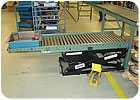
A transmission manufacturer uses a scissor lift attached to a roller conveyor on its assembly line.
Risky Business
The risk of injury during a lifting task depends on numerous variables, such as the size of the object being lifted, the distance of the object from the body, the travel distance of the load, the posture of the worker, the velocity and acceleration of the lift, the frequency of lifting and the physical capabilities of the individual. In other words, lifting activities are too complex to apply a generic weight limit.Manufacturing engineers can use guidelines to estimate injury risk and establish suitable interventions or accommodations. For instance, the most common analysis tools used for this are the Liberty Mutual manual material handling tables and the NIOSH lifting equation.
“Intuitively, every worker knows that they are more productive when work is positioned at a comfortable height,” says Brian McNamara, president of Southworth Products Corp. “However, since workers come in all different sizes, and the size and shape of the items they work on vary greatly, there is a need for adjustable height work surfaces to create a comfortable work environment. Today, as businesses seek to increase productivity wherever possible, the need for vertical positioning equipment is greater than ever.”
“Because of recent lean manufacturing initiatives, there’s been more emphasis on ergonomics and safety,” adds Ray Niemeyer, managing director of the Lift Manufacturers Products Section (LMPS) of the Material Handling Industry of America. “Lift assist systems are now designed into many assembly lines. In the past, it was more of an afterthought.”
For instance, at Lear Corp.’s car seat factory in Montgomery, AL, the recipient of ASSEMBLY’s 2006 Assembly Plant of the Year award, several different ergonomic aids are used to reduce operator fatigue and injury. The devices are used to position, feed, transfer, load and unload parts and subassemblies. For example, each assembly line in the facility is equipped with multifunction build pallets that can be rotated and tilted while work is performed.
“People involved in assembly operations are typically more concerned with positioning items than just lifting them,” says McNamara. “To maximize productivity, they are seeking products that have the ability to present work in a variety of manners, such as vertically, horizontally, tilted or rotated. The ability to simply and inexpensively modify a product to best suit a particular application is also important.”
According to Niemeyer, scissor lifts are the most common type of adjustable tables used in manufacturing plants. A scissor lift is supported by a set of pantograph legs that feature a single central pivot axis. As the table moves upward, the legs unfold in a criss-crossing, X-shaped pattern. The vertical material handling devices are often incorporated into conveyors to facilitate horizontal movement. Tilting devices can also be added to lift tables so that loads can be positioned both vertically and angularly for easy access.
Scissor lifts are typically used in ergonomic applications where bottom-up movement is required. They can be installed many different ways on assembly lines to meet various material handling requirements.
For instance, scissor lifts can be either surface-mounted or pit-mounted. They can also be fixed or mobile to meet specific assembly and material handling applications. Controls can be simple up-down, multiple motions or user-programmable, with various pushbutton- or footswitch-activated configurations.
Scissor lifts are available in a wide range of capacities, sizes and travels. In recent years, there’s been a trend toward smaller capacity lift tables, such as devices that can handle loads weighing less than 2,000 pounds.
The most popular models in the industry feature 36 inches of vertical travel and tables that measure 24 by 48 inches. When fully folded, the devices sit 6 inches off the ground.
At the other extreme, scissor lifts that can handle up to 100,000 pounds are also available. They feature multiple styles of travel and mounting locations that are determined by the application. Heavy-capacity units are typically custom-built.
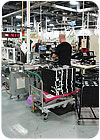
Mobile lift tables are popular, because they accommodate flexible production lines.
Mobility vs. Stability
Mobile lift tables are becoming more popular, because they accommodate flexible production lines. “The issue of mobile vs. stationary lifts is really a matter of application and convenience,” says McNamara. “Mobile lifts are more desirable in applications that involve moving work within a workcell, transporting loads between workcells, or where assembly lines are frequently reconfigured. However, even stationary lifts are rarely installed permanently, so they, too, can be relocated rather easily if production lines need to be reconfigured on an occasional basis.”However, engineers must be aware that there are tradeoffs associated with using mobile lifts. “What you lose with mobility is collapsible height,” says Mike Adel, director of engineering at Autoquip Corp. “Low profiles are important. When you mount scissor lifts on wheels, devices that were once 10 inches off the ground suddenly become 12 to 14 inches high. End users also have to be more careful about correctly balancing loads. If a load is positioned off-center on a mobile device, it will be less stable than a stationary lift.”
“Mobile equipment must be built better than stationary tables,” adds Michael Renken, sales manager at Advance Lifts Inc. “The base frame is critical and wheels must be load-bearing.”
In addition to mobile scissor lifts, personnel work platform lifts are popular with manufacturers that assemble large products, such as aircraft, construction equipment and locomotives. The devices feature high travels (up to 16 feet) and large platform sizes (up to 10 by 40 feet).
“Instead of adjusting the height of the product to fit the unique height of the worker, these scissor lifts adjust the height of the worker to fit the unique height of the product,” explains Adel. “For instance, aerospace engineers have been asking for adjustable work platform lifts that allow assemblers to work on a variety of wings, fuselages and other large parts.”
While all lift tables are essentially the same, minor modifications to platforms and controls can customize them for a wide variety of applications. “Rather than automate entire processes, which can be complicated and expensive, many companies are opting for partial automation,” explains McNamara. “The use of simple, inexpensive custom-modified lift equipment allows for flexibility in the process while still achieving the goal of increased productivity.”
Today, manufacturers want to solve lifting problems in an inexpensive manner. “Lift and tilt tables are easy, cheap solutions for many situations,” says COHAM’s Marras. “However, depending on the nature of the risk, such as pushing or pulling vs. lifting, it is often necessary to combine solutions.
“I see more [manufacturers] using a combination of scissor lifts with rollers or ball bearing tables to customize the solution,” Marras points out. “For situations where precise placement is important and decent end effectors are available, overhead lifts and hoists are becoming popular as the price of these [power-assisted] devices drops. In particular, devices that allow workers to precisely control loads through servo mechanisms appear to be gaining popularity.”
No matter what type of system they choose to use, one of the most important challenges facing engineers is selecting the correct power source. The actuators that raise and lower adjustable tables can be powered with electric or air-powered hydraulic pumps, mechanical lift systems or pneumatic lift systems.
“Power source is critical,” warns Jamie Flinchbaugh, a partner in the Lean Learning Center. “If your lift table isn’t working correctly, it’s worse than not having one at all. What ever you decide to buy, make sure that you can maintain it. Otherwise, it will just become an expensive table.”
Hydraulic, mechanical and pneumatic systems each have pros and cons that should be carefully evaluated. “It’s hard to argue against the performance benefits of a mechanical lift,” says McNamara. “However, it’s equally difficult to justify the expense in most applications, which is often twice as much as hydraulic or pneumatic lifts.”
Hydraulic and pneumatic systems both have advantages and disadvantages. Only in fully understanding the specific application can an argument for or against them be made.
According to Renken, hydraulic systems have always been the most popular power source for scissor lifts. “People love [the technology] because it’s rock solid,” he points out. However, many automotive manufacturers moved away from hydraulic lifting equipment in the past, due to concerns about the environmental effects of leakage.
“They shifted to pneumatic systems, which are cost-effective and can be tied into existing air systems,” says Adel. “But, now the auto industry is re-evaluating pneumatic lifting equipment because its functionality is limited. Many manufacturers are going back to hydraulic systems, which are more precise and repeatable.” A
Looking for a reprint of this article?
From high-res PDFs to custom plaques, order your copy today!