Industry Report: Diesel Engines Go Green
Caterpillar and Perkins Engines are mass-producing diesels in Griffin, GA, that meet and exceed new emissions standards enacted by the EPA.
Traditionally, diesel engines are infamous for their pollution. But, a new breed of products is cleaner and greener than ever. Manufacturers such as Caterpillar Inc. and Perkins Engines Co. are mass-producing diesels that meet and exceed new emissions standards enacted by the U.S. Environmental Protection Agency (EPA). The green diesels are assembled at a pair of “sister” plants in Griffin, GA.
Diesel engines dominate the agriculture, mining and construction equipment industries. “Diesel is the prime fuel for transporting freight, powering tractors, building roads, and meeting critically important demand for emergency services and national defense,” says Allen Schaeffer, executive director of the Diesel Technology Forum. “More than 80 percent of products exported from and imported to the United States are moved using diesel technology and about 75 percent of the fossil-fueled equipment used in construction, mining and agriculture are diesel-powered.”
However, diesel engines are notorious for bursts of black smoke and soot. Seven years ago, the EPA enacted strict regulations to reduce emissions from future nonroad diesels. A series of steps, called “tiers,” were established in North America, with a defined set of standards for allowable emissions per tier, per horsepower range. Each progressive tier has an objective of reducing levels from the previous one.
The industry is currently implementing Tier 4 EPA standards, which will significantly decrease both nitrogen oxides (NOx) and particulate matter. A 10-year phase-in period has ensured that current products are brought up to the new level, and all manufacturing systems achieve full compliance.
According to EPA, exhaust emissions from the new generation of off-road engines will decrease significantly, providing dramatic public health benefits. For instance, by 2030, EPA estimates that controlling these emissions will annually prevent 12,000 premature deaths, 8,900 hospitalizations, and 1 million lost workdays.
Interim Tier 4/Stage III B emissions regulations began Jan. 1, 2011, for 130- to 560-kilowatt engines. These regulations require a 90 percent reduction in diesel particulate matter and a 50 percent reduction in NOx from previous Tier 3/Stage IIIA requirements. By 2015, all diesels must be Tier 4 Final compliant.
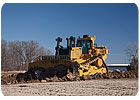
Caterpillar's new D11T dozer is equipped with a C32 ACERT engine that meets EPA Tier 4 Final emissions standards.
Engineering Challenge
The strict new emission regulations are forcing off-road equipment users to invest in new products equipped with electronic control modules and after-treatment components, such as diesel particulate filters. The Tier 4 mandate has created one of the biggest engineering challenges to ever confront the off-highway industry.Construction, mining and agriculture engines are constantly changing speed. An engine’s duty cycle varies dramatically by the kind of job it’s employed at, as well as other things that affect engine performance, such as intake and exhaust temperatures, and the amount of dust in the air.
A wheel loader, for example, typically drives into a pile of dirt, rock or other material, lifts, backs, turns and travels to a dump site, then deposits its load. The whole duty cycle repeats every 40 seconds or so.
“Reducing emissions under fluctuating load and throttle positions, plus meeting performance requirements, is no easy task,” says Bob Montgomery, marketing manage at Caterpillar’s Industrial Power Systems Div., which is responsible for all nonroad diesel engine applications ranging from paving equipment to oilfield pumps. Other factors include hotter working conditions and small engine envelopes that limit the size of radiators, fans and exhaust after-treatment size.
Diesel engine manufacturers have focused on several key elements to address the Tier 4 rule, including sophisticated engine controls for emissions and comprehensive use of exhaust treatment components.
Caterpillar has spent more than $500 million to develop a new type of diesel engine that boasts more than 250 patents. Its ACERT technology-first introduced to the on-highway market in 2002, where emissions standards are tighter-reduces emissions at the point of combustion. The technology capitalizes on Caterpillar’s expertise in four core engine systems: fuel, air, electronics and after-treatment.
ACERT is an advanced combustion technology that uses a building-block approach, based on the integration of key systems technologies, for reducing emissions. The ACERT engine family powers a number of Cat products, including track-type tractors, motor graders and hydraulic excavators. For instance, the company’s new D11T dozer is equipped with a C32 engine that meets EPA Tier 4 Final emissions standards.
In addition, the green technology is being offered in several configurations and ratings for use by customers in the industrial, agriculture and petroleum markets. For instance, Montgomery says the C27 and C32 ACERT engines “are ideal for OEMs that manufacture midsized equipment for pressure pumping, cementing and well fracturing operations.”
The Tier 4 Final configuration employs the Cat NOx Reduction System (NRS), which captures and cools a small volume of exhaust gas, then returns it to the combustion chambers to lower temperatures and retard formation of nitrogen oxides. A diesel Oxidation Catalyst uses oxidation, a chemical process, to condition exhaust gases to meet emission standards.
A new cooling package uses a two-part radiator with aluminum bar-plate cores that contribute to durability, efficient heat transfer and corrosion resistance. The new oil-to-air hydraulic-oil cooler uses similar construction, and a hydraulically variable demand fan uses less power, reduces fuel consumption and lowers sound levels.
“A next-generation turbocharger configuration creates required pressure in the exhaust system to drive the NRS,” says Montgomery. “With minimal moving parts and simple installation requirements, the turbocharger improves durability and lowers OEM packaging costs over competitive designs.
“To further reduce emissions, a modular diesel oxidation catalyst reduces regulated constituents through an oxidation process,” adds Montgomery. “The after-treatment features a simplified design that does not require monitoring by the engine control module.”
Montgomery claims that the ACERT engines provide a long-term solution to emissions reduction with none of the drawbacks associated with other technologies, such as cooled exhaust gas recirculation. “Tier 4 Interim//Stage IIIB is the most aggressive and expensive product development initiative in Caterpillar history,” he points out.
Engineers at Perkins Engines, a Caterpillar subsidiary based in Peterborough, England, also worked with hundreds of different variables to develop an optimum balance between reduced emissions, engine performance, fuel efficiency and engine durability. Perkins is one of the world’s leading suppliers of off-highway diesel and gas engines in the 5 to 2,600 hp market. Its products are used in 5,000 different applications, including a wide variety of small construction equipment, such as generators, aerial platforms, lighting towers, mini excavators and forklifts.
Earlier this year, Perkins unveiled its new 400F, the latest addition to its popular 400 Series range. It meets Tier 4 Final/Stage IIIB regulations, which come into force in January 2013 for engines above 25 hp.
“The three- and four-cylinder engines use 97 percent of the same components as the previous tier engine,” claims David Cromwell, operations and logistics manager. “The 400F will be manufactured alongside the 400D specification engines in Perkins’ plants around the world.”
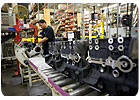
Lean manufacturing is showcased in the Perkins Shibaura plant in Griffin, GA.
Lean, Green Plants
The ground zero of green diesel manufacturing is Griffin, GA. It’s home to a pair of Caterpillar-owned plants that churn out some of the cleanest engines on the planet.Caterpillar operates a 300,000-square-foot plant that assembles large engines and generator sets for more than six different engine models that are used in a wide variety of construction, marine and mining applications. The company recently announced that it plans to invest $120 million in the 13-year-old Griffin factory, which is the global source for C27 and C32 ACERT engines.
Griffin Power Systems sits on more than 200 acres of rolling Georgia countryside approximately 40 miles south of Atlanta. A short walk up the hill sits a 55,000-square-foot Perkins Shibaura Engines plant, a joint-venture between Perkins Engines and Ishikawajima Shibaura Machinery Co. The seven-year-old factory also builds the Caterpillar 3011C to 3024CT family of engines, which is based on the same platform as the Perkins 400 Series. Last year, it celebrated a milestone when it built its 150,000th engine.
The Perkins Shibaura plant produces engines for independent OEMs as well as Caterpillar. A major customer is Cat’s compact off-highway equipment facility in Sanford, NC, which uses Griffin-built engines for products such as skid steer loaders.
Both engine plants manufacture and market separate products. But, they share similar production philosophies.
“The plants operate under the Caterpillar Production System (CPS),” says Nathan Dunbar, manufacturing engineering supervisor at the Cat plant. “We track four key metrics: people, quality, velocity and cost. Since its implementation, CPS has resulted in gains in product quality, costs savings and employee safety. CPS is also the key reason Caterpillar’s manufacturing efficiency has improved in every quarter since the end of 2008.”
Lean manufacturing is showcased in the Perkins Shibaura plant, where engines manually move down the line on roller conveyors. “That allows us maximum flexibility, because we offer our customers many different options,” says Greg Davis, manufacturing engineering manager. “Everything is built to order.
“The Griffin plant is a virtual replica of our plant in Peterborough,” adds Davis. “Engine production is based on simple, flexible processes that bring all major components, fully machined, to the facility for assembly, test and painting.”
The main line is fed by subassembly stations that build components such as crankshafts, camshafts, timing cases, rocker heads and fuel filter systems. Computer screens provide paperless work instructions, while quality gates check engines to prevent defects.
Assemblers use DC electric tools to ensure consistent torque application. Process monitoring allows the plant to continuously improve throughput, quality and traceability. Before performing an operation, assemblers scan a bar code attached to each engine to create a detailed record for each product that moves down the line.
Test stations also play a key role in the compact plant. A suite of 12 engine test cells ensure that all products exceed EPA emissions standards. All engines are tested for emissions, noise, torque, power and efficiency.
The Griffin plant is serving as the lead facility for the new Perkins 400F engine. It will be assembled on the same lines as the traditional 400D model starting early next year.
“Core assembly will remain the same until just before the test cell,” says Davis. “In the finish department, several after-treatment components, such as a diesel particulate filter, will be attached. The new 400F engine will require 10 to 12 more assembly steps.” A
Looking for a reprint of this article?
From high-res PDFs to custom plaques, order your copy today!