Assembly Magazine logo
search
Ask ASSEMBLY AI
cart
facebook twitter linkedin youtube
  • Sign In
  • Create Account
  • Sign Out
  • My Account
Assembly Magazine logo
  • TRENDS
    • Ask ASSEMBLY AI
    • Trends
    • News
    • New Products
  • INDUSTRIES
    • Aerospace
    • Appliance
    • DFMA Assembly
    • Medical Devices
    • Green Manufacturing
    • Lean Manufacturing
    • Machinery Assembly
    • Electronics Assembly
    • Automotive
  • TECHNOLOGIES
    • Adhesives & Dispensing
    • Assembly Presses
    • Automated Assembly Systems
    • Manufacturing Management
    • Manufacturing Software
    • Motion Control
    • Screwdriving & Riveting
    • Robotics
    • Test & Inspection
    • Plastics & Metal Welding
    • Wire Processing
    • Workstations
  • AUTONOMOUS & ELECTRIC MOBILITY
    • AEM Magazine Archives
    • Autonomy
    • Electrification
    • Mobility Services
    • Assembly & Testing
    • AV/EM News
  • MEDIA
    • Ask ASSEMBLY AI
    • Podcasts
    • Assembly News Now
    • Assembly TV
    • Webinars
    • eBooks
  • EVENTS
    • Calendar
    • The ASSEMBLY Show
  • MORE
    • Exclusives >
      • Plant of the Year
      • Capital Spending
    • Buyers Guide >
      • Supplier Insights
    • Classifieds
    • Featured Products
    • Newsletters
    • Store
    • White Papers
    • Columns
    • Sponsor Insights
  • INFOCENTER
    • Assembly & Test Solutions
  • EMAGAZINE
    • eMagazine
    • Archive Issues
    • Advertise
    • Contact Us
    • Sign Up
Screwdriving and Riveting Assembly

advertisement

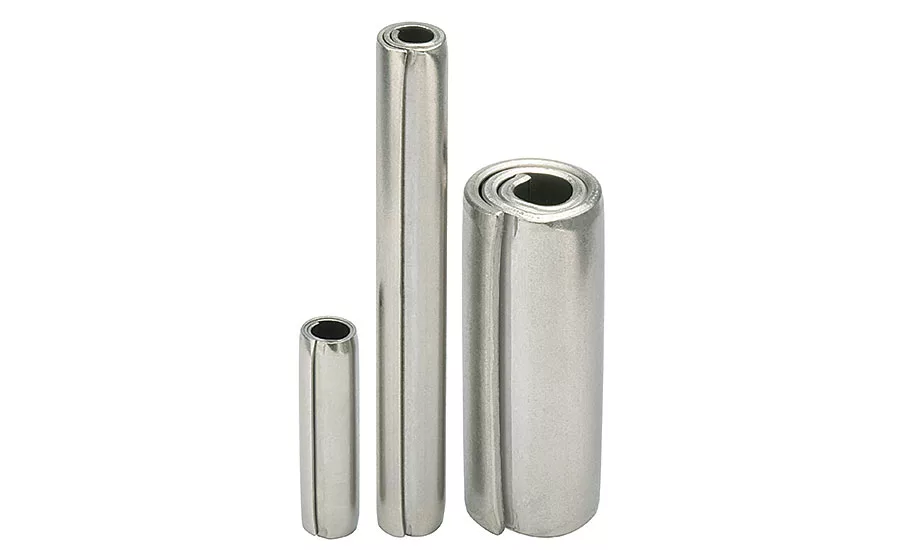
How to Design Assemblies That Use Coiled Pins for Locating and Alignment
spirol
spirol
spirol

Figure 1

spirol

Figure 2

spirol

Figure 3

spirol
spirol
spirol
spirol
spirol
March 8, 2016

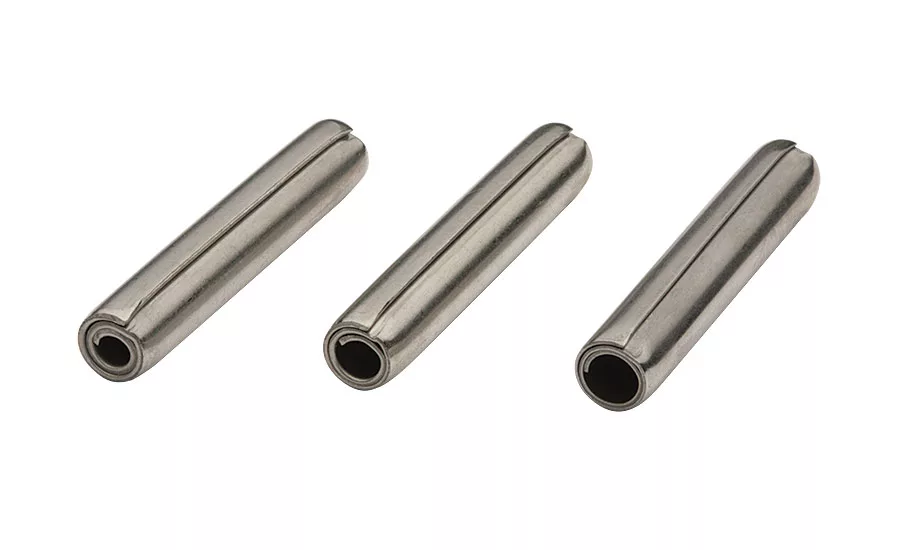
To achieve optimal alignment when using Coiled Pins, two primary design elements must be adhered to:

1) The hole diameters in the host and mating component must be correctly sized to achieve the desired interference and accuracy of alignment.

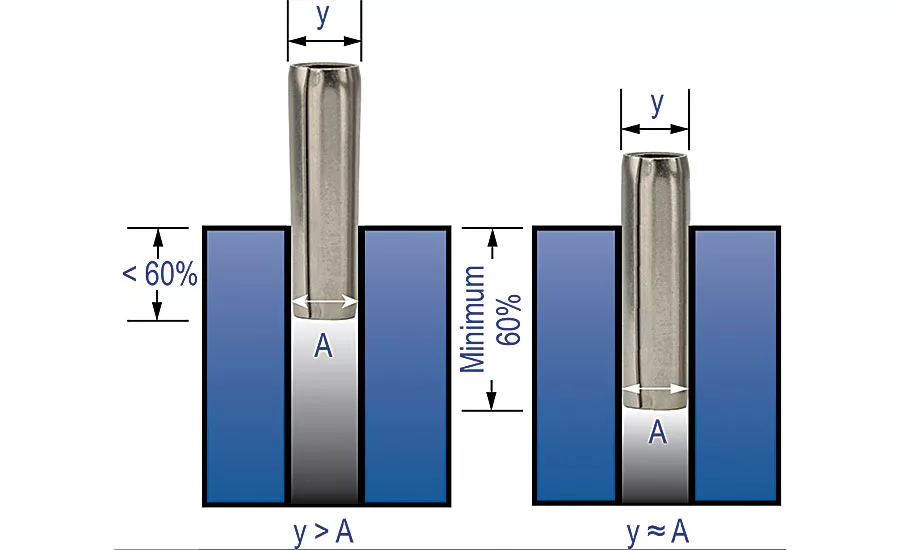
2) The engagement length of the Coiled Pin in the component providing primary retention must be no less than 60% of the pin’s overall length. The remaining protruding length will align with the mating component.  Increasing the initial length of engagement is recommended in thru-hole applications; however, the Coiled Pin still has to protrude in order to align the mating component. (Figure 1)

Interference fit for maximum alignment accuracy:

Coiled Pins are functional springs that conform to the holes into which they are installed.  The assembly force to achieve maximum accuracy in alignment should not exceed a ‘light’ press to seat mating components.  Depending upon the Coiled Pin’s duty, quantity of alignment pins, and host material, this may be as little as a tap with the palm of a hand or a mallet.  An interference fit must not be confused with that of a traditional Solid Dowel which typically requires seating with pneumatic or hydraulic presses.  This is a primary benefit of the Coiled Pin.

To ensure a light press fit, ideally, the hole size in both the host and mating components should be precision matched within the recommended tolerance range.  This may not be practical if holes are not drilled together as an assembly.

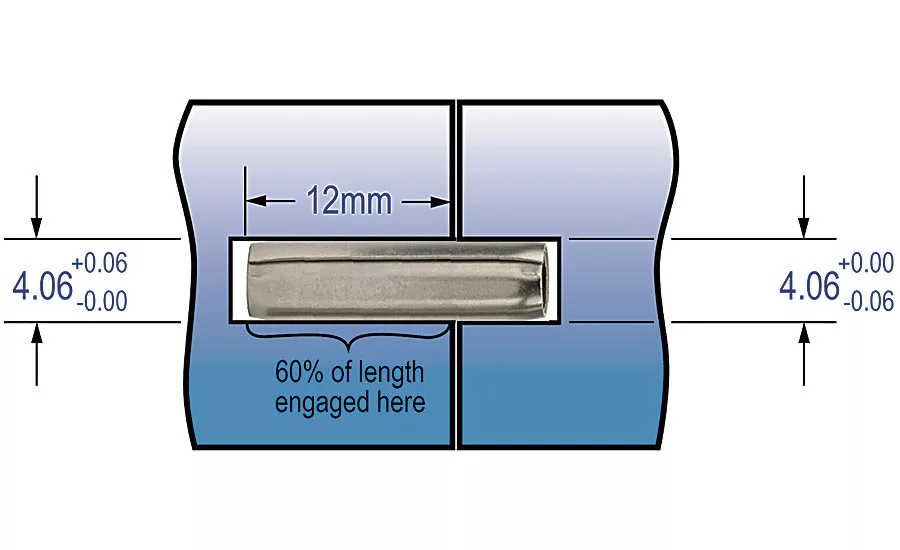
In situations where holes cannot be precision matched or where the cost of honing/reaming is prohibitive, a significant benefit of the Coiled Pin is its ability to compensate for larger hole tolerances.  The recommended tolerance range may be divided between components as demonstrated in Figure 2.  (Note: Utilizing less of the allowable manufacturing tolerance will further improve the fit and alignment of the assembly.)

Assigning the larger tolerance to the 60% retention location ensures interference between the free end of the pin and the opposing hole that is prepared at the lower half of the tolerance.  Where there is interference there is no clearance, thus ensuring proper projection of the primary hole’s position.

Clearance fit for course alignment and ease of assembly:

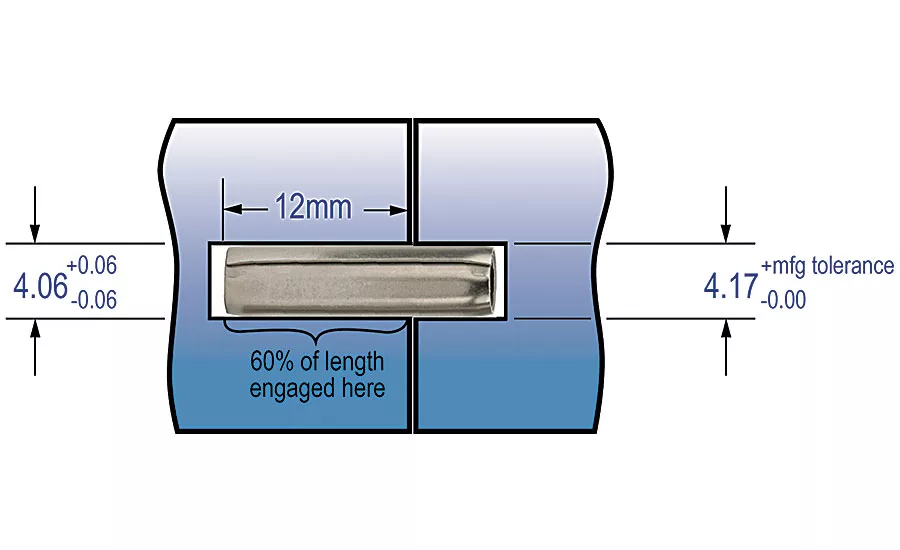
If a clearance fit over the pin is desired for ease of assembly, it will be necessary to compensate for spring recovery at the pin’s free end.  To determine the maximum diameter of the free end of the pin, install the pin to 60% of the pin’s length into the maximum hole size of the primary retention host and measure the exposed diameter.  A 0.025mm (.001”) to 0.05mm (.002”) clearance factor should be added to the free end of the pin depending upon desired alignment accuracy. (Figure 3)

Looking for quick answers on assembly and manufacturing topics? Try Ask ASM, our new smart AI search tool. Ask ASM →

When used as a free fit alignment dowel, assembly force is not a consideration; although it is important to note that consideration should be given to using the Coiled Pin as an interference fit solution.  As outlined above, Coiled Pins provide the benefit of a zero clearance fit without the added complexity of high insertion force.

Selecting the Appropriate Duty for Alignment:

The Coiled Pin is available in three “duties” to enable the designer to choose the optimum combination of strength, flexibility and diameter to suit different host materials and application requirements. Light duty pins are recommended for soft (aluminum, plastic), brittle (ceramic) or thin materials and where holes are close to an edge.  In most alignment applications, the pins are not typically subjected to significant loads.  In these instances, light duty pins are often used since installation is easy as a result from lower insertion force used. Standard duty pins were designed for use in nonferrous and mild steel components.  Heavy duty pins  should only be used in hardened materials where space or design limitations rule out a larger diameter standard duty pin.

Although this article offers general design guidelines, it is recommended that Application Engineers who specialize in fastening and joining be consulted to ensure the components are properly designed and the proper Coiled Pin is selected for each specific assembly.


SPIROL

860-774-8571

info@spirol.com

www.spirol.com 

KEYWORDS: pin insertion spring pins

Share This Story

Looking for a reprint of this article?
From high-res PDFs to custom plaques, order your copy today!

Recommended Content

JOIN TODAY
To unlock your recommendations.

Already have an account? Sign In

  • Made in the U.S.A.

    Consumer Products Manufacturing: Made in the USA

    Supply chain lessons learned during the coronavirus...
    Automated Assembly Systems
    By: Austin Weber
  • Best Practices for Press-Fit Assembly

    Best Practices for Press-Fit Assembly

    In manufacturing, ironclad formulas for success are hard...
    Assembly Presses
    By: Jim Camillo
  • aem0523leader-tesla1.jpg

    Tesla Rethinks the Assembly Line

    Engineers at Tesla Inc. have developed a new process that...
    Industries
    By: Austin Weber
Manage My Account
  • eMagazine Subscription
  • Assembly Newsletters
  • Online Registration
  • Subscription Customer Service
  • Manage My Preferences

More Videos

Sponsored Content

Sponsored Content is a special paid section where industry companies provide high quality, objective, non-commercial content around topics of interest to the ASSEMBLY audience. All Sponsored Content is supplied by the advertising company and any opinions expressed in this article are those of the author and not necessarily reflect the views of ASSEMBLY or its parent company, BNP Media. Interested in participating in our Sponsored Content section? Contact your local rep!

close
  • ultrasonic welding
    Sponsored bySonobond Ultrasonics

    Engineering Efficiency in High-Performance Assembly: How Ultrasonic Welding Enhances Throughput, Reliability and Quality

  • UV curing system
    Sponsored byDymax

    Why UV Intensity Alone Doesn’t Define Curing Performance

  • wooden pallets
    Sponsored byLEAN Manufacturing Products

    Eliminating Waste on the Shop Floor: Applying Lean Principles to Improve Manufacturing Efficiency

Popular Stories

ASSEMBLY News Now, episode-30: Volvo Redesigns EV Manufacturing

Volvo Redesigns EV Manufacturing

Boeing CEO Kelly Ortberg announces 1 billion investment

Boeing Plans $1 Billion Wichita Investment, Workforce Training Center

GE Appliances Worker on Line

GE Appliances Expands Factory AI With 800 Gemini Enterprise Agents

Watch the latest episode of ANN now!

Events

July 24, 2025

From Shop Floor to CFO: How Manufacturers Are Closing the Loop Between Operations and Finance

On Demand Learn how manufacturers are bridging the gap between the shop floor and ERP systems to gain real-time visibility, streamline operations, and kick-start digital transformation—without waiting years.

Sponsored by:

PicoStratusGreen
July 30, 2025

Buffer Analysis and Design Fundamentals for Manufacturing Excellence

On Demand In this presentation, Dr. Herman Tang shares practical insights from his industry experience and research on buffer management in manufacturing operations.

View All Submit An Event

Poll

Difficult Assembly Processes

Which assembly process gives you the most difficulty?
View Results Poll Archive

Products

Manufacturing Cost Policy Deployment (MCPD) Profitability Scenarios: Systematic and Systemic Improvement of Manufacturing Costs

Manufacturing Cost Policy Deployment (MCPD) Profitability Scenarios: Systematic and Systemic Improvement of Manufacturing Costs

See More Products
Register for webinar - Modernizing Automotive Assembly: Why Upgrading Legacy MES is a Business Imperative

Related Articles

  • Fastening: Coiled Pins for Assembly

    See More
  • Staking for Plastic Parts Assembly

    Course Teaches How to Design Plastic Parts for Automotive Applications

    See More

Related Products

See More Products
  • leaner

    Leaner Manufacturing: How to Make the Lean Production Process Easier, Faster, and More Cost-Effective

  • pocket.jpg

    How To Implement Lean Manufacturing, Second Edition

  • Introduction to the Design and Behavior of Bolted Joints, Fourth Edition: Non-Gasketed Joints

See More Products

Events

View AllSubmit An Event
  • March 10, 2026

    Design for Flexibility: How to Assemble More With Less

    On Demand Whether you are specifying new equipment or improving existing processes, this session will provide practical insight into building adaptable assembly strategies that support growth, reliability, and continuous improvement. Sponsored by:
View AllSubmit An Event

Related Directories

  • HowToRobot

  • Assembly Guidance Systems Inc. dba Aligned Vision

×

Never miss the latest news and trends driving the manufacturing industry

Stay in the know on the latest assembly trends.

JOIN TODAY!
  • RESOURCES
    • Advertise
    • Contact Us
    • Directories
    • Manufacturing Division
    • Store
    • Want More?
  • SIGN UP TODAY
    • Create Account
    • eMagazine
    • Newsletters
    • Customer Service
    • Manage Preferences
  • SERVICES
    • Marketing Services
    • Reprints
    • Market Research
    • List Rental
    • Survey/Respondent Access
  • STAY CONNECTED
    • LinkedIn
    • Facebook
    • Instagram
    • YouTube
    • X (Twitter)
  • PRIVACY
    • PRIVACY POLICY
    • TERMS & CONDITIONS
    • DO NOT SELL MY PERSONAL INFORMATION
    • PRIVACY REQUEST
    • ACCESSIBILITY

Copyright ©2026. All Rights Reserved BNP Media, Inc. and BNP Media II, LLC.

Design, CMS, Hosting & Web Development :: ePublishing