Compact Pneumatic Cylinders Can Play Big Roles in Automation
Engineers have a wealth of options when choosing compact, short-stroke cylinders for their motion control applications.
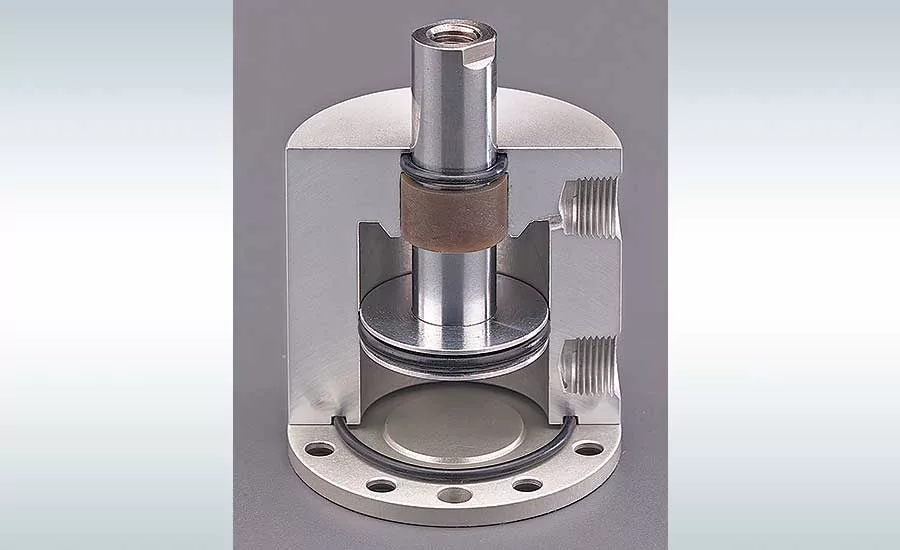
Fabco-Air’s Pancake cylinder is available with bore sizes ranging from 0.5 to 4 inches and standard strokes ranging from 0.0625 to 4 inches. Photo courtesy Fabco-Air Inc.
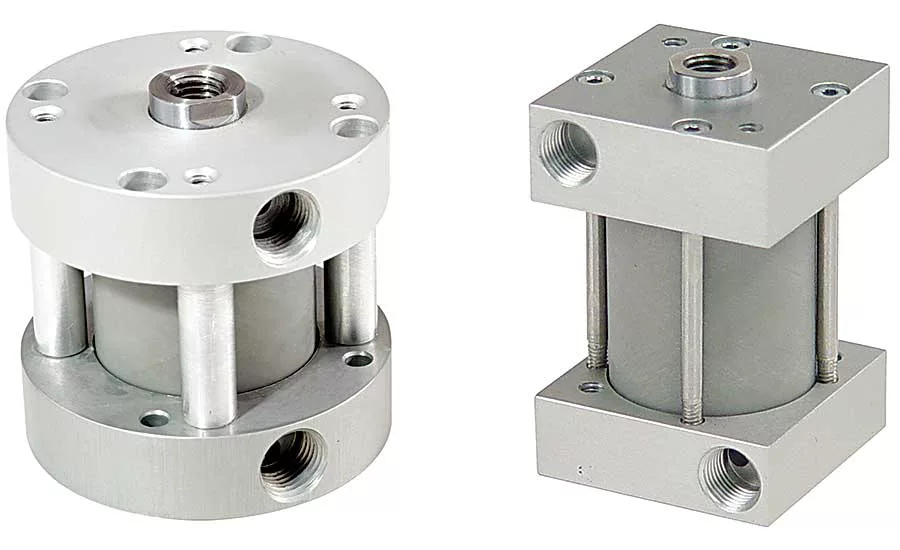
Compact cylinders are also available in a conventional tie-rod-and-spacer configuration, with round, square and extruded body designs. Photo courtesy Fabco-Air Inc.
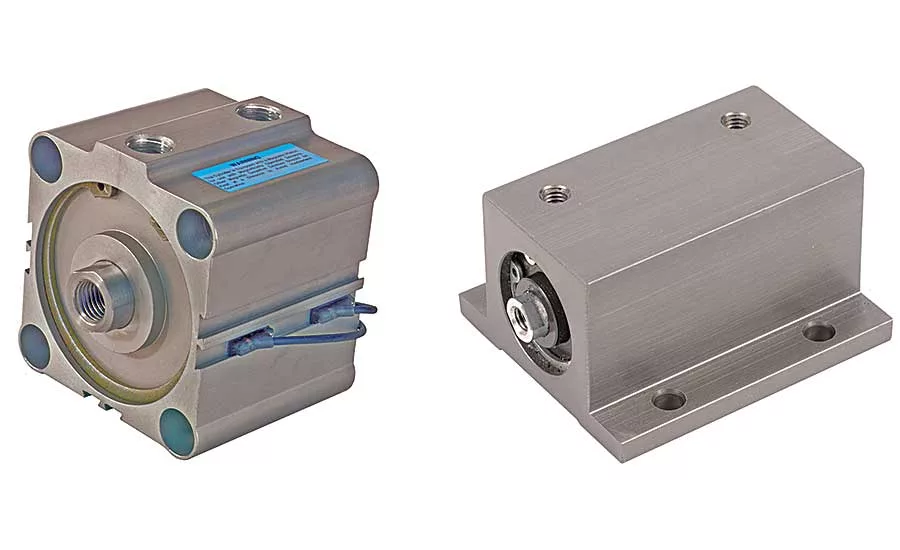
Compact cylinders are also available in a conventional tie-rod-and-spacer configuration, with round, square and extruded body designs. Photo courtesy Fabco-Air Inc.
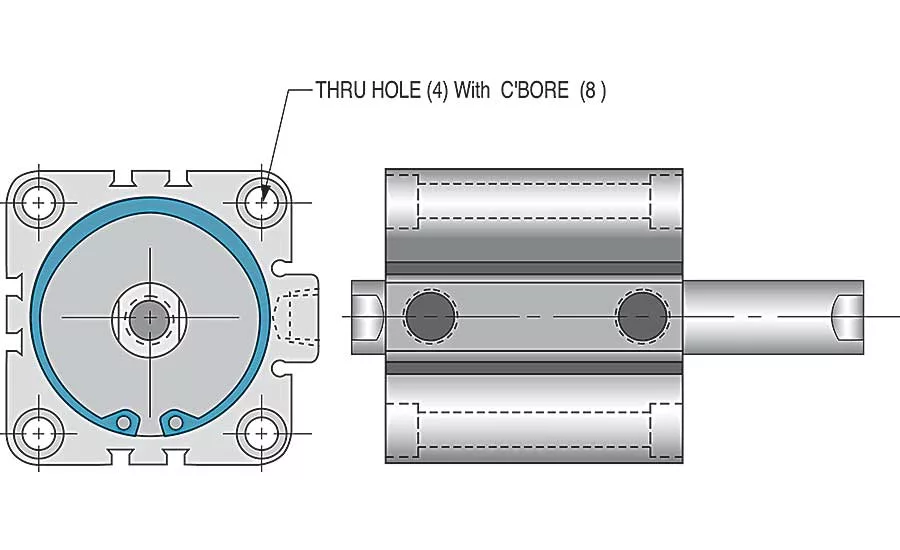
Through-hole mounting is available on many short-stroke cylinders. In this case, counterbored holes are drilled through the cylinder body for easy mounting with socket-head cap screws. Photo courtesy Fabco-Air Inc.
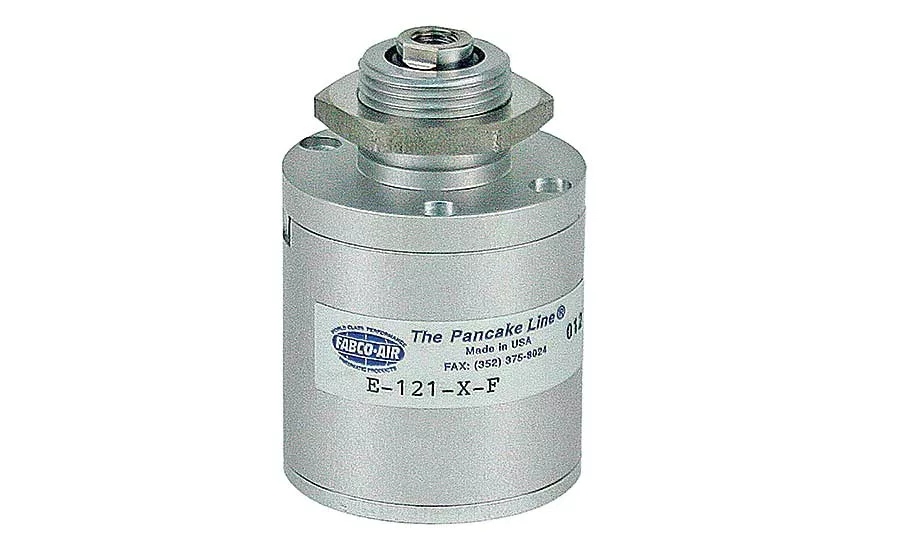
With the nose-mounting option, engineers can attach the front of the cylinder to the machine. Photo courtesy Fabco-Air Inc.
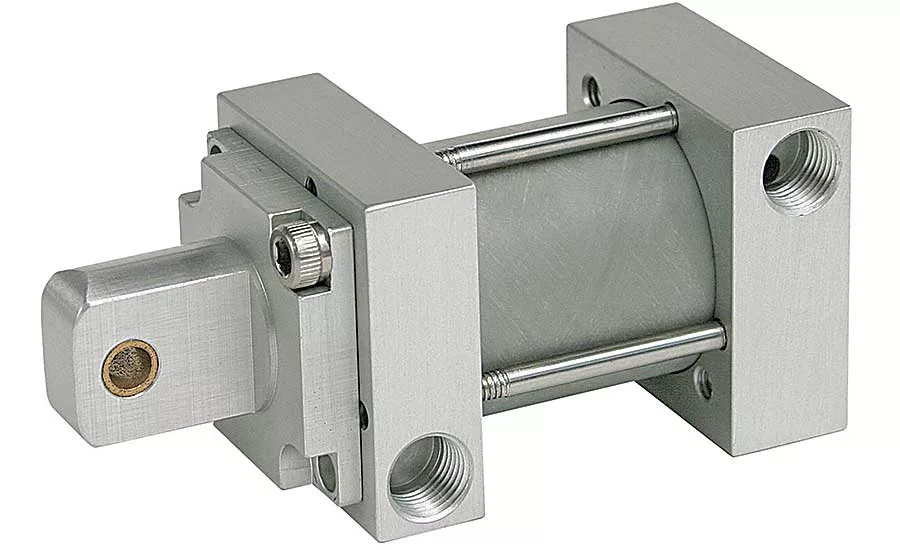
Pivot-mounting enables the cylinder to pivot through an arc. Eye and clevis mounts, as well as trunnion mounts, are available on many compact cylinder models. Photo courtesy Fabco-Air Inc.
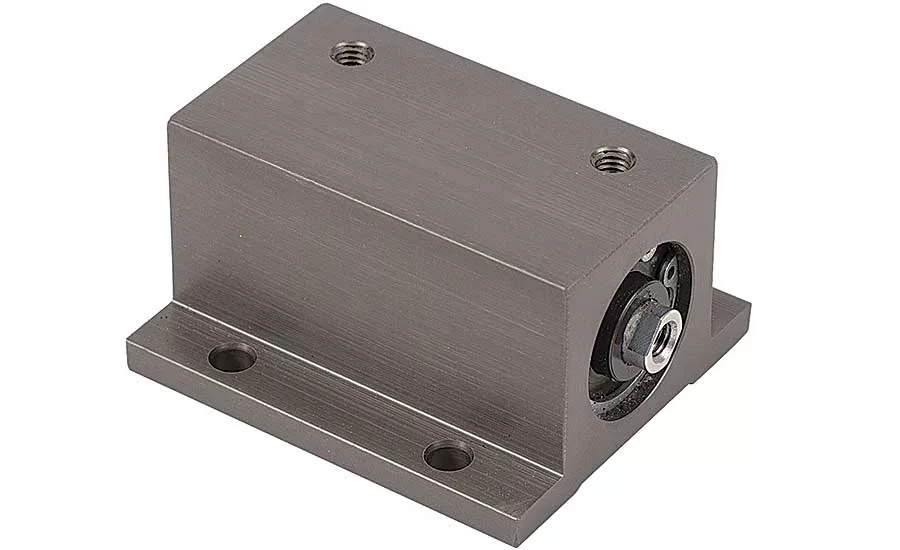
In some cases, non-centerline mounting may be less rigid than other mounting options. Because the plane of the mounting surface is not through the centerline of the cylinder, a bending moment is created around the mounting points. Nonetheless, side-lug cylinders are sometimes the perfect solution for unique applications. Photo courtesy Fabco-Air Inc.
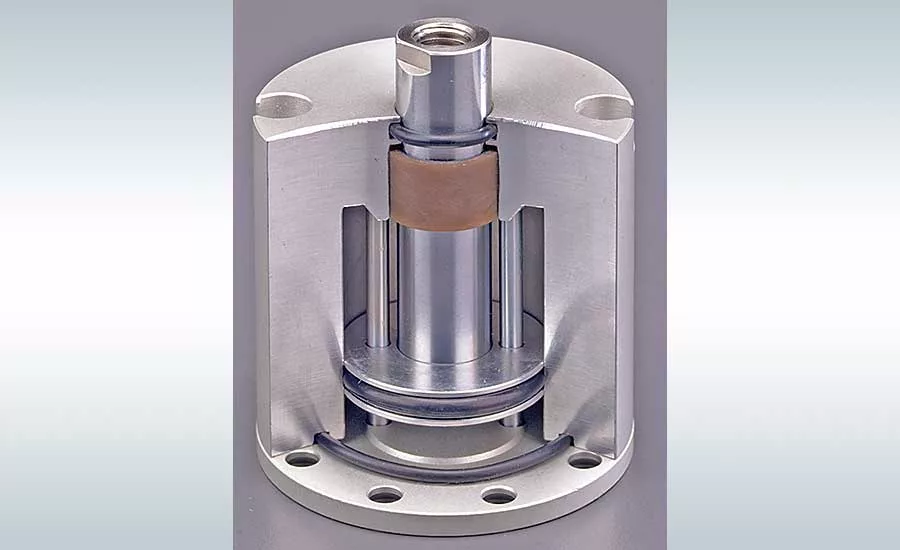
Maintaining the rod’s fixed orientation can be accomplished in several ways. Internal guide pins are one option for double-acting, singlerod cylinders. Two guide pins incorporated inside the cylinder pass through the piston head. These guide pins prevent rotation of the rod with a usual tolerance of ±1 degree. Photo courtesy Fabco-Air Inc.
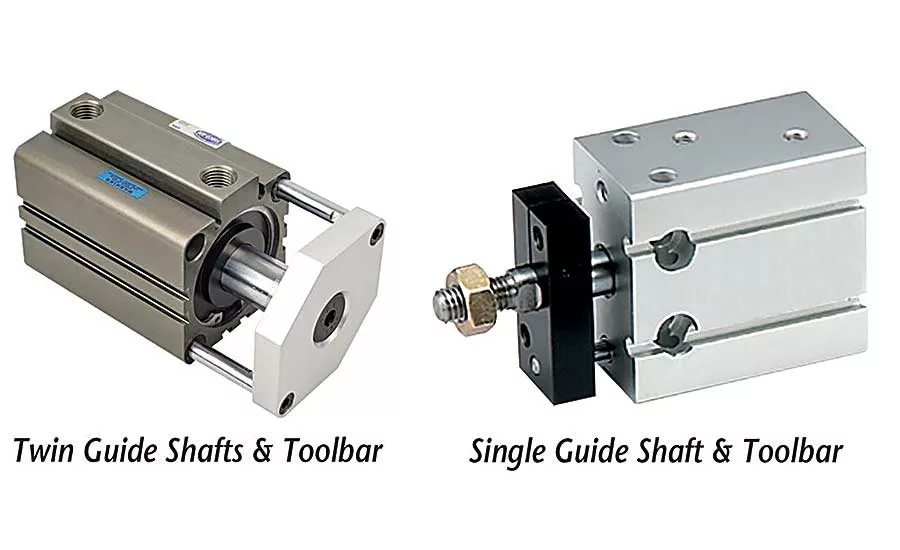
Another anti-rotation option is to use an external guide block securely attached to the piston rod. One or two steel guide shafts, attached to the guide block, assure anti-rotation of usually less than 0.8 degree. Photo courtesy Fabco-Air Inc.
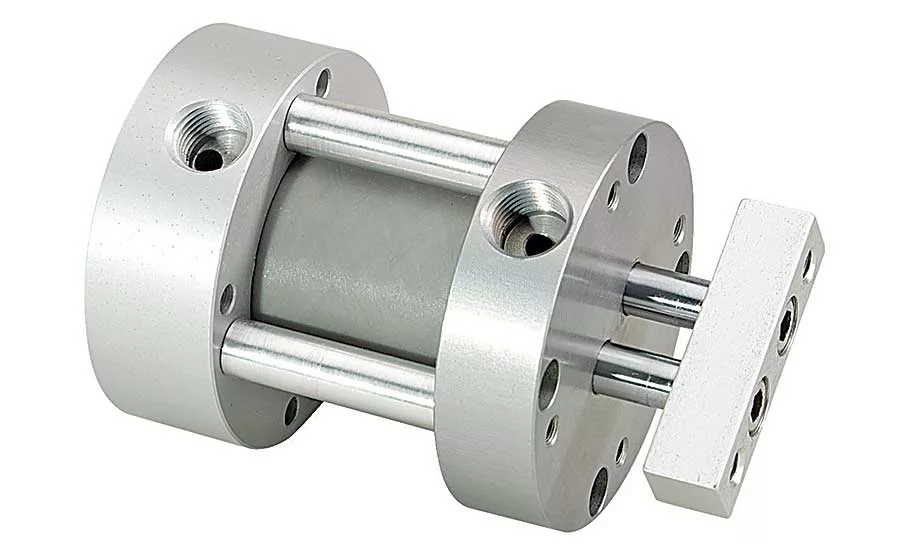
One more option to prevent rotation is to incorporate twin piston rods into the cylinder head. The rods are securely fastened to the piston and tied together externally by a tool bar at the ends of the rods. The tooling plate ensures that the rods move in tandem and provides an ideal mounting surface for attachments. Photo courtesy Fabco-Air Inc.
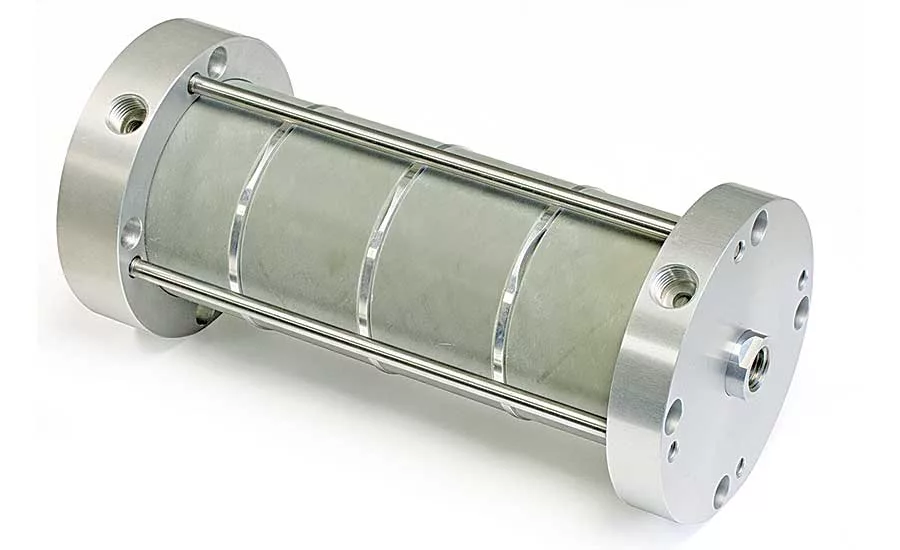
Multiple pistons are used to increase the thrust force of the cylinder. Multipiston cylinders provide the same output force as single-piston cylinders with much larger bores. Higher forces can be achieved in tight spaces vs. larger bore cylinders, which require a larger footprint and a wider center-tocenter space when more than one cylinder is required. Photo courtesy Fabco-Air Inc.
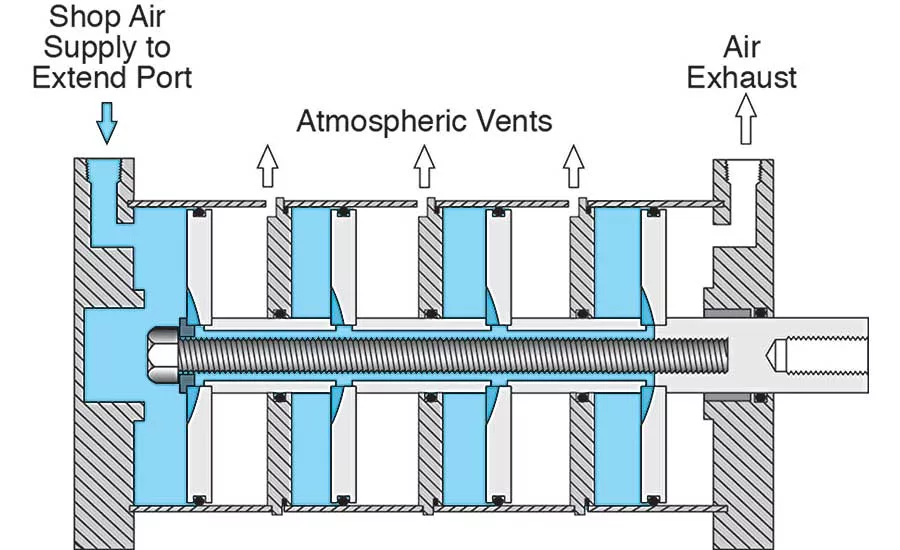
Multiple pistons are used to increase the thrust force of the cylinder. Multipiston cylinders provide the same output force as single-piston cylinders with much larger bores. Higher forces can be achieved in tight spaces vs. larger bore cylinders, which require a larger footprint and a wider center-tocenter space when more than one cylinder is required. Photo courtesy Fabco-Air Inc.
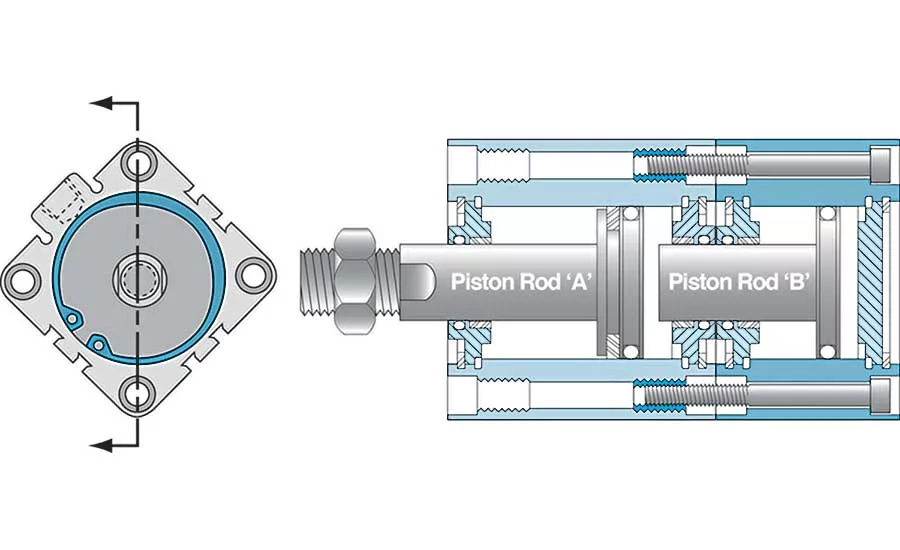
This setup provides three stroke positions. Two cylinder bodies are coupled end-to-end. The piston rod of the rear cylinder extends through the cap end and can push the piston of the front cylinder. In position 1, both pistons are retracted. To get position 2, the piston rod of the rear cylinder extends, moving the front cylinder’s piston rod partially forward. Position 3 is reached when the front cylinder’s piston rod is fully extended. Photo courtesy Fabco-Air Inc.
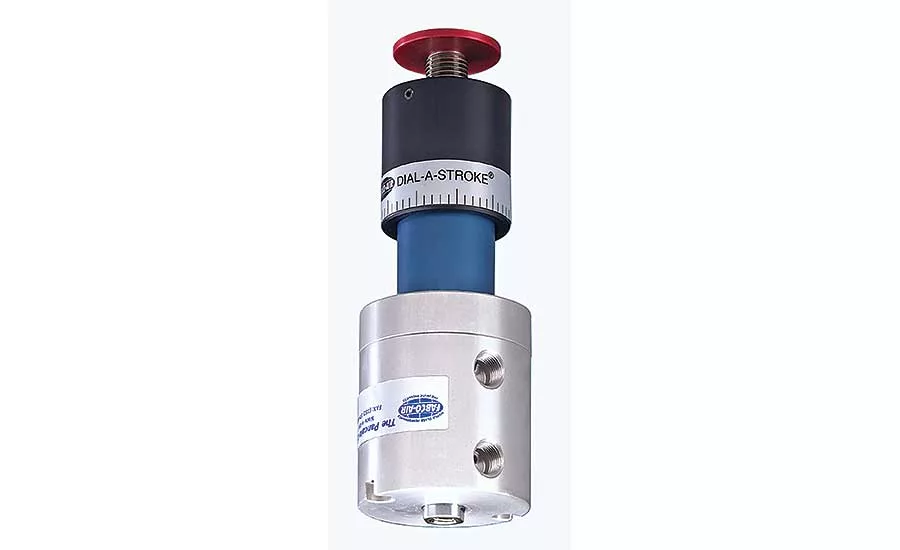
Fabco-Air’s Dial-a-Stroke option allows engineers to precisely adjust the extend stroke of the cylinder. The stop tube, adjustment nut with skirt, and minimum clearances combine to eliminate pinch points, ensuring operator safety. Photo courtesy Fabco-Air Inc.
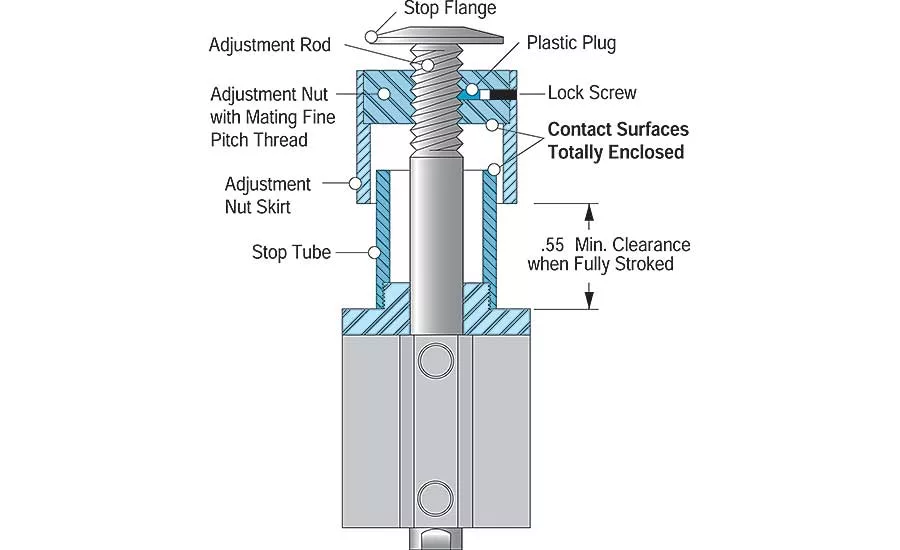
Fabco-Air’s Dial-a-Stroke option allows engineers to precisely adjust the extend stroke of the cylinder. The stop tube, adjustment nut with skirt, and minimum clearances combine to eliminate pinch points, ensuring operator safety. Photo courtesy Fabco-Air Inc.
"Less is more" seems to be the trend in the pneumatic actuator market. Real estate on production equipment is at a premium today more than ever. This just confirms that Alfred W. Schmidt (the founder of Fabco-Air) was ahead of the curve when he designed the original Pancake air cylinder in the late 1950s. This pneumatic actuator was designed to satisfy the need for short-stroke, low-profile, compact air cylinders that can fit in tight spaces. In fact, this cylinder provides the longest stroke possible in the smallest overall envelope size. Six decades later, compact air cylinders are still a big deal!
Today, compact pneumatic cylinders are the primary mechanism for linear actuation when space is limited. Frequently referenced as short-stroke cylinders, these devices are available with bore sizes ranging from 0.5 to 4 inches and standard strokes ranging from 0.0625 to 4 inches.
The original Pancake has a bored body design. Today, compact cylinders are also offered in a conventional tie-rod-and-spacer configuration, with round, square and extruded body designs.
Compact air cylinders have a piston rod configuration (as opposed to rodless cylinders). Piston rod cylinders function in two ways: double-acting and single-acting.
Double-acting cylinders use compressed air to power both the extend stroke and the retract stroke (moving the rod back and forth). This arrangement makes double-acting cylinders ideal for pushing and pulling loads. Common applications for double-acting compact air cylinders include: assembling, bending, clamping, feeding, forming, lifting, lowering, positioning, pressing, processing, punching, shaking and sorting.
With single-acting cylinders, compressed air is supplied to only one side of the piston. The other side vents to atmosphere. Depending on whether air is routed to the cap end or the rod end of the cylinder, the piston rod will either extend or retract when the cylinder is actuated. The most common design uses air pressure to extend the piston rod. An internal spring returns the piston to its original position when air exhausts. This is typically called spring-return.
In a spring-extend design, air pressure retracts the piston rod and the spring force causes the rod to extend when pressure is removed. This makes single-acting cylinders ideal when a force is needed in only one direction and the return stroke is unimpeded and unloaded. These are also popular in applications where, for safety reasons, a defined position must be taken in the event of a power failure.
Looking for quick answers on assembly and manufacturing topics? Try Ask ASM, our new smart AI search tool. Ask ASM
Typical applications for single-acting, compact air cylinders include: actuating flaps and levers, clamping parts, and ejecting parts.
A single-rod configuration is, by far, the most common air cylinder design. However, double-rod cylinders are quite useful in many applications.
Double-rod cylinders are used:
- When equal displacement is needed on both sides of the piston.
- When the cylinder is required to perform work on both sides.
- When it is mechanically advantageous to couple a load to each end.
- When the extra end can be used to mount cams for operating limit switches.
Range of Options
Short stroke cylinders might be compact in stature, but the number of available models and standard options is huge.
Compact air cylinders have many of the same type of mounts as the larger National Fluid Power Association (NFPA) and International Organization for Standardization (ISO) interchangeable cylinders. Here is an overview of typical short stroke cylinder mounting types and examples.
Centerline mounting is the most common option. The best support for an air cylinder is along its centerline. It is called centerline mounting because the mounting plane is the centerline of the cylinder. This provides rigid support, but it requires accurate alignment.
Through-hole mounting is available on many short-stroke cylinder models. In this case, counterbored holes are drilled through the cylinder body for easy mounting with socket head cap screws. Nose mounts as well as front and rear flange mounts are also offered on a variety of compact cylinder styles.
Pivot-mounting enables the cylinder to pivot through an arc. Eye and clevis mounts, as well as trunnion mounts, are available on many compact cylinder models.
Non-centerline mounting is generally quite rugged, but in some cases, may be less rigid than other mounting options. Because the plane of the mounting surface is not through the centerline of the cylinder, a bending moment is created around the mounting points. Nonetheless, side lug and foot-mounted compact air cylinders are sometimes the perfect solution for unique applications.
Anti-Rotation Options
For applications in which anti-rotation and registration are critical, nonrotating cylinder designs are available. However, keep in mind that nonrotating options on compact, short-stroke cylinders are for light torsional handling and registration only.
Maintaining the rod’s fixed orientation can be accomplished in several ways. Internal guide pins are one option for double-acting, single-rod cylinders. Two guide pins incorporated inside the cylinder pass through the piston head. These guide pins prevent rotation of the rod with a usual tolerance of ±1 degree. A rubber disk is included at the end of each guide pin to take up end play and firmly seat the pins in the guide holes.
Another option is to use an external guide block securely attached to the piston rod. One or two steel guide shafts, attached to the guide block, assure anti-rotation of usually less than 0.8 degree.
One more option to prevent rotation is to incorporate twin piston rods into the cylinder head. The rods are securely fastened to the piston and tied together externally by a tool bar at the ends of the rods. The tooling plate ensures that the rods move in tandem and provides an ideal mounting surface for attachments required by your application. Tool bars are sometimes furnished with threaded mounting holes or counterbored mounting holes.
Multiple Pistons, Multiple Positions
Multiple pistons are used to increase the thrust force of the cylinder. Multipiston cylinders provide the same output force as single-piston cylinders with much larger bores. Higher forces can be achieved in tight spaces vs. larger bore cylinders, which require a larger footprint and a wider center-to-center space when more than one cylinder is required.
If the application requires a compact cylinder with intermediate load positions, there are options are available. Three or more rod positions can be achieved with a single cylinder.
The most popular is the three-position configuration. In this design, two cylinder bodies are coupled end-to-end using two socket-head cap screws. The piston rod of the rear cylinder extends through the cap end and can push the piston of the front cylinder. In position 1, both pistons are retracted. To get position 2, the piston rod of the rear cylinder extends, moving the front cylinder’s piston rod partially forward. Position 3 is reached when the front cylinder’s piston rod is fully extended. To get three discrete positions with this arrangement, the front cylinder’s piston rod must be longer than the rear cylinder’s piston rod.
Additional Options
Standard electronic switches for position sensing are a popular option for pneumatic cylinders. All that is needed is the addition of an internal magnet attached to the piston. Many compact cylinders come standard with external grooves in their bodies for easy mounting and adjustment of sensors.
Stroke adjustment is another popular option for cylinders. Cylinders can be equipped so that engineers can adjust both the extend and retract strokes.
For example, Fabco-Air’s Dial-a-Stroke option allows engineers to precisely adjust the extend stroke of the cylinder. The stop tube, adjustment nut with skirt, and minimum clearances combine to eliminate pinch points, ensuring operator safety.
For the opposite direction, a screw with a thread-sealing locknut mounted in the rear cover provides simple, rugged and precise means of adjusting the retract stroke of the cylinder. The stroke stops when the piston contacts the end of the screw. The fine thread of the adjusting screw provides precision adjustment.
Cylinder Applications
The applications for compact air cylinders are boundless. Cylinders are used in animatronics, conveyors and material handling equipment, custom assembly and test systems, packaging and palletizing machinery, paper converting machinery, plastic molding machinery, printing presses, stamping and forming lines, semiconductor processing equipment, and door and window frame manufacturing equipment.
Compact air cylinders are selected according to their ability to perform a specific function. Numerous designs, options and configurations are available from numerous brands.
However, sometimes the job at hand falls outside of standard product offerings and only a custom product will suffice. The development of custom compact air actuators can often be both expensive and time-consuming, but may be the only solution for unique applications.
To specify a compact air actuator for any application, two main questions must be answered before moving into the heart of the design. What do you need the cylinder to do? What types of cylinders are available to do that? If the ideal actuator cannot be found among the host of standard offerings, then a custom actuator might be a better solution.
For more information on pneumatic cylinders, call Fabco Air at 352-373-3578 or visit www.fabco-air.com.
Looking for a reprint of this article?
From high-res PDFs to custom plaques, order your copy today!