Assembly Magazine logo
search
Ask ASSEMBLY AI
cart
facebook twitter linkedin youtube
  • Sign In
  • Create Account
  • Sign Out
  • My Account
Assembly Magazine logo
  • TRENDS
    • Ask ASSEMBLY AI
    • Trends
    • News
    • New Products
  • INDUSTRIES
    • Aerospace
    • Appliance
    • DFMA Assembly
    • Medical Devices
    • Green Manufacturing
    • Lean Manufacturing
    • Machinery Assembly
    • Electronics Assembly
    • Automotive
  • TECHNOLOGIES
    • Adhesives & Dispensing
    • Assembly Presses
    • Automated Assembly Systems
    • Manufacturing Management
    • Manufacturing Software
    • Motion Control
    • Screwdriving & Riveting
    • Robotics
    • Test & Inspection
    • Plastics & Metal Welding
    • Wire Processing
    • Workstations
  • AUTONOMOUS & ELECTRIC MOBILITY
    • AEM Magazine Archives
    • Autonomy
    • Electrification
    • Mobility Services
    • Assembly & Testing
    • AV/EM News
  • MEDIA
    • Ask ASSEMBLY AI
    • Podcasts
    • Assembly News Now
    • Assembly TV
    • Webinars
    • eBooks
  • EVENTS
    • Calendar
    • The ASSEMBLY Show
  • MORE
    • Exclusives >
      • Plant of the Year
      • Capital Spending
    • Buyers Guide >
      • Supplier Insights
    • Classifieds
    • Featured Products
    • Newsletters
    • Store
    • White Papers
    • Columns
    • Sponsor Insights
  • INFOCENTER
    • Assembly & Test Solutions
  • EMAGAZINE
    • eMagazine
    • Archive Issues
    • Advertise
    • Contact Us
    • Sign Up
IndustriesMedical Devices AssemblyWire Processing Assembly

Laser Wire Stripping for Medical Device Assembly

Small wires in medical devices can be safely stripped with lasers
By Pete Doyon
Laser Wire Stripping for Medical Device Assembly

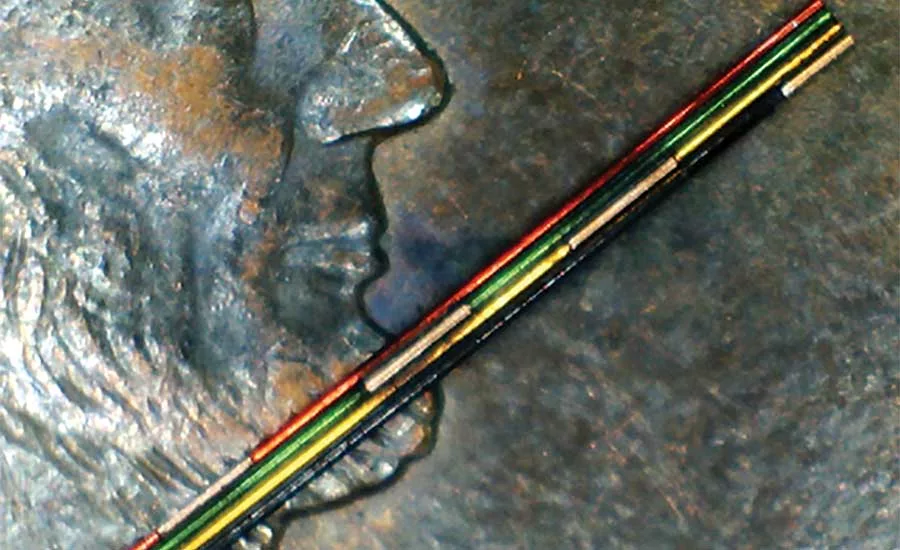
Laser wire stripping allows for precision even on the smallest wires, like this catheter wire. Photo courtesy Schleuniger Inc.
Laser Wire Stripping for Medical Device Assembly

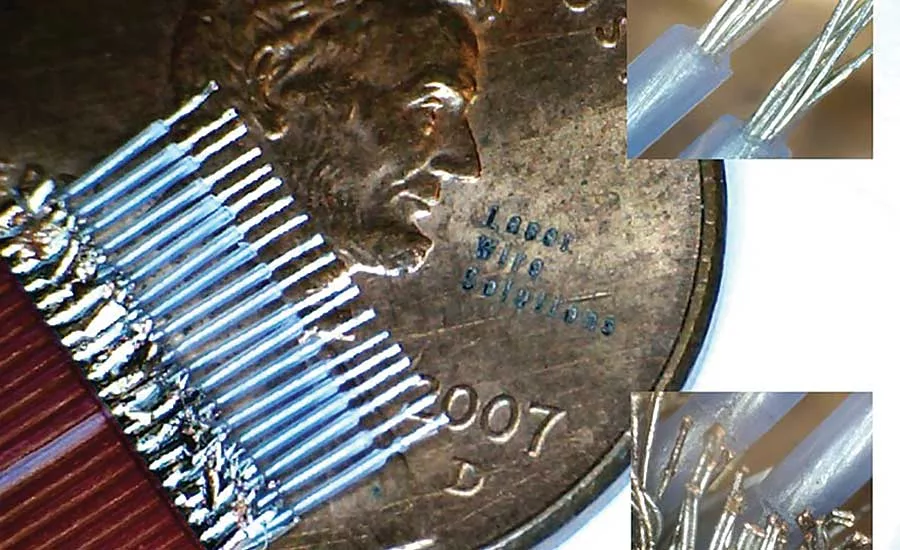
Micro-coaxial ribbon cables, such as those used in ultrasound machines, have small flexible wires that prove difficult for traditional stripping methods. Photo courtesy Schleuniger Inc.

Laser Wire Stripping for Medical Device Assembly
May 1, 2018

Laser wire stripping was developed by NASA in the 1970s as part of the Space Shuttle program. The technology made it possible to use smaller sized wires with thinner insulations, without risk of the damage that can be caused by traditional mechanical wire stripping methods.

Laser wire stripping technology was commercialized in the 1990s, initially for use in aerospace and defense applications. Laser wire stripping grew significantly when the consumer electronics market exploded. Lasers became the only way to strip the tiny data cables found in laptops, mobile phones and other consumer electronics products. Another large industry that has adopted laser wire stripping methods, and for good reason, is high-end medical device manufacturing.


The Benefits of Laser Stripping

Using laser light to remove insulation or coating layers from electrical wires, catheters and other components for medical devices is now the norm as there are many benefits to using a laser stripping process. The most significant is the highly repeatable quality that is inherent to the process. When using a CO2 laser to strip polymer insulation, from a wire conductor for example, the laser energy is readily absorbed by the insulation but highly reflected by the underlying metal conductor. Since the conductor reflects the laser light, there is no risk of damage during the stripping process. With laser stripping, there are no limits on how small of a wire can be stripped. Also, no matter the wire size there is no risk of damage to the conductor.  

Another benefit is that laser stripping machines can strip round, out-of-round, flat ribbon or any other shape of wire or cable. Stripping geometries include end stripping, window stripping, slitting or complete area ablation. The process is user-friendly. There are no blades to change or consumables to replace in contrast to mechanical stripping methods. The process is non-contact, so there are no maintenance or wear items that need to be replaced frequently.

Laser stripping machines are also versatile. There are many different laser types on the market, each having a different wavelength. The idea is to select a laser with a wavelength and power that is readily absorbed by the outer coating layer yet is strongly reflected by the underlying layer. 

Laser strippers can be used in a semi-automatic process where the operator presents the material to be stripped to the machine. This is typically used for end stripping and can be used for single ends or a batch at a time. In addition, the laser stripper can also be fully integrated with a downstream cut and strip machine to measure, cut and strip in a fully automatic process.


Medical Device Applications

In medical device manufacturing, selecting and properly processing the correct wires and cables is important. In some cases, it can be the difference between life and death for a patient. Laser wire stripping can ensure higher quality processing for several medical applications.

Looking for quick answers on assembly and manufacturing topics? Try Ask ASM, our new smart AI search tool. Ask ASM →

Catheter wiring is used to guide a medical probe or device to the specific tissue location. The highest demands are placed on reducing wiring size to improve maneuverability and increase functionality. Typical applications include radiofrequency ablation where the catheter carries multiple conductors, a number of thermocouples, and the RF ablation signal. This fine wiring tends to be manufactured using either enamel, like polyimide, coatings or bio-compatible fluoropolymers.

Smaller wires used in catheters can easily be nicked when using traditional mechanical stripping methods. However, because the conductor will reflect the laser, laser wire stripping ensures a completely nick-free strip.

Pacemaker Electrodes are flexible and spring-like. These electrodes pose special challenges to laser ablation due to their fluoropolymer coatings and sensitivity to heat during processing. Those challenges can be overcome by selecting of the proper laser and processing technique, making laser stripping a viable option. 

Medical power tools, such as drills used in brain surgery, require the highest levels of quality and reliability. Lasers are used to strip the enamel for the wiring used in the windings for high-performance motors. Traditional mechanical brushing and abrading of the windings can introduce dangerous particulates into the end product. Laser stripping offers a clean alternative.

A hypotube is a long metal tube with micro-engineered features along its length. It is a critical component of minimally-invasive catheters, which are used in conjunction with balloons and stents to open up clogged arteries. The balloon portion of the catheter is attached to the head of the hypotube. These tubes are typically coated with a polymer, such as PTFE, ETFE or a nylon-based compound. When manufacturing a catheter, it is necessary to remove part of the extruded coating on the tube. Laser removal is proving popular over more traditional blade-based methods, primarily due to the ability to automate the process.

Small gauge single conductors are very common in medical devices, whether found in a catheter delivered device or in a cochlear implant or hearing aid —With laser stripping, wires as small as 50 AWG and smaller can be stripped without damage to the conductor.

Flat micro-coaxial ribbon cables are found in a number of medical devices, such as ultra-sound scanners. High-density, high-frequency signals must be transmitted with the most flexible cabling possible. Laser stripping guarantees quality results when stripping the small conductors in high-density micro-coax ribbons.

The medical device manufacturing market requires high-quality processes coupled with complex and delicate wiring systems. Laser wire stripping can meet many of the challenges of the industry and will continue to be the method of choice as smaller and more delicate medical devices continue to evolve.

KEYWORDS: wire stripping

Share This Story

Looking for a reprint of this article?
From high-res PDFs to custom plaques, order your copy today!

Vice President of Product Management Schleuniger Inc.

Recommended Content

JOIN TODAY
To unlock your recommendations.

Already have an account? Sign In

  • Made in the U.S.A.

    Consumer Products Manufacturing: Made in the USA

    Supply chain lessons learned during the coronavirus...
    Automated Assembly Systems
    By: Austin Weber
  • Best Practices for Press-Fit Assembly

    Best Practices for Press-Fit Assembly

    In manufacturing, ironclad formulas for success are hard...
    Assembly Presses
    By: Jim Camillo
  • aem0523leader-tesla1.jpg

    Tesla Rethinks the Assembly Line

    Engineers at Tesla Inc. have developed a new process that...
    Industries
    By: Austin Weber
Manage My Account
  • eMagazine Subscription
  • Assembly Newsletters
  • Online Registration
  • Subscription Customer Service
  • Manage My Preferences

More Videos

Sponsored Content

Sponsored Content is a special paid section where industry companies provide high quality, objective, non-commercial content around topics of interest to the ASSEMBLY audience. All Sponsored Content is supplied by the advertising company and any opinions expressed in this article are those of the author and not necessarily reflect the views of ASSEMBLY or its parent company, BNP Media. Interested in participating in our Sponsored Content section? Contact your local rep!

close
  • ultrasonic welding
    Sponsored bySonobond Ultrasonics

    Engineering Efficiency in High-Performance Assembly: How Ultrasonic Welding Enhances Throughput, Reliability and Quality

  • UV curing system
    Sponsored byDymax

    Why UV Intensity Alone Doesn’t Define Curing Performance

  • wooden pallets
    Sponsored byLEAN Manufacturing Products

    Eliminating Waste on the Shop Floor: Applying Lean Principles to Improve Manufacturing Efficiency

Popular Stories

Ferrari

Ferrari Unveils Four-Door EV

ASSEMBLY News Now, episode-30: Volvo Redesigns EV Manufacturing

Volvo Redesigns EV Manufacturing

automated consumer goods assembly system

Best Practices for Cycle Time Optimization

Watch the latest episode of ANN now!

Events

July 24, 2025

From Shop Floor to CFO: How Manufacturers Are Closing the Loop Between Operations and Finance

On Demand Learn how manufacturers are bridging the gap between the shop floor and ERP systems to gain real-time visibility, streamline operations, and kick-start digital transformation—without waiting years.

Sponsored by:

PicoStratusGreen
July 30, 2025

Buffer Analysis and Design Fundamentals for Manufacturing Excellence

On Demand In this presentation, Dr. Herman Tang shares practical insights from his industry experience and research on buffer management in manufacturing operations.

View All Submit An Event

Poll

Difficult Assembly Processes

Which assembly process gives you the most difficulty?
View Results Poll Archive

Products

Manufacturing Cost Policy Deployment (MCPD) Profitability Scenarios: Systematic and Systemic Improvement of Manufacturing Costs

Manufacturing Cost Policy Deployment (MCPD) Profitability Scenarios: Systematic and Systemic Improvement of Manufacturing Costs

See More Products
Register for webinar - Modernizing Automotive Assembly: Why Upgrading Legacy MES is a Business Imperative

Related Articles

  • PSAs for Medical Device Assembly

    See More
  • Medical Assembly: Molding for Medical Device Assembly

    See More
  • asb0123silicone1.jpg

    Silicone Adhesives for Medical Device Assembly

    See More

Related Products

See More Products
  • Joining and Assembly of Medical Materials and Devices, 1st Edition

  • Laser Welding of Plastics

See More Products

Related Directories

  • Laser Wire Solutions

  • Kahle Automation

    Kahle is a worldwide supplier of high speed automation, for the Medical Device and Pharmaceutical Industries. Kahle designs and builds equipment for the custom assembly, inspection and process of all types of medical devices and drug delivery products with complete equipment validation services.
×

Never miss the latest news and trends driving the manufacturing industry

Stay in the know on the latest assembly trends.

JOIN TODAY!
  • RESOURCES
    • Advertise
    • Contact Us
    • Directories
    • Manufacturing Division
    • Store
    • Want More?
  • SIGN UP TODAY
    • Create Account
    • eMagazine
    • Newsletters
    • Customer Service
    • Manage Preferences
  • SERVICES
    • Marketing Services
    • Reprints
    • Market Research
    • List Rental
    • Survey/Respondent Access
  • STAY CONNECTED
    • LinkedIn
    • Facebook
    • Instagram
    • YouTube
    • X (Twitter)
  • PRIVACY
    • PRIVACY POLICY
    • TERMS & CONDITIONS
    • DO NOT SELL MY PERSONAL INFORMATION
    • PRIVACY REQUEST
    • ACCESSIBILITY

Copyright ©2026. All Rights Reserved BNP Media, Inc. and BNP Media II, LLC.

Design, CMS, Hosting & Web Development :: ePublishing