Assembly Magazine logo
search
Ask ASSEMBLY AI
cart
facebook twitter linkedin youtube
  • Sign In
  • Create Account
  • Sign Out
  • My Account
Assembly Magazine logo
  • TRENDS
    • Ask ASSEMBLY AI
    • Trends
    • News
    • New Products
  • INDUSTRIES
    • Aerospace
    • Appliance
    • DFMA Assembly
    • Medical Devices
    • Green Manufacturing
    • Lean Manufacturing
    • Machinery Assembly
    • Electronics Assembly
    • Automotive
  • TECHNOLOGIES
    • Adhesives & Dispensing
    • Assembly Presses
    • Automated Assembly Systems
    • Manufacturing Management
    • Manufacturing Software
    • Motion Control
    • Screwdriving & Riveting
    • Robotics
    • Test & Inspection
    • Plastics & Metal Welding
    • Wire Processing
    • Workstations
  • AUTONOMOUS & ELECTRIC MOBILITY
    • AEM Magazine Archives
    • Autonomy
    • Electrification
    • Mobility Services
    • Assembly & Testing
    • AV/EM News
  • MEDIA
    • Ask ASSEMBLY AI
    • Podcasts
    • Assembly News Now
    • Assembly TV
    • Webinars
    • eBooks
  • EVENTS
    • Calendar
    • The ASSEMBLY Show
  • MORE
    • Exclusives >
      • Plant of the Year
      • Capital Spending
    • Buyers Guide >
      • Supplier Insights
    • Classifieds
    • Featured Products
    • Newsletters
    • Store
    • White Papers
    • Columns
    • Sponsor Insights
  • INFOCENTER
    • Assembly & Test Solutions
  • EMAGAZINE
    • eMagazine
    • Archive Issues
    • Advertise
    • Contact Us
    • Sign Up
Robotics Assembly

SCHUNK on Automation

SCHUNK Grippers Have Set Assembly Benchmarks for More Than 30 Years
By Jesse Hayes
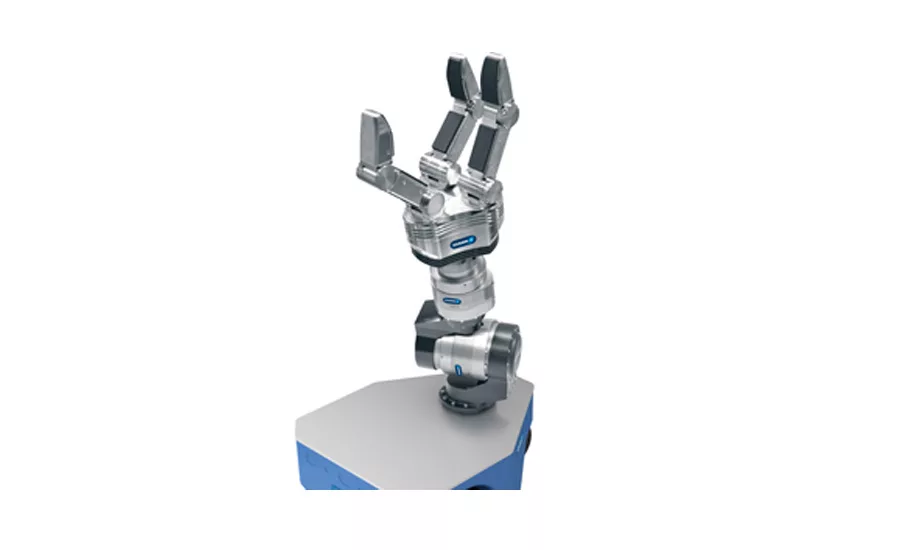
Schunk five finger hand
September 30, 2013

At the beginning of the 1980s, Heinz-Dieter Schunk, the managing partner of SCHUNK, had an idea. Inspired by the starting boom in industrial robotics, he noticed how bulky grippers were. Due to their pneumatic lines, the grippers often had extreme interfering contours. For Schunk, it was clear: To make robots and other handling systems more successful, a new generation of smaller, lighter, more precise and more cost-efficient grippers would be needed.

In 1983, SCHUNK introduced the world’s first standardized industrial gripper. Known then as the “industrial hand,” it was comparatively light and had integrated air channels. Graduated sizes enabled engineers to design particularly efficient systems. SCHUNK has been setting new standards for grippers ever since.

Our multitooth guidance system for gripper fingers, which we introduced in 2000, is still considered a benchmark in the technology. Instead of the traditional T-slot, the base of each finger runs along multiple prismatic channels arranged in parallel. This spreads the force and moment loads across many shoulders. As a result, engineers can use longer fingers without increasing the size of the gripper body or overloading the guidance system. The extra guiding area reduces surface pressure, which minimizes wear. It also ensures minimal guidance play throughout the gripper’s service life. Finally, the large space between the channels allows for a particularly strong diagonal pull. This ensures that the force of the oval piston is exerted to the fullest extent, while limiting wear and damage.

In 2006, SCHUNK introduced a program for mobile gripping systems. In addition to mechatronic rotary units and efficient lightweight arms, the program included the SDH dexterous hand, a sensitive three-finger hand for applications in service robotics. The latest development of this business unit is a five-finger hand. It’s amazing how it resembles a human hand in size, shape and mobility.

The latest generation of grippers does away with pneumatics in favor of mechatronics. In 2008, we introduced the modular, lightweight LEG electric long-stroke gripper. In 2011, we introduced an entire line of electrically actuated modules, including the EGP small parts gripper, the adaptable EGA long-stroke gripper, and the intelligent and sensitive WSG parallel gripper.

Our latest generation of grippers further capitalizes on the mechatronics trend. With a single servo-driven gripper, multiple gripping scenarios can be implemented. These powerful and sensitive devices can handle varying components one after the other, without any setup time. With every grip, the finger position and gripping force are individually adjusted to the workpiece. Sensors, controls and regulation technology—as well as a Web browser for communicating with higher-ranking system components—are integrated in the gripper. Via intuitively operable programming interfaces, the grippers can be easily integrated, controlled and maintained. No additional software is needed.

When we compare modern SCHUNK grippers with the “Industrial Hand” of 1983, the enormous development in gripping technology over the past 30 years is obvious. Simple, mechanical components have evolved into intelligent, powerful and highly efficient high-tech modules that allow engineers to design flexible and closely integrated handling processes. Today, SCHUNK offers more than 10,000 automation components, including grippers, rotary actuators, linear actuators, pick-and-place units, mobile gripping systems, and compact robot accessories.

What do you think? What adjunct technologies have made the biggest difference in the adoption of industrial robotics? What will grippers and end-effectors of the future look like? Share your thoughts.

Looking for quick answers on assembly and manufacturing topics? Try Ask ASM, our new smart AI search tool. Ask ASM →

KEYWORDS: mechatronics pick and place robot end-effectors robot grippers

Share This Story

Jesse Hayes is Automation Product Manager for SCHUNK Inc. in Morrisville, NC

Blog Topics

Austin Weber

Assembly Automation

Ergo Corner

Hoffmann on Testing

Jim Camillo

Jim Smith

John Sprovieri

Recent Comments

Helpful for Trainees

Cable Assembly Manufacturers

Huawei for manufacturing?

should have a scanner and then 3D print the repair

IPC-A-610 and IPC-j-std-001

Manage My Account
  • eMagazine Subscription
  • Assembly Newsletters
  • Online Registration
  • Subscription Customer Service
  • Manage My Preferences

More Videos

Sponsored Content

Sponsored Content is a special paid section where industry companies provide high quality, objective, non-commercial content around topics of interest to the ASSEMBLY audience. All Sponsored Content is supplied by the advertising company and any opinions expressed in this article are those of the author and not necessarily reflect the views of ASSEMBLY or its parent company, BNP Media. Interested in participating in our Sponsored Content section? Contact your local rep!

close
  • ultrasonic welding
    Sponsored bySonobond Ultrasonics

    Engineering Efficiency in High-Performance Assembly: How Ultrasonic Welding Enhances Throughput, Reliability and Quality

  • UV curing system
    Sponsored byDymax

    Why UV Intensity Alone Doesn’t Define Curing Performance

  • wooden pallets
    Sponsored byLEAN Manufacturing Products

    Eliminating Waste on the Shop Floor: Applying Lean Principles to Improve Manufacturing Efficiency

Popular Stories

ASSEMBLY News Now, episode-30: Volvo Redesigns EV Manufacturing

Volvo Redesigns EV Manufacturing

Boeing CEO Kelly Ortberg announces 1 billion investment

Boeing Plans $1 Billion Wichita Investment, Workforce Training Center

GE Appliances Worker on Line

GE Appliances Expands Factory AI With 800 Gemini Enterprise Agents

Watch the latest episode of ANN now!

Events

July 24, 2025

From Shop Floor to CFO: How Manufacturers Are Closing the Loop Between Operations and Finance

On Demand Learn how manufacturers are bridging the gap between the shop floor and ERP systems to gain real-time visibility, streamline operations, and kick-start digital transformation—without waiting years.

Sponsored by:

PicoStratusGreen
July 30, 2025

Buffer Analysis and Design Fundamentals for Manufacturing Excellence

On Demand In this presentation, Dr. Herman Tang shares practical insights from his industry experience and research on buffer management in manufacturing operations.

View All Submit An Event

Poll

Difficult Assembly Processes

Which assembly process gives you the most difficulty?
View Results Poll Archive

Products

Manufacturing Cost Policy Deployment (MCPD) Profitability Scenarios: Systematic and Systemic Improvement of Manufacturing Costs

Manufacturing Cost Policy Deployment (MCPD) Profitability Scenarios: Systematic and Systemic Improvement of Manufacturing Costs

See More Products
Register for webinar - Modernizing Automotive Assembly: Why Upgrading Legacy MES is a Business Imperative
×

Never miss the latest news and trends driving the manufacturing industry

Stay in the know on the latest assembly trends.

JOIN TODAY!
  • RESOURCES
    • Advertise
    • Contact Us
    • Directories
    • Manufacturing Division
    • Store
    • Want More?
  • SIGN UP TODAY
    • Create Account
    • eMagazine
    • Newsletters
    • Customer Service
    • Manage Preferences
  • SERVICES
    • Marketing Services
    • Reprints
    • Market Research
    • List Rental
    • Survey/Respondent Access
  • STAY CONNECTED
    • LinkedIn
    • Facebook
    • Instagram
    • YouTube
    • X (Twitter)
  • PRIVACY
    • PRIVACY POLICY
    • TERMS & CONDITIONS
    • DO NOT SELL MY PERSONAL INFORMATION
    • PRIVACY REQUEST
    • ACCESSIBILITY

Copyright ©2026. All Rights Reserved BNP Media, Inc. and BNP Media II, LLC.

Design, CMS, Hosting & Web Development :: ePublishing