Plastics Assembly
Plastics Assembly Machines Maximize Productivity
Engineers have many options for joining plastic parts. There’s ultrasonic welding, hot-plate welding, vibration welding, spin welding, laser welding and staking. And, of course, parts can be joined with fasteners, snap-fits or adhesives.
No matter which method you use, you would have found the latest technologies for plastic assembly at The ASSEMBLY Show. There were at least 10 suppliers of plastics joining equipment on the show floor, including first-time exhibitors Rinco Ultrasonics and Thermal Press International Inc.
The following are some of the new plastics assembly technologies on display.
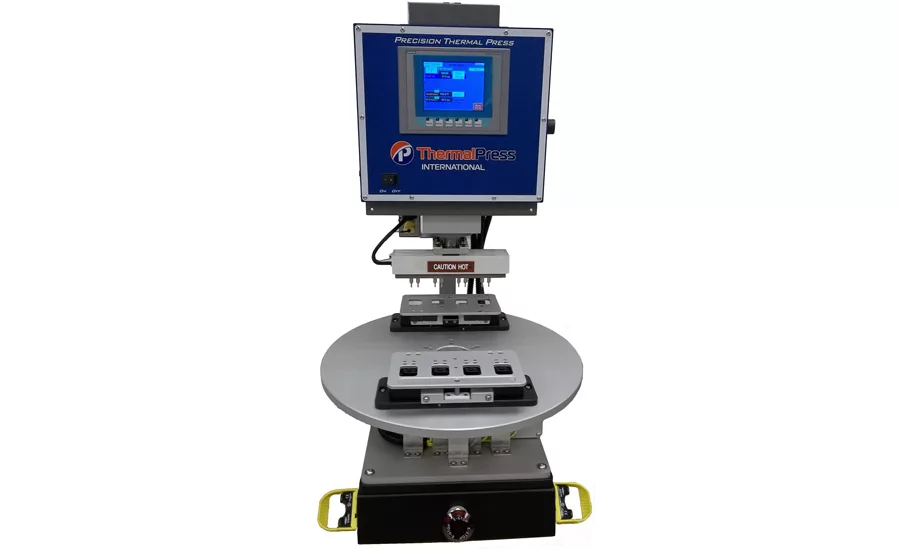
Increase Production with Thermal Press Rotary Tables
Thermal Press International Inc. manufactures a broad line of precision machines and automation systems for heat staking, film welding, heat sealing, thermal insertion and thermal assembly applications.
The company’s rotary indexing table can increase production rates up to 50 percent for heat staking and other plastic assembly applications. The indexer is available with two to eight positions in diameters from 16 inches to 8 feet.
The table can be paired with the C series thermal press. The press has an open C-frame format to accommodate all sizes of parts and assemblies. It is fully self-contained and can easily sit on most workbenches or tables. The press comes standard with a 4-inch stroke and an adjustable hard stop. Maximum press force is 1,000 pounds. The base and actuator are pinned and slotted for repeatable change-out of tooling packages without any realignment. Velocity control is programmable.
Looking for quick answers on assembly and manufacturing topics? Try Ask ASM, our new smart AI search tool. Ask ASM
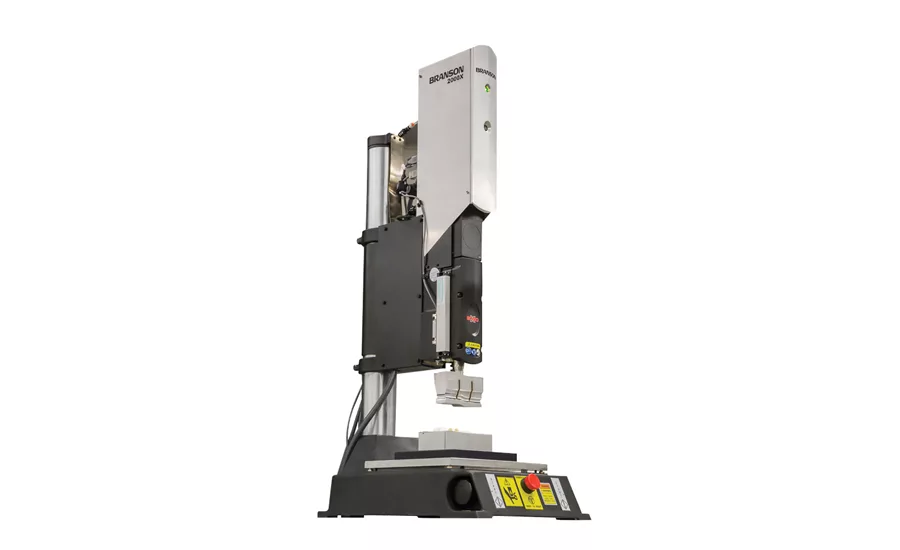
Ultrasonic Welding System
Branson Ultrasonics Corp. displayed the new 2000Xc ultrasonic welding system. With electronic welder settings, hierarchical password protection and Ethernet connectivity access, the device provides detailed weld data and secure process controls that help engineers meet their customers’ compliance and traceability requirements. The system produces consistent high-quality welds for packaging, medical and consumer electronics applications.
The welder is available in three frequencies: 20, 30, and 40 kilohertz. Engineers can weld by time, energy, peak power, ground detect, collapse distance or absolute distance. Weld pressure, hold pressure, down speed and rapid traverse functions are easily programmable.
The device can be adapted to operate within an automated assembly system or as a complete stand-alone unit. It can be integrated with a bar code scanner for recording Unique Device Identification numbers or recalling presets. The system memory can store 100,000 weld result histories and 1,000 weld recipe presets. Weld histories and other files can be output to a PDF format.
Accessories include sound enclosures, self-adjusting fixture plates and statistical process control software.
Module Simplifies Welding Cell Setup
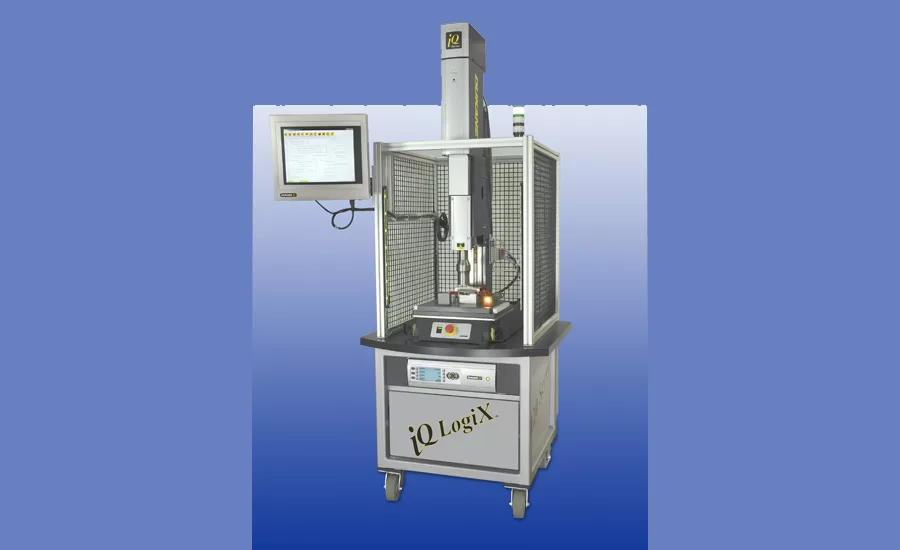
Dukane Corp. showed the new iQLogix, an optional module available for the iQ Series ultrasonic generators to simplify the configuration of workcells for plastic welding.
Ultrasonic welding workcells are commonly used to assemble plastic products in many industries. These workcells offer safety, noise reduction, part-in-place detection, part clamping, light curtains and many other features that improve the quality and speed of the process and reduce cost. Accommodating all these additional features requires workcells to have a significant amount of electrical components, wiring and programming.
However, the iQLogiX module eliminates the need of all the other electrical components. Instead, engineers simply insert the module into the rear card slot of an iQ Series ultrasonic generator and the generator’s UMMA (Ultrasonic Module Menu Adapt) populates the menu of the iQ Explorer II user interface with all the programmable options.
The iQLogiX module comes with 20 programmable input and 16 output connections. Programming these I/O connections is simple via iQ Explorer II software and requires no PLC programming skills. An engineer can save, copy or change the program at any time with no special programming hardware.
Another advantage of the module is that all the expensive electrical hardware and PLC programming is no longer needed to convert an ultrasonic welder from just a simple desktop machine to a sophisticated turnkey workcell. The module also provides flexibility, since it can be reconfigured at any time as process needs change. For example, if an engineer needs to add a part clamp to an application, it can easily be done by clicking on the program tab and assigning another I/O.
Infrared Welding System
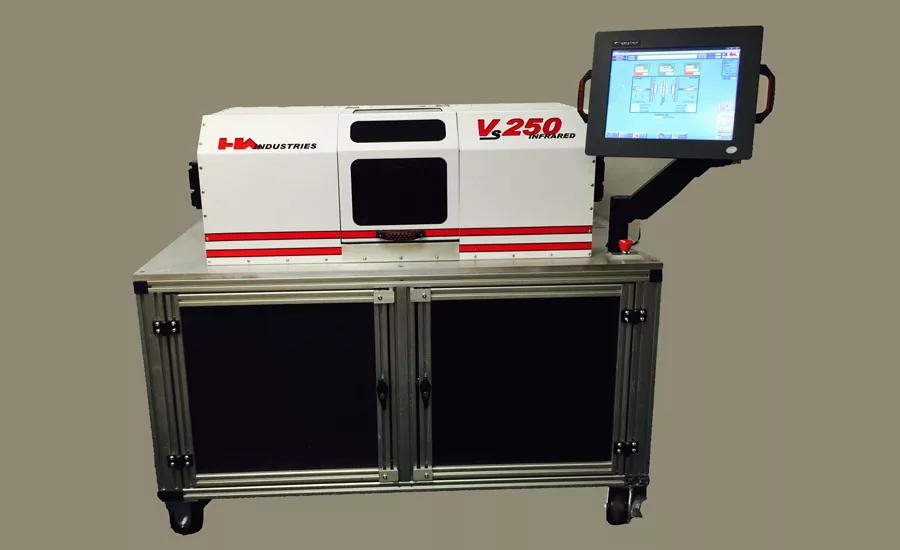
HA Industries showed the VS250 infrared welding system.
The parts to be welded are loaded into opposing servo-driven press platens. At cycle start, the machine positions infrared quartz emitters between the two platens. The emitters are then positioned near the parts, but do not touch them. Heating is precisely targeted to the parts.
The infrared radiation heats ribs molded into each part to a semi-molten state. At that point, the heat is removed and the press platens push the two parts together to form a weld. When the plastic has cooled, the assembly is unloaded.
The system’s 15 inches of tooling space allows it to effectively handle small parts. Two FLIR A35 thermal imaging cameras monitor weld quality and also let the operator know when an emitter is not operating properly.
Third-party software can be installed to trigger an alarm or stop the welding process when product specifications are not being met. Standard safety features include door closure detection.
Servo-Driven Hot-Plate Welder
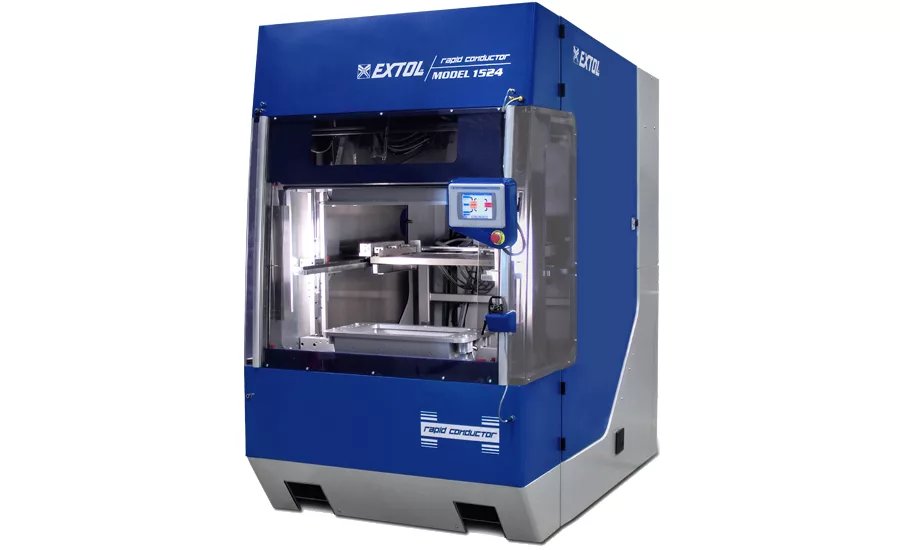
Extol Inc. showed its Rapid Conductor line of hot-plate welders.
Hot-plate welding is a method of joining thermoplastic components together by contact with a heated platen. The parts are pressed against the platen for a specific amount of time and force, then precisely pressed together to form a final assembly. The process is preferred for applications that require a robust weld, a hermetic seal, and for components with complex geometries. Assemblies can be handled immediately after welding.
Extol’s hot-plate welder features servo-controlled platens for precise force, velocity and distance control. They also have an intuitive, graphical operator interface for easy programming. Servo control ensures superior flash control and creates a robust weld—typically 80 to 100 percent of the strength of the parent material. Servo control also gives engineers the ability to move the platens creatively to combat sticking and flash.
Standard features include exhaust hood; on-board data logging; memory for storing 15 setups; teach mode; multiple heat zones with heater burn-out and thermocouple detection; and vacuum-controlled part retention with sensing.
Servo-Driven Ultrasonic Welder
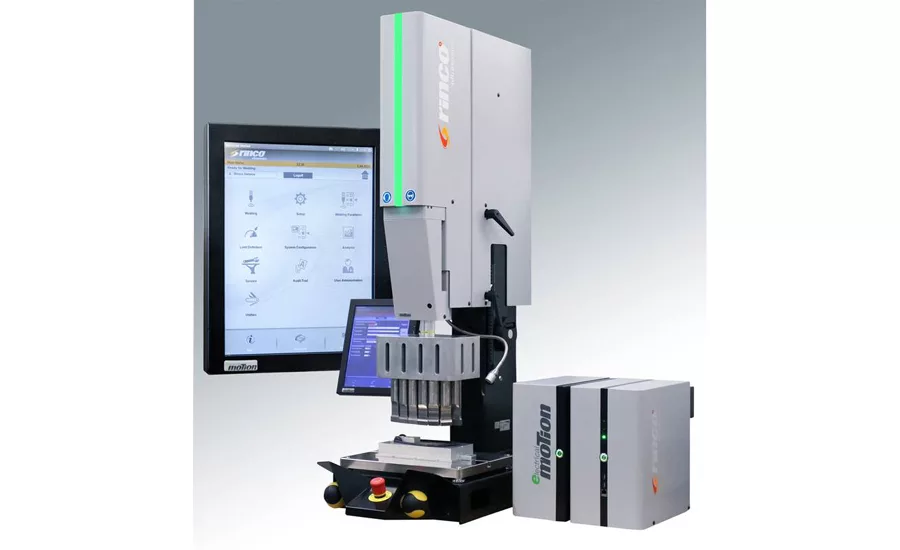
Rinco Ultrasonics exhibited the new Electrical Motion 20-kilohertz ultrasonic welder.
With servo control, engineers can precisely and individually regulate all the parameters of the ultrasonic welding process—from the positioning of the sonotrode and to the welding force.
The welder is equipped with a high-performance industrial PC that can be comfortably operated via a 12-inch touchscreen. The welding process is triggered via an ergonomically designed two-hand operation.
With a pneumatic welder, the sonotrode returns to its starting position after each weld. In contrast, with a servo-driven welder, the starting position of the sonotrode can be freely selected. Consequently, the weld cycle can often be shortened, depending on the geometry of the object to be welded.
The welding mode can also be freely selected. A total of eight modes are available, including time, distance and energy, a combination of time and energy, and a mode for presetting the melting rate. For all welding modes, the ultrasonic trigger can be a specific force, distance or time, or it can be an external signal.
Depending on the welding mode, the actual welding process can be subdivided into as many as ten steps. With this level of detail, the welding process can be controlled far more accurately than with a pneumatic drive. Even a speed-dependent or force-dependent weld profile can thus be achieved. All this improves weld quality, so even parts that are difficult or impossible to weld can now be joined reliably.
Through the user interface, individual user accounts with relevant authorizations can be set up for each level of the employee hierarchy. The application software is logically structured, self-explanatory and easy to use. Weld characteristics are shown clearly in the form of graphs, and the results and parameter data sets can be exported to a data carrier. For documentation and tracking, all the results are saved in a database. All parameter changes and events (such as maintenance cycles) are recorded in the system and documented in a nonerasable audit trail.
To ensure uptime, the welder can be set up for remote access service. In the event of problems or malfunctions, a service technician from Rinco headquarters can, via an Internet connection, quickly come up with a diagnosis and, in most cases, directly correct any parameter errors.
30-Kilohertz Ultrasonic Welder
Sonics & Materials Inc. introduced the Model 3050, a benchtop, 30-kilohertz ultrasonic plastics welder. The 30-kilohertz frequency is particularly suitable for applications where both power and Class A surface cosmetics are important considerations.
The welder offers front-panel pneumatic speed and pressure controls with a direct in-line air cylinder. The microprocessor-controlled power supply provides consistent reliability, with features such as digital amplitude control; ultrasonic horn and stack frequency display; good part, bad part output signal; and a 30 percent smaller power supply footprint.
The welder includes a 1,200-watt power supply and three weld modes (digital time; digital time or constant energy; or digital time, constant energy or distance). Additional standard features include automatic frequency tuning, multiple job storage, digital force triggering, calibration pulse, ultrasonic load meter scale, and upper and lower weld limit settings.
The welder features a single-piece, rigid cast aluminum machine base and hub with in-line load cell for precise force triggering. It also has a single-rail linear slide and 360-degree converter alignment. An optional linear encoder for distance welding is available.