Ensuring Effective Robotic Dispensing
A strong team and clear expectations are critical to implementing a system that will provide a good return on investment.
Whether a manufacturer is considering the purchase of a new robotic dispensing system or simply considering converting or upgrading an existing line, there are a number of factors that will determine the project’s ultimate success. Selecting the wrong dispensing equipment, robots or even materials can lead to problems down the road. These problems can include long delays, cost overruns and even misapplied equipment that will cause the project to fall short of the desired return on investment, thereby necessitating substantial follow-up work or even a complete overhaul.
The key to avoiding these situations is to assemble a trained and experienced team that includes the manufacturer, the systems integrator, the dispensing equipment manufacturer, the robot supplier, the material supplier, the fixture builder and the parts supplier.
Equally important, every team member should be provided with a complete process specification. This specification needs to include details of the part, or parts, that will be processed (including drawings), and the requirements of the material being dispensed, including placement, profile and volume. The specification should also detail the processing times for things like loading, unloading, dispensing, and the indexing of parts from station to station.
Ideally, all team members will have experience with systems that are similar to the application in question. There is nothing wrong with performing minor modifications to an existing product for a given process. However, it is important that a supplier not substitute an inferior component because of a lack of product offering.
With this in mind, manufacturers need to be sure and look at the details when comparing multiple proposals. Manufacturers should also be sure to question and understand any differences between them.
Finally, each team member should be familiar with the products supplied by the various team members to ensure compatibility.
In terms of particular responsibilities, the material supplier will generally select or custom-formulate a one- or two-part material formulation based on the specific needs of the application. Dispensing system engineers will then select the appropriate supply, meter and dispensing components. Some dispensing engineers will also be capable of engineering end-of-arm tooling, material headers, robot dress-out, control software and bead path programming.
Complementing these efforts, the design team’s material handling engineers will be responsible for creating part fixturing and tooling. As they do so, they will also work with the robot supplier to select the correct robot. To perform these tasks, both the material handling engineers and the robot supplier will need to know the exact size and number of parts involved in the process, the number of parts per hour that will be processed, and the speed with which the material will be dispensed on the parts.
Again, the specification is the key document, like an architect’s drawings when building a house. If the process specification changes at any time during the build cycle, all team members need to be notified.
With regard to systems integration, the manufacturer should select a turnkey provider with experience in its particular field. Typically, the robot or dispensing system supplier will be able to provide references. Make sure that, in addition to a stable of programmers writing systems code, the integrator has the engineering experience and installation know-how to support both startup and any needs you might have after the system is up and running.
When it comes to selecting a specific dispensing system, the dispensing equipment supplier will look at both the material formulator’s selection and the manufacturer’s process specs to ensure it selects the correct types of products. Among other system components, the supplier will size and spec equipment such as pressure tanks for pourable materials or pumps for non-flowable materials. With respect to the daily volume of material dispensed, it may be necessary to employ a dual supply unit with automatic crossover for nonstop dispensing. Other requirements may include material level monitoring or de-gassing, as well as dehumidifying capabilities for bubble-free and moisture sensitive materials.
At the heart of every dispensing system is its metering equipment. Selecting the right metering approach is critical to ensuring the robot will dispense the material consistently, thereby ensuring a quality assembly. Technologies commonly used in robotic applications include positive rod displacement, piston displacement, reciprocating piston and precision gear metering-all technologies that have been in use in robotic applications since the 1970s.
Double-acting piston, progressive-cavity, piston cup, and time and pressure technologies are typically not used in a robotic setting. These types of metering are adequate for many other types of applications. However, because they do not employ the positive displacement principle, part quality may suffer do to lack of precision. It is important that the metering system employ a servomotor to accurately control displacement of material by volume, not by pressure.
Popular robotic dispense methods, or patterns, include a single bead extruded according to a specific cross-section and length; a predesigned profile drop, also known as “kiss”; a wide coating; multiple short beads in what is called a stitch pattern; and potting or filling by volume. Pattern choice combined with the properties of the material being dispensed has a direct bearing on the valve, nozzle tip and, if necessary, mixer that will be used.
Dispensing robots are available in many different styles and sizes. Cartesian robots generally have three linear axes of control, with each axis positioned at a right angle to the other and moving in a straight line. These robots are also referred to as gantry, or X-Y-Z robots. Cartesian robots tend to cost less, but are limited in terms of motion and their work envelopes.
SCARA robots are also available, and function best when processing workpieces that are oriented in the same plane, like flat parts presented on a conveyor. Only one axis is used to lift the part, or parts, straight up and away from the work surface. SCARA robots are known for their speed and accuracy.
Another common technology used in dispensing applications is the six-axis articulating robot. Six-axis robots can accommodate higher payloads, multiplane bead paths and part sizes. They can be mounted on the floor, on a pedestal or on a gantry to facilitate access to the part being processed, as well as minimize the system footprint.
When integrating a dispenser with a robot, meter location is critical for ensuring a precision bead profile and precise volume control, especially when working with a two-component material. In most cases, it’s best to mount the meter as near as possible to the point of dispense. This means mounting the meter assembly next to the robot, on the robot shoulder or even on the robot wrist. In some cases, the meter can be mounted on an overhead catwalk or mezzanine. Correct hose selection is also important for precision dispensing and ratio control.
In either case, the fixture requires precision tooling for accurate positioning, as well as enough safety devices to ensure that all hands and fingers are out of the way of any moving machinery. The fixture should also include part-in-place sensors to ensure material is dispensing only when the part is present.
To reduce tooling costs, fixtures and other tooling can be configured to accept multiple part configurations or even parts of different sizes. Of course, each different part type will require its own unique dispensing program. In some applications, sensors are used to identify the specific type of part being processed, so that the system controller can automatically select the correct dispensing path.
Finally, fixtures should be designed to accommodate expected future design changes or production demands. Anticipating future needs can substantially extend the life of the robot dispensing system.
In a basic system, the robot starts its cycle, moves to the point of dispense, signals the dispenser to “start dispense,” moves to the final dispense position, removes the dispense signal to stop dispense, and then moves to a home position. Additional signals are transmitted through the I/O to ensure correct part, dispensing, faults, quality control and safety.
The human-machine interface located on each control panel or pendant can be a simple keypad display, a small color touch-screen or a larger graphical user interface. Advanced robot and dispensing system controls improve user interface capabilities, machine uptime and supervisor convenience. Controls can be PLC- or PC-based. Basic controls may use digital or discrete I/O communication, while advanced controls may use DeviceNet, Profibus or Ethernet IP.
One advantage to high-end communication is that it enables remote access to the machine control system, allowing engineers to extract everything from job data to information on where and how to fix system issues.
For example, many manufacturers employ a temperature control system to ensure consistent material dispensing profiles irrespective of ambient temperatures. This can be done through the use of heating and cooling water; with a heat-only electric system; or through the use of a heating and cooling Peltier electric system.
Another means of ensuring consistency and precision is through the use of vision bead control. With this technology, cameras view the fluid as it exits the dispense nozzle to ensure it matches a preset profile for bead placement and size. This allows the system to automatically correct the dispensing application or mark it for physical inspection.
Another use for vision is to ensure correct part position, whereby the cameras first locate the part and then fine tune the robot path program to the correct coordinates.
Whether a manufacturer is considering the purchase of a new robotic dispensing system or simply considering converting or upgrading an existing line, there are a number of factors that will determine the project’s ultimate success. Selecting the wrong dispensing equipment, robots or even materials can lead to problems down the road. These problems can include long delays, cost overruns and even misapplied equipment that will cause the project to fall short of the desired return on investment, thereby necessitating substantial follow-up work or even a complete overhaul.
The key to avoiding these situations is to assemble a trained and experienced team that includes the manufacturer, the systems integrator, the dispensing equipment manufacturer, the robot supplier, the material supplier, the fixture builder and the parts supplier.
Equally important, every team member should be provided with a complete process specification. This specification needs to include details of the part, or parts, that will be processed (including drawings), and the requirements of the material being dispensed, including placement, profile and volume. The specification should also detail the processing times for things like loading, unloading, dispensing, and the indexing of parts from station to station.
Ideally, all team members will have experience with systems that are similar to the application in question. There is nothing wrong with performing minor modifications to an existing product for a given process. However, it is important that a supplier not substitute an inferior component because of a lack of product offering.
With this in mind, manufacturers need to be sure and look at the details when comparing multiple proposals. Manufacturers should also be sure to question and understand any differences between them.
Finally, each team member should be familiar with the products supplied by the various team members to ensure compatibility.
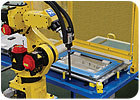
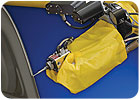
In this application, three vision cameras mounted on the robot tooling find the part’s position in space and then direct the dispensing nozzle to apply a bead of sealant on the backside of the part.
Dividing Up the Work
Throughout the team building and component-selection process, the manufacturer needs to remain involved to ensure the final product provides the desired results.In terms of particular responsibilities, the material supplier will generally select or custom-formulate a one- or two-part material formulation based on the specific needs of the application. Dispensing system engineers will then select the appropriate supply, meter and dispensing components. Some dispensing engineers will also be capable of engineering end-of-arm tooling, material headers, robot dress-out, control software and bead path programming.
Complementing these efforts, the design team’s material handling engineers will be responsible for creating part fixturing and tooling. As they do so, they will also work with the robot supplier to select the correct robot. To perform these tasks, both the material handling engineers and the robot supplier will need to know the exact size and number of parts involved in the process, the number of parts per hour that will be processed, and the speed with which the material will be dispensed on the parts.
Again, the specification is the key document, like an architect’s drawings when building a house. If the process specification changes at any time during the build cycle, all team members need to be notified.
With regard to systems integration, the manufacturer should select a turnkey provider with experience in its particular field. Typically, the robot or dispensing system supplier will be able to provide references. Make sure that, in addition to a stable of programmers writing systems code, the integrator has the engineering experience and installation know-how to support both startup and any needs you might have after the system is up and running.
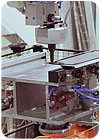
In this application, a robot articulates the part under a fixed dispense valve to form a gasket with three different bead diameters. A vision system confirms that the beads are in spec.
Dispensing System Options
When it comes to dispensing, a number of different equipment suppliers are available. Some suppliers have equipment that is specifically designed for use with robots, while others have equipment that has been adapted to the task. Some dispensing system suppliers incorporate one or two principles of metering in their machines, while others offer as many as eight types of metering. The option of more metering principles ensures a manufacturer will be able to employ the most effective type of dispensing. The wrong technology may result in imprecise dispensing, longer downtimes, more frequent maintenance and higher spare parts cost. Always remember that higher initial capital equipment cost may result in more efficient product assembly, better product quality, more uptime and lower lifecycle cost in the long run.When it comes to selecting a specific dispensing system, the dispensing equipment supplier will look at both the material formulator’s selection and the manufacturer’s process specs to ensure it selects the correct types of products. Among other system components, the supplier will size and spec equipment such as pressure tanks for pourable materials or pumps for non-flowable materials. With respect to the daily volume of material dispensed, it may be necessary to employ a dual supply unit with automatic crossover for nonstop dispensing. Other requirements may include material level monitoring or de-gassing, as well as dehumidifying capabilities for bubble-free and moisture sensitive materials.
At the heart of every dispensing system is its metering equipment. Selecting the right metering approach is critical to ensuring the robot will dispense the material consistently, thereby ensuring a quality assembly. Technologies commonly used in robotic applications include positive rod displacement, piston displacement, reciprocating piston and precision gear metering-all technologies that have been in use in robotic applications since the 1970s.
Double-acting piston, progressive-cavity, piston cup, and time and pressure technologies are typically not used in a robotic setting. These types of metering are adequate for many other types of applications. However, because they do not employ the positive displacement principle, part quality may suffer do to lack of precision. It is important that the metering system employ a servomotor to accurately control displacement of material by volume, not by pressure.
Popular robotic dispense methods, or patterns, include a single bead extruded according to a specific cross-section and length; a predesigned profile drop, also known as “kiss”; a wide coating; multiple short beads in what is called a stitch pattern; and potting or filling by volume. Pattern choice combined with the properties of the material being dispensed has a direct bearing on the valve, nozzle tip and, if necessary, mixer that will be used.
Choosing a Robot
Not surprisingly, selecting a robot supplier is as important as choosing the dispensing system supplier. The robot model, software and hardware should be configured specifically for fluid dispensing and bead path programming, so that they will work well with the dispensing system. Robot selection is generally based on the application’s reach requirements, payload, application speed, bead path and accuracy. In operation, the robot can hold and position the dispense valve, or it can present and manipulate the part, while the valve remains in a fixed position. In some cases the dispense valve will be mounted on a Z-axis slide for additional flexibility.Dispensing robots are available in many different styles and sizes. Cartesian robots generally have three linear axes of control, with each axis positioned at a right angle to the other and moving in a straight line. These robots are also referred to as gantry, or X-Y-Z robots. Cartesian robots tend to cost less, but are limited in terms of motion and their work envelopes.
SCARA robots are also available, and function best when processing workpieces that are oriented in the same plane, like flat parts presented on a conveyor. Only one axis is used to lift the part, or parts, straight up and away from the work surface. SCARA robots are known for their speed and accuracy.
Another common technology used in dispensing applications is the six-axis articulating robot. Six-axis robots can accommodate higher payloads, multiplane bead paths and part sizes. They can be mounted on the floor, on a pedestal or on a gantry to facilitate access to the part being processed, as well as minimize the system footprint.
When integrating a dispenser with a robot, meter location is critical for ensuring a precision bead profile and precise volume control, especially when working with a two-component material. In most cases, it’s best to mount the meter as near as possible to the point of dispense. This means mounting the meter assembly next to the robot, on the robot shoulder or even on the robot wrist. In some cases, the meter can be mounted on an overhead catwalk or mezzanine. Correct hose selection is also important for precision dispensing and ratio control.
Part Presentation
Effective fixturing and tooling are essential, whether the system is dispensing adhesives, sealants or lubricants. The fixture may be a simple one, in which an operator manually loads the part, initiates the robot dispense cycle and then manually unloads the part after dispensing. Or, the fixture can be semi- or fully automated, using rotary or linear indexing to position the part into the dispense station.In either case, the fixture requires precision tooling for accurate positioning, as well as enough safety devices to ensure that all hands and fingers are out of the way of any moving machinery. The fixture should also include part-in-place sensors to ensure material is dispensing only when the part is present.
To reduce tooling costs, fixtures and other tooling can be configured to accept multiple part configurations or even parts of different sizes. Of course, each different part type will require its own unique dispensing program. In some applications, sensors are used to identify the specific type of part being processed, so that the system controller can automatically select the correct dispensing path.
Finally, fixtures should be designed to accommodate expected future design changes or production demands. Anticipating future needs can substantially extend the life of the robot dispensing system.
Communication Options
There are many choices when it comes to robotic dispensing communications. In fact, the typical robot will have many more inputs and outputs (I/O) than the application actually requires.In a basic system, the robot starts its cycle, moves to the point of dispense, signals the dispenser to “start dispense,” moves to the final dispense position, removes the dispense signal to stop dispense, and then moves to a home position. Additional signals are transmitted through the I/O to ensure correct part, dispensing, faults, quality control and safety.
The human-machine interface located on each control panel or pendant can be a simple keypad display, a small color touch-screen or a larger graphical user interface. Advanced robot and dispensing system controls improve user interface capabilities, machine uptime and supervisor convenience. Controls can be PLC- or PC-based. Basic controls may use digital or discrete I/O communication, while advanced controls may use DeviceNet, Profibus or Ethernet IP.
One advantage to high-end communication is that it enables remote access to the machine control system, allowing engineers to extract everything from job data to information on where and how to fix system issues.
Precision is Critical
Always remember that equipment selection choices made at the beginning of a project can directly affect its final quality. Again, the correct robot, metering-dispensing system, controllers and communication interface all play a critical role. In addition, manufacturers may want to consider implementing various accessories to improve dispensing and positional accuracy.For example, many manufacturers employ a temperature control system to ensure consistent material dispensing profiles irrespective of ambient temperatures. This can be done through the use of heating and cooling water; with a heat-only electric system; or through the use of a heating and cooling Peltier electric system.
Another means of ensuring consistency and precision is through the use of vision bead control. With this technology, cameras view the fluid as it exits the dispense nozzle to ensure it matches a preset profile for bead placement and size. This allows the system to automatically correct the dispensing application or mark it for physical inspection.
Another use for vision is to ensure correct part position, whereby the cameras first locate the part and then fine tune the robot path program to the correct coordinates.
Looking for a reprint of this article?
From high-res PDFs to custom plaques, order your copy today!